Check patentability & draft patents in minutes with Patsnap Eureka AI!

A method of quenching a melt polycarbonate

A polycarbonate, melt polymerization technology, applied in chemical instruments and methods, mixers with rotating stirring devices, mixers, etc., can solve the problem of reducing the applicability of polycarbonate, reducing the optical performance of polycarbonate, and reducing the optical quality And other issues

Inactive Publication Date: 2017-09-26
SABIC GLOBAL TECH BV
View PDF6 Cites 0 Cited by
  • Summary
  • Abstract
  • Description
  • Claims
  • Application Information

AI Technical Summary

Problems solved by technology

Molten polycarbonate where no quencher is added can result in polycarbonate with reduced optical properties
This reduction in optical quality may ultimately reduce the suitability of unquenched polycarbonate in applications such as media storage

Method used

the structure of the environmentally friendly knitted fabric provided by the present invention; figure 2 Flow chart of the yarn wrapping machine for environmentally friendly knitted fabrics and storage devices; image 3 Is the parameter map of the yarn covering machine
View more

Image

Smart Image Click on the blue labels to locate them in the text.
Viewing Examples
Smart Image
  • A method of quenching a melt polycarbonate
  • A method of quenching a melt polycarbonate
  • A method of quenching a melt polycarbonate

Examples

Experimental program
Comparison scheme
Effect test

Embodiment approach 1

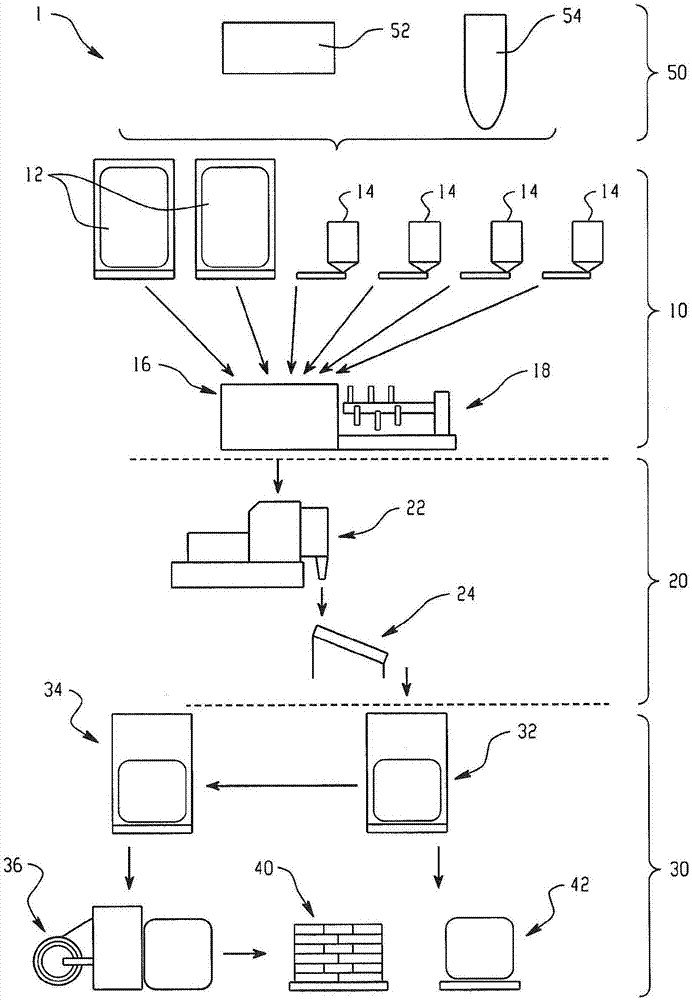
[0085] Embodiment 1: A method for forming a quenched composition comprising: mixing unquenched molten polycarbonate and quenched molten polycarbonate to form a quenched composition; wherein the quenched polycarbonate Formed from a first melt polymerization, wherein the first melt polymerization includes adding a quenching agent to form a quenched polycarbonate, wherein the unquenched polycarbonate is formed from a second melt polymerization.

Embodiment approach 2

[0086] Embodiment 2: A method for forming a quenched composition comprising: combining 40 to 95 wt % or 80 to 95 wt % of unquenched molten polycarbonate and 5 to 20 wt % or 5 to 60 wt % of quenched polycarbonate Molten polycarbonates are mixed to form a quenched composition, wherein the weight percent is based on the total weight of the quenched composition; wherein the quenched polycarbonate is formed from a first melt polymerization, wherein the first melt polymerization includes adding a quenching agent to form a quenched polycarbonate, wherein the quenched molten polycarbonate contains greater than or equal to 0.5 ppm free quencher; wherein the unquenched polycarbonate is formed from a second melt polymerization, wherein the unquenched melt The polycarbonate includes an active catalyst used during the second melt polymerization, and wherein the second melt polymerization does not add a quencher to the unquenched molten polycarbonate.

Embodiment approach 3

[0087] Embodiment 3: The method of the preceding embodiment, wherein the quenched molten polycarbonate is free of additives having reactive OH groups, wherein reactivity is relative to quenched molten polycarbonate and unquenched molten polycarbonate ester.

the structure of the environmentally friendly knitted fabric provided by the present invention; figure 2 Flow chart of the yarn wrapping machine for environmentally friendly knitted fabrics and storage devices; image 3 Is the parameter map of the yarn covering machine
Login to View More

PUM

PropertyMeasurementUnit
melt flow indexaaaaaaaaaa
heightaaaaaaaaaa
Login to View More

Abstract

In an embodiment, a process for forming a quenched composition comprises mixing an unquenched melt polycarbonate and a quenched melt polycarbonate to form the quenched composition; wherein the quenched polycarbonate was formed from a first melt polymerization, wherein the first melt polymerization comprises adding a quencher to form the quenched polycarbonate, wherein the unquenched polycarbonate was formed from a second melt polymerization, wherein the unquenched melt polycarbonate comprises an active catalyst used during the second melt polymerization, and wherein the second melt polymerization is free of a quencher addition.

Description

[0001] Citations to related applications [0002] This application claims the benefit of European Patent Application No. 15382061 filed on February 17, 2015. The related application is hereby incorporated by reference in its entirety. technical field [0003] The present disclosure describes methods of quenching molten polycarbonate. Background technique [0004] Melt polymerization of polycarbonates is generally accomplished by reacting a bisphenol compound with a carbonate compound in a series of reactors in the presence of a catalyst. After polymerization is complete, the catalyst (herein referred to as quenched polycarbonate) can be quenched to obtain a quenched polycarbonate composition. Molten polycarbonate in which no quencher is added can result in a polycarbonate with reduced optical properties. This reduction in optical quality may ultimately reduce the suitability of unquenched polycarbonates in applications such as media storage. [0005] Accordingly, a metho...

Claims

the structure of the environmentally friendly knitted fabric provided by the present invention; figure 2 Flow chart of the yarn wrapping machine for environmentally friendly knitted fabrics and storage devices; image 3 Is the parameter map of the yarn covering machine
Login to View More

Application Information

Patent Timeline
no application Login to View More
Patent Type & Authority Applications(China)
IPC IPC(8): C08G64/40C08L69/00
CPCC08G64/40C08L69/00C08L2205/025C08K5/42C08K5/053B29K2069/00B01F27/232
Inventor 伊格纳西奥·维克·费尔南德斯
Owner SABIC GLOBAL TECH BV
Features
  • R&D
  • Intellectual Property
  • Life Sciences
  • Materials
  • Tech Scout
Why Patsnap Eureka
  • Unparalleled Data Quality
  • Higher Quality Content
  • 60% Fewer Hallucinations
Social media
Patsnap Eureka Blog
Learn More