Application of hybridoma cell line for secreting monoclonal antibody resisting rice strip mosaic virus (RSMV) and monoclonal body of hybridoma cell line

A hybridoma cell line and monoclonal antibody technology, applied in the biological field, can solve problems such as unseen virus antibody reports and patent applications

CN108165533AActive Publication Date: 2018-06-15ZHEJIANG UNIV
1 Cites 2 Cited by

Patent Information

Authority / Receiving Office
CN · China
Patent Type
Applications(China)
Current Assignee / Owner
Publication Date
2018-06-15

Smart Images

  • Figure 1
    Figure 1
  • Figure 2
    Figure 2
  • Figure 3
    Figure 3
Patent Text Reader

Abstract

The invention discloses application of a hybridoma cell line for secreting a monoclonal antibody resisting rice strip mosaic virus (RSMV) and the monoclonal antibody of the hybridoma cell line. The purified RSMV is an antigen immune BALB / c mouse; a hybridoma cell line 1D4 which can stably pass and secrete the monoclonal antibody resisting the RSMV is obtained by cell fusion, screening and colonizing, and the preservation number of the hybridoma cell line 1D4 is CGMCC (China General Microbiological Culture) No.14898. The ascites indirect ELISA (Enzyme Lined Immunosorbent Assay) titer of the monoclonal antibody secreted by the hybridoma cell reaches 10<-10>, and the type and subclass of the antibody are IgG1 and kappa chains. The monoclonal antibody has specific reaction with N protein of the RSMV. An ACP-ELISA method and a dot-ELISA method for detecting the RSMV are established by taking the 1D4 as a core; the sensitivities of the two methods for detecting disease leaves respectively reach the dilution of 1 to 2621440 and the dilution of 1 to 40960 (w / v, g / mL). The obtaining of the hybridoma cell line and the monoclonal antibody thereof and establishment of a serological testing method provide material and technical support for detection and diagnosis and scientific prevention and control of virus disease.
Need to check novelty before this filing date? Find Prior Art

Description

technical field

[0001] The invention relates to the field of biotechnology, in particular to a hybridoma cell line secreting monoclonal antibody against rice stripe mosaic virus and the application of the monoclonal antibody. Background technique

[0002] Rice is one of the important food crops in my country and even in the world, and rice virus disease has caused serious losses to rice production in my country every year. In 2015, a new rice virus disease was discovered in Taiping Town, Luoding City, Guangdong Province. Its symptoms are different from various rice virus diseases that have been reported. It is a new species of Cytoplasmic Rhabdovirus in Rhabdoviridae. Named as rice stripe mosaic virus (Rice stripe mosaic virus, RSMV). As far as we know, this virus is the only cytoplasmic rhabdovirus that naturally infects rice so far, and it is also the first cytoplasmic rhabdovirus transmitted by leafhoppers. The RSMV-infected plants were slightly dwarfed, and the leaves ...

Examples

Embodiment Construction

[0016] The hybridoma cell line 1D4 secreting monoclonal antibody resistant to rice stripe mosaic virus was preserved in the General Microbiology Center of China Microbiology Culture Collection Management Committee, Institute of Microbiology, Chinese Academy of Sciences on December 15, 2017. The preservation number is CGMCCNo.14898. It can secrete anti-Rice Monoclonal antibody to rice stripe mosaic virus.

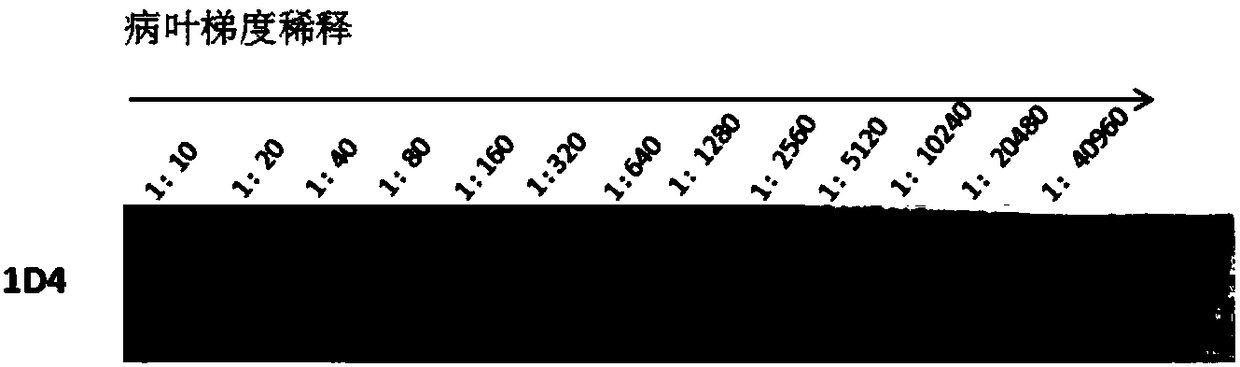
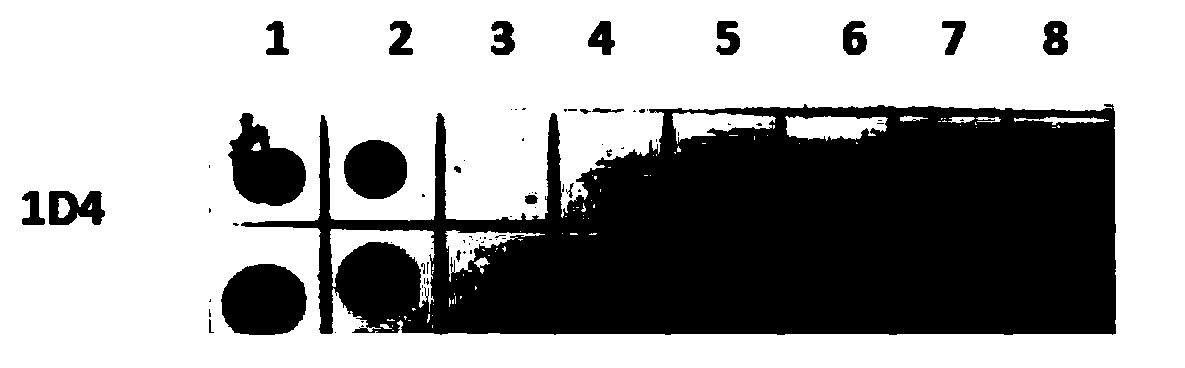
[0017] Ascites fluid indirect ELISA titer of monoclonal antibody against rice stripe mosaic virus reaches 10 -10 , the type and subclass of the antibody are IgG1 and kappa chains, which can have a specific immune reaction with the 60kDa N protein of rice stripe mosaic virus. Using ACP-ELISA and dot-ELISA methods, it was found that the monoclonal antibody detected the diseased rice leaves infected with RSMV The sensitivity reached 1:2 621 440 and 1:40 960 times dilution (w / v, g / mL) respectively.

[0018] The monoclonal antibody against rice stripe mosaic virus has specific i...