
A kind of HPLC method analysis and the method for preparing diacetyl corylidene enantiomer
A technology of enantiomers and corylides, which is applied in the field of chromatographic analysis and separation and high performance liquid chromatography, can solve the problems of rare reports of enantiomers of diacetyl corylides and achieve quality assurance , to ensure stability and good separation effect
- Summary
- Abstract
- Description
- Claims
- Application Information
AI Technical Summary
Problems solved by technology
Method used
Image

Examples
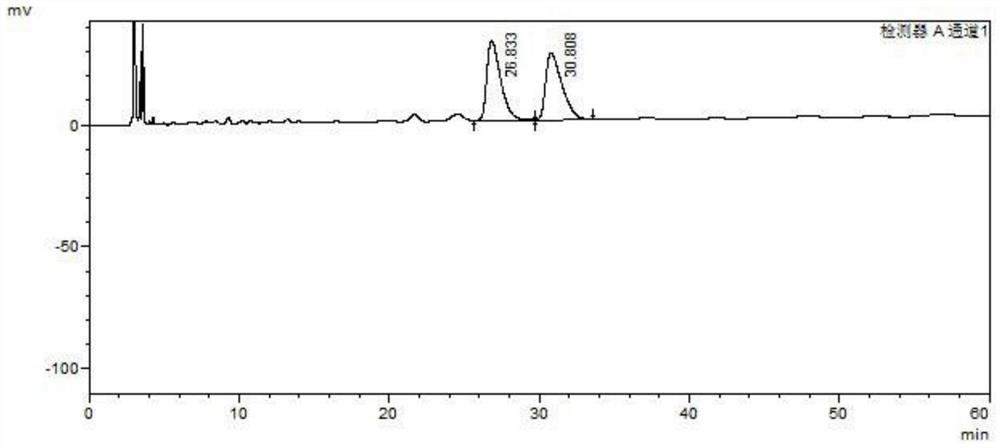
Embodiment 1
[0042] Embodiment 1: the analysis of (-)-diacetyl corilide and (+)-diacetyl corilide
[0043] Instruments and Conditions
[0044] Column: AD-H (250×4.6mm, 5.0μm)
[0045] Mobile phase: n-hexane-ethanol (95:5)
[0046] Column temperature: 40°C
[0047] Flow rate: 1.0mL / min
[0048] Injection volume: 5μL
[0049] Sample concentration: 1mg / mL
[0050] Detection wavelength: 205nm
[0051] Experimental procedure
[0052] Accurately measure 1 mg each of (+)-diacetylcorylide and (-)-bisacetylcorylide respectively, place in a 10mL volumetric flask, dissolve in ethanol and dilute to the mark, shake well, and use it as a reference solution. Accurately weigh 10 mg of (±)-diacetylcorylide, place it in a 10 mL volumetric flask, dissolve it in ethanol and dilute to the mark, shake well, and use it as the mother solution of the test sample. Accurately draw 5 μL each of the reference substance and the mother solution of the test product into the liquid chromatogram, and refer to the...
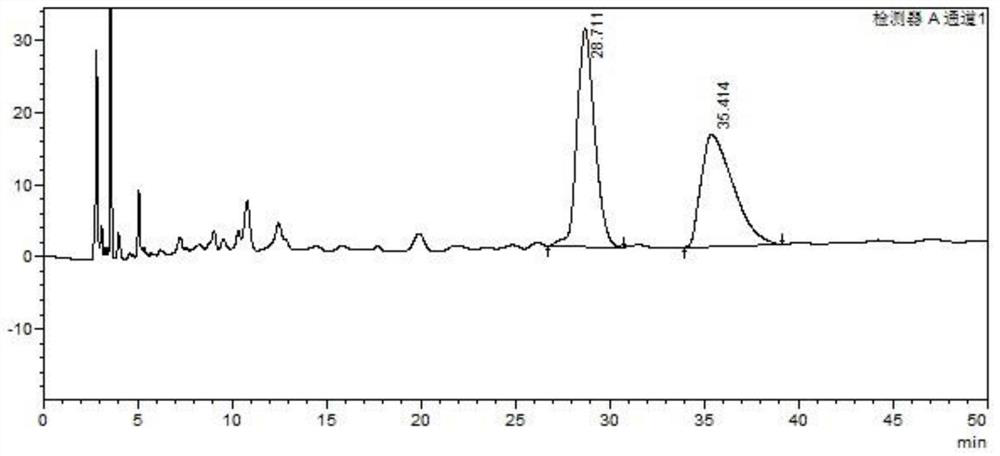
Embodiment 2
[0054] Embodiment 2: the analysis of (-)-diacetyl corilide and (+)-diacetyl corilide
[0055] Instruments and Conditions
[0056] Column: AD-H (250×4.6mm, 5.0μm)
[0057] Mobile phase: n-hexane-ethanol (60:40)
[0058] Column temperature: 20°C
[0059] Flow rate: 0.5mL / min
[0060] Injection volume: 10μL
[0061] Sample concentration: 0.1mg / mL
[0062] Detection wavelength: 205nm
[0063] Experimental procedure
[0064] Accurately measure 1 mg each of (+)-diacetylcorylide and (-)-bisacetylcorylide respectively, place in a 10mL volumetric flask, dissolve in ethanol and dilute to the mark, shake well, and use it as a reference solution. Accurately weigh 10 mg of (±)-diacetylcorylide, place it in a 10 mL volumetric flask, dissolve it in ethanol and dilute to the mark, shake well, and use it as the mother solution of the test sample. Precisely draw 1mL of the mother solution of the test product, place it in a 10mL volumetric flask, dissolve it in ethanol and dilute to th...
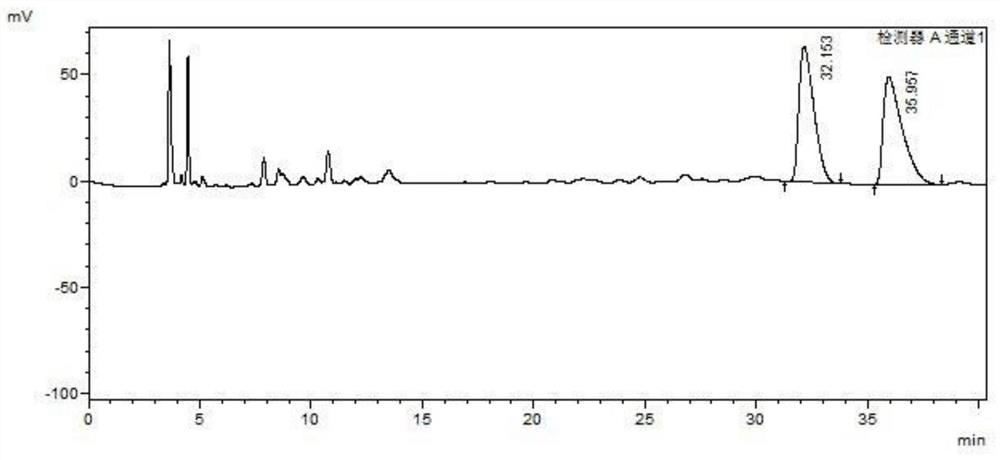
Embodiment 3
[0066] Embodiment 3: the analysis of (-)-diacetyl corilide and (+)-diacetyl corilide
[0067] Instruments and Conditions
[0068] Column: AD-H (250×4.6mm, 5.0μm)
[0069] Mobile phase: n-hexane-ethanol (75:25)
[0070] Column temperature: 30°C
[0071] Flow rate: 0.8mL / min
[0072] Injection volume: 5μL
[0073] Sample concentration: 1mg / mL
[0074] Detection wavelength: 205nm
[0075] Experimental procedure
[0076] Accurately measure 1 mg each of (+)-diacetylcorylide and (-)-bisacetylcorylide respectively, place in a 10mL volumetric flask, dissolve in ethanol and dilute to the mark, shake well, and use it as a reference solution. Accurately weigh 10 mg of (±)-diacetylcorylide, place it in a 10 mL volumetric flask, dissolve it in ethanol and dilute to the mark, shake well, and use it as the mother solution of the test sample. Accurately draw 5 μL each of the reference substance and the mother solution of the test product into the liquid chromatogram, and refer to th...
PUM
| Property | Measurement | Unit |
|---|---|---|
| wavelength | aaaaa | aaaaa |
| separation | aaaaa | aaaaa |
| separation | aaaaa | aaaaa |
Abstract
Description
Claims
Application Information
 Login to View More