Supercharge Your Innovation With Domain-Expert AI Agents!

A kind of breeding method of male sterile Brassica napus hybrid

A technology of male sterility in Brassica napus, applied in botany equipment and methods, plant gene improvement, application, etc., can solve the problems of difficult to completely pull out fertile plants, negative cytoplasmic effect, increase production risk, etc., and achieve the goal of protecting knowledge The effects of property rights and breeders' rights, simple breeding procedures, and flexible configuration of hybrids

Active Publication Date: 2021-05-07
HUAZHONG AGRI UNIV
View PDF2 Cites 0 Cited by
  • Summary
  • Abstract
  • Description
  • Claims
  • Application Information

AI Technical Summary

Problems solved by technology

[0011] (2) The Pol CMS and Ogura CMS hybrids selected by the prior art are three-line (sterile line, maintainer, restorer) hybrids, which have the disadvantages of few restorer sources, long breeding cycles for maintainer lines and restorer lines
[0012] (3) The Pol CMS and Ogura CMS hybrids selected and bred in the prior art, because Pol CMS is a natural mutation, and OguraCMS is created by artificially transferring radish cytoplasm into Brassica napus, there are few recovery sources and extremely limited recovery sources as The restorer lines of Pol CMS or Ogura CMS bred by the parents have little genetic difference, and it is not easy to screen for strong dominant hybrids
[0013] (4) The rapeseed male sterility of the prior art has sterility and there is separation. When producing seeds, it is necessary to get rid of 50% of the fertile plants in the sterile line at the early flowering stage of Brassica napus, which will not only reduce the yield of seed production , increase the cost of seed production, and it is often difficult to completely remove the fertile plants, which affects the purity of seed production and increases production risks
[0015] Although there are many ways to utilize heterosis in Brassica napus, including cytoplasmic male sterility, nuclear male sterility, self-incompatibility, and chemical malecide, the existing technology is aimed at oily Brassica napus for the purpose of harvesting seeds. The breeding method of hybrids requires the hybrids to be able to flower normally and self-seed, so not only must there be a restorer line to completely restore the sterility of the sterile line to fertile, but also the fertility of the sterile line is not separated and stable.
The nuclear male sterility of Brassica napus has the disadvantages of segregation of fertility, pollution of the environment and low purity of hybrids produced by chemical maleicide.
At present, the most widely used domestic and foreign systems are the Brassica napus Polima cytoplasmic male sterile system (Pol cms) and the radish cytoplasmic male sterile system (Ogura cms). Disadvantages such as long breeding cycle of restorer lines
Due to the lack of restorer sources and extremely limited restorer sources, the genetic differences of the Pol CMS or OguraCMS restorer lines bred from the parents are small, and the heterosis is greatly limited.

Method used

the structure of the environmentally friendly knitted fabric provided by the present invention; figure 2 Flow chart of the yarn wrapping machine for environmentally friendly knitted fabrics and storage devices; image 3 Is the parameter map of the yarn covering machine
View more

Image

Smart Image Click on the blue labels to locate them in the text.
Viewing Examples
Smart Image
  • A kind of breeding method of male sterile Brassica napus hybrid

Examples

Experimental program
Comparison scheme
Effect test

Embodiment 1

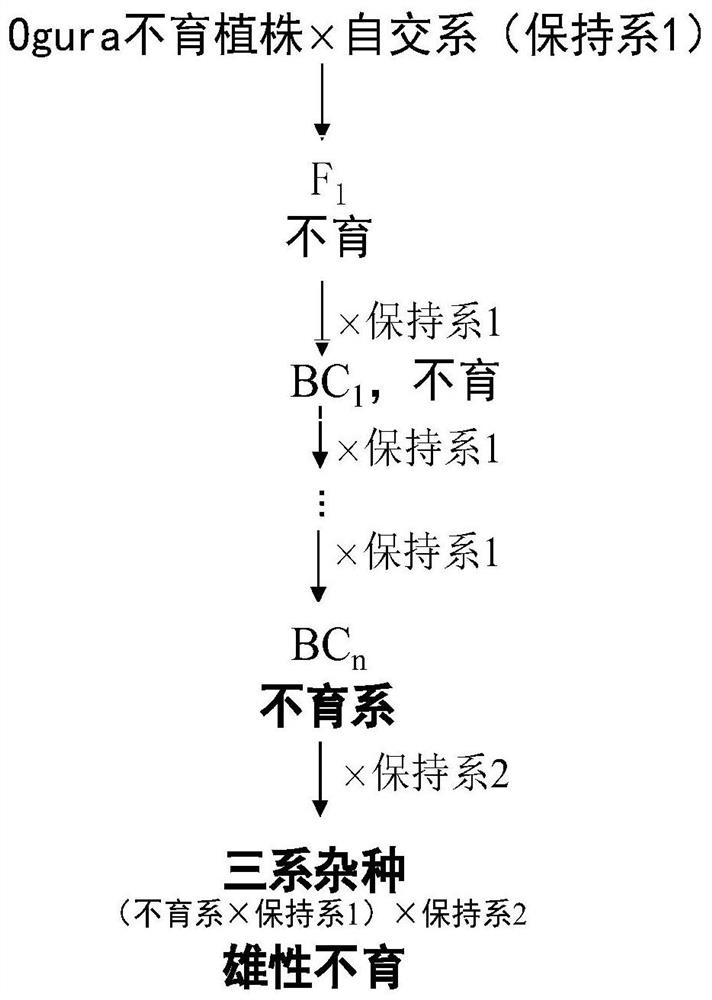
[0042] 1) Breeding of the cytoplasmic male sterile maintainer line of Brassica napus radish: In September 2013, the hybrid "Yunyouza No. Approved by the Crop Variety Approval Committee, Dian Shen Rapeseed No. 2016001). In March 2014, the hybrid plants were bagged and selfed during the flowering stage of rapeseed, and F 2 Seed, Harvested Plant Bagging Selfed F 2 Seed; F sown in Hezheng County, Gansu Province in May 2014 2 Seeds, 10 rows, about 100 plants, select male sterile plants at the flowering stage, and conventional species "Hua Shuang No. 3" (passed the approval of Hubei Province in 1998), "Hua Shuang No. Xingyou 2004006), "Zhongshuang No. 10" (passed the Hubei Provincial Appraisal in 2003, passed the National Approval in 2005), "Zhongshuang 11" (passed the National Approval in 2008, and the National Examination Oil 2008030) hybridized to get F 1 seed. Sowing F in Wuhan in September 2014 1 Seeds, spring 2015 survey F during flowering 1 The fertility of the plants, ...

the structure of the environmentally friendly knitted fabric provided by the present invention; figure 2 Flow chart of the yarn wrapping machine for environmentally friendly knitted fabrics and storage devices; image 3 Is the parameter map of the yarn covering machine
Login to View More

PUM

No PUM Login to View More

Abstract

The invention belongs to the technical field of Brassica napus breeding, and discloses a method for breeding male sterile Brassica napus hybrids, and breeding of Brassica napus radish cytoplasmic male sterile maintainer lines and homokaryotic heterogeneous sterile lines thereof; Breeding of male sterile hybrids: plant the selected cytoplasmic male sterile line of Brassica radish, and cross it with the inbred line to obtain (sterile line × homogeneous heterogeneous maintainer line 1) × maintainer line 2, three The hybrids of the radish line are male sterile; the inbred lines include self-compatible lines, conventional lines and self-incompatible lines, all of which are maintainer lines of radish cytoplasmic male sterility. The invention utilizes the cytoplasmic male sterility system of Brassica napus to successfully breed sterile hybrids that cannot harvest seeds and are non-oil varieties, which will speed up the breeding of new varieties of Brassica napus with high biological yield and promote non-oil use. The planting and promotion of Brassica napus in the field, and the promotion of multifunctional utilization of Brassica napus.

Description

technical field [0001] The invention belongs to the technical field of Brassica napus breeding, in particular to a method for breeding male sterile Brassica napus hybrids. Background technique [0002] At present, the existing technologies commonly used in the industry are as follows: [0003] Brassica napus (also known as rapeseed) is the main oil crop in my country. 40% of the edible vegetable oil in China comes from rapeseed, and the planting area of ​​hybrids accounts for more than 80% of the total area of ​​rapeseed in my country. Ways to utilize heterosis in Brassica napus include cytoplasmic male sterility, nuclear male sterility, self-incompatibility and chemical malecide (Edited by Fu Tingdong, Hybrid Rapeseed Breeding and Utilization, Hubei Science and Technology Press, 2000). [0004] One of the prerequisites for the utilization of heterosis is complete and stable maternal sterility. Rapeseed nuclear male sterility has the advantage of stable sterility, but its ...

Claims

the structure of the environmentally friendly knitted fabric provided by the present invention; figure 2 Flow chart of the yarn wrapping machine for environmentally friendly knitted fabrics and storage devices; image 3 Is the parameter map of the yarn covering machine
Login to View More

Application Information

Patent Timeline
no application Login to View More
Patent Type & Authority Patents(China)
IPC IPC(8): A01H1/02
CPCA01H1/02
Inventor 马朝芝
Owner HUAZHONG AGRI UNIV
Features
  • R&D
  • Intellectual Property
  • Life Sciences
  • Materials
  • Tech Scout
Why Patsnap Eureka
  • Unparalleled Data Quality
  • Higher Quality Content
  • 60% Fewer Hallucinations
Social media
Patsnap Eureka Blog
Learn More