
A negative temperature and radiation-resistant boron-containing barium-rich sulfoaluminate cement clinker
A technology of barium-enriched sulfoaluminate and cement clinker, applied in cement production and other directions, can solve problems such as being unsuitable for operation and construction in alpine regions, and achieve the effects of good multiple radiation protection ability, slowing down hydration rate and low porosity
Active Publication Date: 2021-07-16
UNIV OF JINAN
View PDF8 Cites 0 Cited by
- Summary
- Abstract
- Description
- Claims
- Application Information
AI Technical Summary
Problems solved by technology
Chinese patent CN201410243401.X discloses a radiation-proof cement and its preparation method. The cement can shield α, β, γ and X-rays, and also has a certain absorption effect on neutron radiation. However, the material belongs to Portland cement and cannot Suitable for construction in alpine regions
Method used
the structure of the environmentally friendly knitted fabric provided by the present invention; figure 2 Flow chart of the yarn wrapping machine for environmentally friendly knitted fabrics and storage devices; image 3 Is the parameter map of the yarn covering machine
View moreImage
Smart Image Click on the blue labels to locate them in the text.
Smart ImageViewing Examples

Examples
Experimental program
Comparison scheme
Effect test
Embodiment
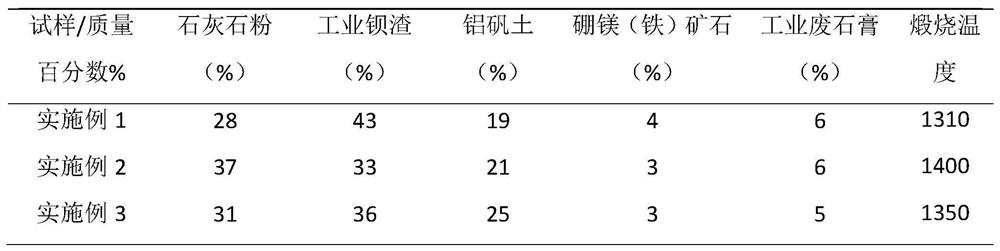
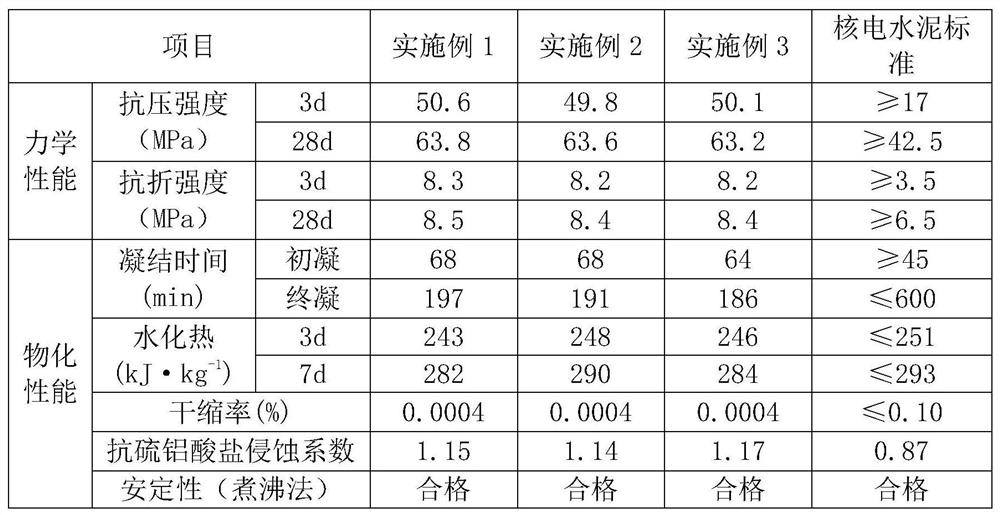
[0015] In order to further study the performance characteristics of the negative temperature and radiation-resistant boron-containing barium-rich sulfoaluminate cement clinker of the present invention, the present invention designs 3 groups of examples according to the raw material composition, and the specific composition is shown in Table 1 below.
[0016] Table 1 Raw material composition of each group of samples
[0017]
the structure of the environmentally friendly knitted fabric provided by the present invention; figure 2 Flow chart of the yarn wrapping machine for environmentally friendly knitted fabrics and storage devices; image 3 Is the parameter map of the yarn covering machine
Login to View More PUM
 Login to View More
 Abstract
The invention discloses a negative temperature and radiation-proof boron-containing barium-rich sulfoaluminate cement clinker. The cement clinker is composed of the following minerals in weight percentage: barium calcium sulfoaluminate 48-62%, dicalcium ferrite 5-12%, dicalcium silicate 20-26%, barium aluminate 8-15% and boric acid Calcium 3-8%. The cement clinker of the present invention has high strength, good durability, high compactness, low dry shrinkage rate, good radiation protection performance and excellent frost resistance performance, and is suitable for use in high and cold regions such as the two poles of the world and northern China, and in nuclear power projects. Freezing and thawing may damage the construction of structures, such as containment, shielded powerhouses, auxiliary powerhouses, etc.
Description
technical field [0001] The invention relates to a boron-containing barium-rich sulfoaluminate cement clinker for nuclear power projects in high-latitude regions with resistance to negative temperature and radiation protection, and belongs to the technical field of special cement preparation. Background technique [0002] Nuclear energy was developed during World War II to meet the needs of war. After the war, the peaceful use of nuclear energy has become the focus of research by many scientists. In 1951, the United States first tried nuclear reactor power generation at the Idaho National Reactor Test Center, which produced 100 kilowatts of nuclear power, which was the first step for mankind to use nuclear energy peacefully. In June 1954, the former Soviet Union built the world's first nuclear power plant to send electricity to the industrial grid in Yuebninsk, a suburb of Moscow, but the power was only 5000kW. In July 1961, the United States built the first commercial nucle...
Claims
the structure of the environmentally friendly knitted fabric provided by the present invention; figure 2 Flow chart of the yarn wrapping machine for environmentally friendly knitted fabrics and storage devices; image 3 Is the parameter map of the yarn covering machine
Login to View More Application Information
Patent Timeline
 Login to View More
 Patent Type & AuthorityPatents(China)
IPC IPC(8): C04B7/21C04B7/24
CPCY02P40/10
Inventor程新徐信刚王守德李树森赵丕琪芦令超
OwnerUNIV OF JINAN