

Size dependent cross-component linear model
A linear model, component technology, used in digital video signal modification, electrical components, image communication, etc.
- Summary
- Abstract
- Description
- Claims
- Application Information
AI Technical Summary
Problems solved by technology
Method used
Image



Examples
Embodiment approach
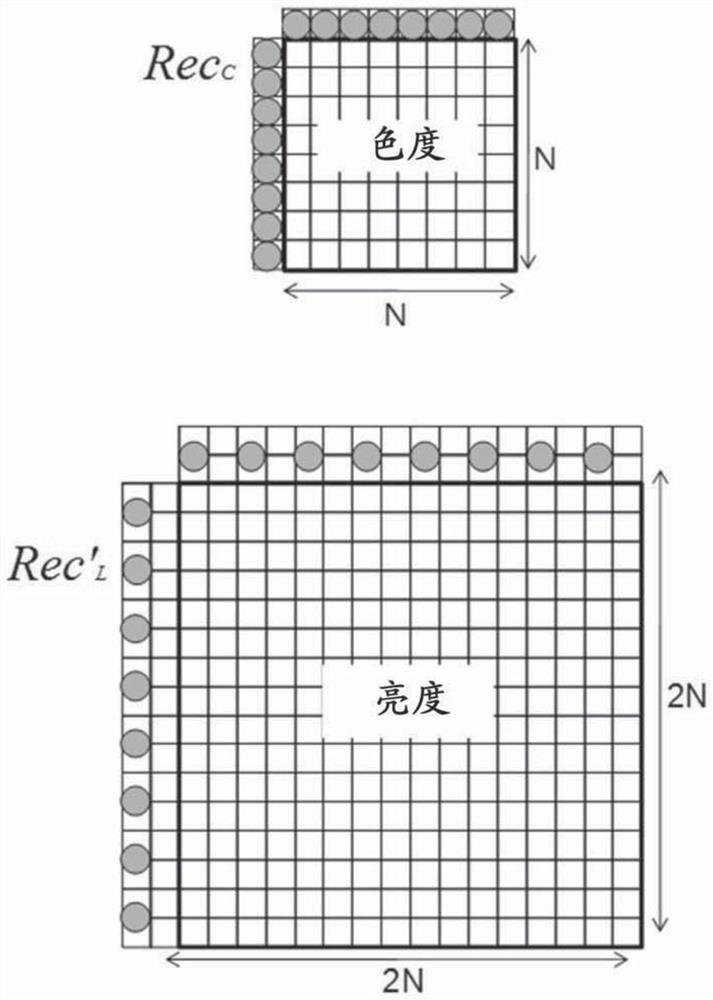
[0079] - Requires more neighboring luma samples than used in normal intra prediction. CCLM requires two luminance samples for the upper adjacent row and three luminance samples for the left adjacent column. MM-CCLM requires four luma samples for the upper adjacent row and four luma samples for the left adjacent column.
[0080] • Luma samples (for adjacent luma samples used for parameter derivation and co-located luma reconstructed samples) need to be downsampled with a 6-tap filter, which increases computational complexity.
[0081] 3 Exemplary method for simplified cross-component prediction in video codec
[0082] Embodiments of the currently disclosed technology overcome the shortcomings of existing implementations, thereby providing video codecs with higher codec efficiency but lower computational complexity. Based on the disclosed techniques, simplified cross-component prediction can enhance existing and future video codec standards, illustrated in the following examples...
example 1
[0087] Example 1. In one example, CCLM is proposed to be done without downsampling filtering of luma samples.
[0088] (a) In one example, a downsampling process that removes adjacent luma samples during derivation of CCLM parameters (eg, α and β). Instead, the down-sampling process is replaced by a sub-sampling process in which non-consecutive luma samples are utilized.
[0089] (b) In one example, a downsampling process that removes samples in co-located luma blocks during the CCLM chroma prediction process. Instead, only some of the luma samples in the co-located luma block are used to derive a prediction block of chroma samples.
[0090] (c) Figure 6A-6J An example is shown for an 8x8 luma block corresponding to a 4x4 chroma block.
[0091] (d) where Figure 6A In an example shown, Figure 4 The luma sample at position "C" in is used to correspond to the chroma sample. The linear model is derived using the upper neighbors during training.
[0092] (e) where Fig...
example 2
[0101] Example 2. In one example, it is proposed that CCLM only requires neighboring luma samples used in the normal intra prediction process, that is, no other neighboring luma samples are allowed to be used in the CCLM process. In one example, CCLM is accomplished by 2-tap filtering of luma samples. Figure 7A-Figure 7D An example is shown for an 8x8 luma block corresponding to a 4x4 chroma block.
[0102] (a) where Figure 7A In an example shown, Figure 4 Luma samples at positions "C" and "D" in are filtered as F(C,D) for corresponding to chroma samples. The linear model is derived using the upper neighbors during training.
[0103] (b) where Figure 7B In an example shown, Figure 4 Luma samples at positions "C" and "D" in are filtered as F(C,D) for corresponding to chroma samples. The linear model is derived during training using the upper and upper right neighbors.
[0104] (c) where Figure 7C In an example shown, Figure 4 Luma samples at positions 'B' and ...
PUM
 Login to View More
 Abstract
Description
Claims
Application Information
 Login to View More