Electronic cochlea language processing method having S parameter control and based-on Chinese language characteristics

A cochlear electron and voice processing technology, which is applied in voice analysis, ear therapy, instruments, etc., can solve problems such as difficulty in conveying Chinese tones and other information, and difficulty in meeting patients' needs, so as to improve language recognition ability, save memory, and reduce complexity. degree of effect

CN1861026AInactive Publication Date: 2006-11-15SHENZHEN GRADUATE SCHOOL TSINGHUA UNIV
0 Cites 9 Cited by

Patent Information

Authority / Receiving Office
CN · China
Patent Type
Applications(China)
Current Assignee / Owner
Publication Date
2006-11-15
Estimated Expiration
Not applicable · inactive patent

Smart Images

  • Figure 1
    Figure 1
  • Figure 2
    Figure 2
  • Figure 3
    Figure 3
Patent Text Reader

Abstract

A speech processing method with S parameter control and based on the characteristics of Chinese language for electronic cochlea includes such steps as pre-treating the speech signals and dividing them into two channels by external unit, dividing one channel of speech signals into several frequency bands, extracting the envelopes of the signals in each frequency band, extracting the base frequency of another channel of speech signals, coding, controlling the channel number by S parameter, transmitting to amplitude transmission channel for chosen frequency band, transmitting the information about base frequency and amplitude in the format of command frame to internal unit, receiving them by internal unit, generating electric stimulation pulses, applying them to relative electrode, and stimulating the relative acoustic nerve for restoring the auditognosis of patient.
Need to check novelty before this filing date? Find Prior Art

Description

Technical field:

[0001] The invention relates to an electronic cochlear, in particular to an electronic cochlear voice processing method with S parameter control based on Chinese features. Background technique:

[0002] Cochlear implants, also known as cochlear implants, electronic ears, bionic ears or cochlear implants, are currently the only devices that can restore hearing to totally deaf patients. It relies on directly exciting the auditory nerve fibers with weak current to imitate the physiological function of the peripheral auditory system, and produces a nerve firing pattern similar to that of the normal human ear, thereby restoring the patient's hearing.

[0003] Cochlear implants can help patients with total deafness regain their ability to communicate and increase their opportunities for education, employment and social interaction. Especially for deaf children, whether they are prelingual deafness or postlingual deafness, when they still cannot hear the sound wit...

Examples

Embodiment Construction

[0028] The specific implementation manner of the present invention will be described below in conjunction with the accompanying drawings.

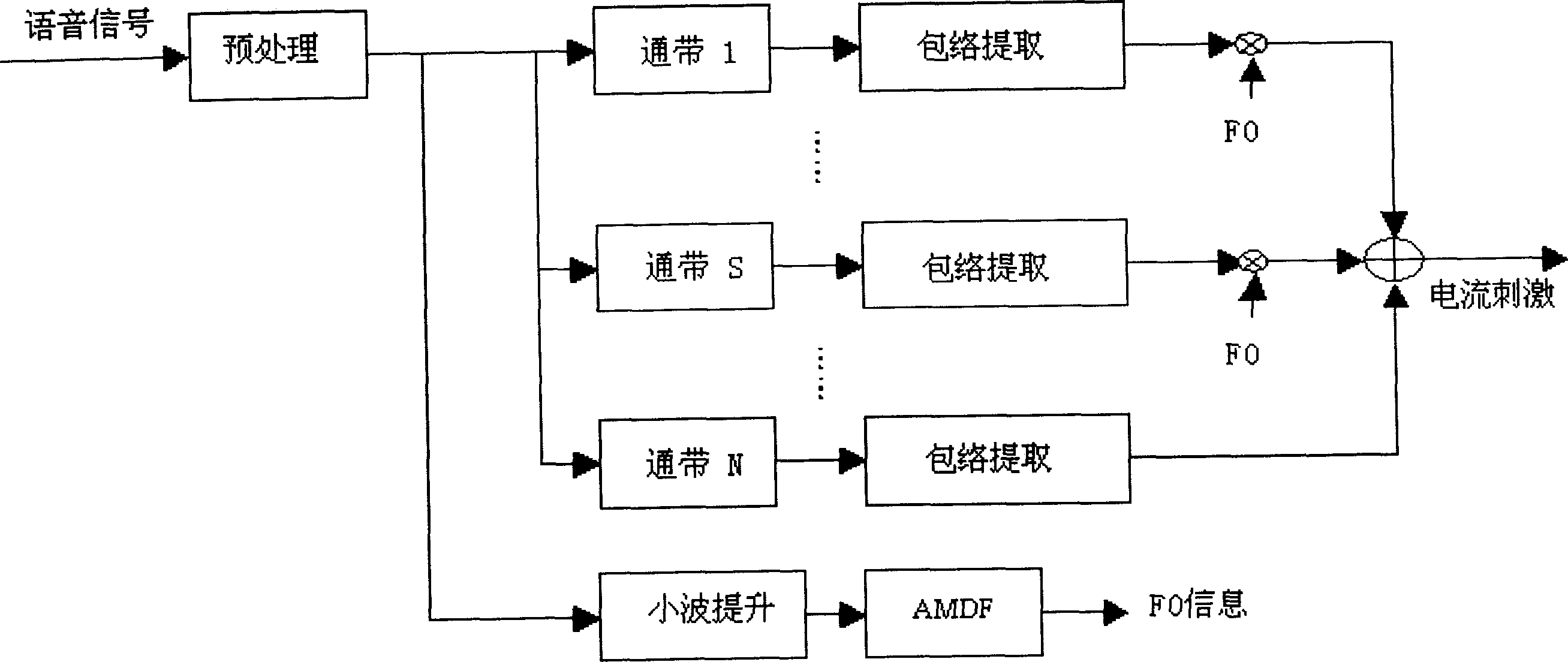
[0029] figure 1 It is a structural block diagram of the overall algorithm of the present invention. refer to figure 1 , the in vitro speech processing part of the electronic cochlear preprocesses the speech signal, and divides the frequency band and extracts the envelope in one path; the other path uses wavelet lifting to extract the fundamental frequency. Under the control of S parameters, the extracted fundamental frequency information is only transmitted to the selected part of the low frequency bands (for example, when S=5, it is only transmitted to the 5 frequency bands near the top of the cochlea), the amplitude information of the selected low frequency bands and The encoded fundamental frequency information F0 is sent to the stimulation circuit in the body through the transmission module in the format of a command frame, and the s...