Methods of fabrication of flexible micro-thermoelectric generators

a technology of flexible micro-thermoelectric generators and manufacturing methods, which is applied in the manufacture/treatment of thermoelectric devices, thermoelectric device junction materials, electrical apparatus, etc., can solve the problems of in-plane device structure, in-plane tegs that normally have worse performance than cross-plane tegs, and degrade power output, etc., to achieve low internal resistance, high power density, and easy realization of commercial production lines

Active Publication Date: 2020-06-09
THE CHINESE UNIVERSITY OF HONG KONG
View PDF3 Cites 0 Cited by
  • Summary
  • Abstract
  • Description
  • Claims
  • Application Information

AI Technical Summary

Benefits of technology

The method achieves a high power density for flexible TEGs with low internal resistance, enabling them to maintain performance even when bent, and is scalable for commercial production, suitable for wearable devices.

Problems solved by technology

Without the protection of rigid substrates and covers, however, flexible TEGs need to have certain mechanical flexibility to bear repeated bending or stretching.
These flexible TEGs adopted Bi2Te3, Sb2Te3, or their alloys as thermoelectric materials and demonstrated high flexibility, high open-circuit voltage, but quite low power density typically from tens of nW cm−2 to μW cm−2 at temperature difference of 20° C. This drawback is mainly due to the large electrical resistance of printed / sputtered materials and large contact resistance at interfaces, which dramatically degrade the power output.
Another drawback of these flexible TEGs is their in-plane device structure, since in-plane TEGs normally have worse performance than the cross-plane TEGs because of the low density of thermoelectric pairs and detrimental parasitic heat flow through the substrate, as discussed in W. Glatz, E. Schwyter, L. Durrer, and C. Hierold, “Bi2Te3-based flexible micro thermoelectric generator with optimized design,”J. Microelectromech. Syst., vol.
However, electroplating techniques are seldom adopted for use in fabrication of flexible TEGs since presumably a rigid substrate is needed to conduct the electroplating process.
Although this approach attempts fabrication of a flexible TEG by electroplating, the releasing and flipping processes as well as the fabrication process after flipping are complicated and are not compatible with massive commercial production.

Method used

the structure of the environmentally friendly knitted fabric provided by the present invention; figure 2 Flow chart of the yarn wrapping machine for environmentally friendly knitted fabrics and storage devices; image 3 Is the parameter map of the yarn covering machine
View more

Image

Smart Image Click on the blue labels to locate them in the text.
Viewing Examples
Smart Image
  • Methods of fabrication of flexible micro-thermoelectric generators
  • Methods of fabrication of flexible micro-thermoelectric generators
  • Methods of fabrication of flexible micro-thermoelectric generators

Examples

Experimental program
Comparison scheme
Effect test

Embodiment Construction

[0029]Embodiments of the present invention relate methods of fabricating flexible TEGs. In particular, the invention provides improved methods of fabrication that produce flexible micro-TEGs having reduced internal resistance that imparts improved power density.

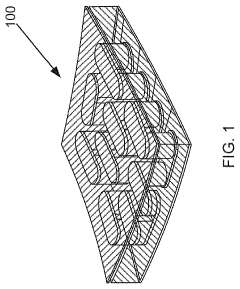
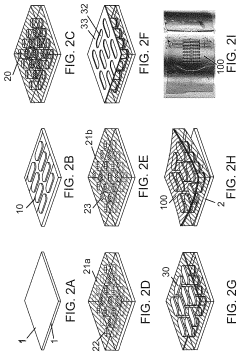
[0030]FIG. 1 depicts a flexible micro-TEG 100 fabricated in accordance with the fabrication methods described herein. TEG 100 is without the rigid shell or substrate associated with conventional high output power density TEGs such that it is suitable for a variety of applications, including wearable devices. As shown, the device is fabricated as a cross-plane flexible micro-TEG with hundreds of pairs of thermoelectric pillars via electroplating, microfabrication, and substrate transferring processes provided herein. Typically, the fabrication process is conducted on a rigid substrate, such as a silicon substrate, which can be easily realized by commercial production line. The fabricated micro-TEG is then transferred to the fl...

the structure of the environmentally friendly knitted fabric provided by the present invention; figure 2 Flow chart of the yarn wrapping machine for environmentally friendly knitted fabrics and storage devices; image 3 Is the parameter map of the yarn covering machine
Login to View More

PUM

PropertyMeasurementUnit
thickaaaaaaaaaa
thickaaaaaaaaaa
thickaaaaaaaaaa
Login to View More

Abstract

A cross-plane flexible micro-TEG with hundreds of pairs of thermoelectric pillars formed via electroplating, microfabrication, and substrate transferring processes is provided herein. Typically, fabrication is conducted on a Si substrate, which can be easily realized by commercial production line. The fabricated micro-TEG transferred to the flexible layer from the Si substrate. Fabrication methods provided herein allow fabrication of main TEG components including bottom interconnectors, thermoelectric pillars, and top interconnectors by electroplating. Such flexible micro-TEGs provide high output power density due to high density of thermoelectric pillars and very low internal resistance of electroplated components. The flexible micro-TEG can achieve a power per unit area of 4.5 mW cm−2 at a temperature difference of ˜50 K, which is comparable to performance of flexible TEGs developed by screen printing. The power per unit weight of flexible TEGs described herein is as high as 60 mW g−1, which is advantageous for wearable applications.

Description

[0001]The present application is a Non-Provisional of and claims the benefit of U.S. Provisional Application No. 62 / 340,685 filed on May 24, 2016, the entire contents of which are incorporated herein by reference in their entirety.BACKGROUND[0002]The present invention relates to fabrication of flexible micro-thermoelectric generators. In particular, the invention provides improved methods of fabrication that produce flexible micro-thermoelectric generators having reduced internal resistance that imparts improved power density.1. Field of the Invention[0003]Thermoelectric generators (TEGs) are promising devices for waste heat recovery by virtue of their ability to directly convert heat to electricity. Despite relatively low energy conversion efficiency, TEGs have many advantages including high reliability, long lifetime, and environmental friendliness. Especially when compared to conventional heat engines, TEGs are compact, scalable, and can be easily driven by small temperature diff...

Claims

the structure of the environmentally friendly knitted fabric provided by the present invention; figure 2 Flow chart of the yarn wrapping machine for environmentally friendly knitted fabrics and storage devices; image 3 Is the parameter map of the yarn covering machine
Login to View More

Application Information

Patent Timeline
no application Login to View More
Patent Type & AuthorityPatents(United States)
IPC IPC(8): H01L21/00H01L35/20H01L35/32H01L35/34H01L35/30H10N10/01H10N10/17H10N10/13H10N10/854
CPCH01L35/20H01L35/34H01L35/30H01L35/325H10N10/854H10N10/13H10N19/101H10N10/01
InventorZHANG, WENHUAXU, DONGYAN
OwnerTHE CHINESE UNIVERSITY OF HONG KONG