
Method for cleaning a glass substrate for a magnetic recording medium, a glass substrate cleaned by such a method, and a magnetic recording medium using such a substrate
a technology of magnetic recording medium and glass substrate, which is applied in the direction of magnetic materials for record carriers, instruments, record information storage, etc., can solve the problems of affecting the stability of the head flight, the surface roughness of cleaning with acid, and the inability to read and write in those locations
Inactive Publication Date: 2002-02-07
FUJI ELECTRIC CO LTD
View PDF7 Cites 12 Cited by
- Summary
- Abstract
- Description
- Claims
- Application Information
AI Technical Summary
Benefits of technology
[0006] In view of the foregoing, it is an object of the present invention to provide a method for cleaning a glass substrate for a magnetic recording medium, in which contaminants including abrasive grains and polishing powder generated and attached in the polishing step are eliminated without damaging the surface by exaggerating microscopic latent flaws on the substrate surface.
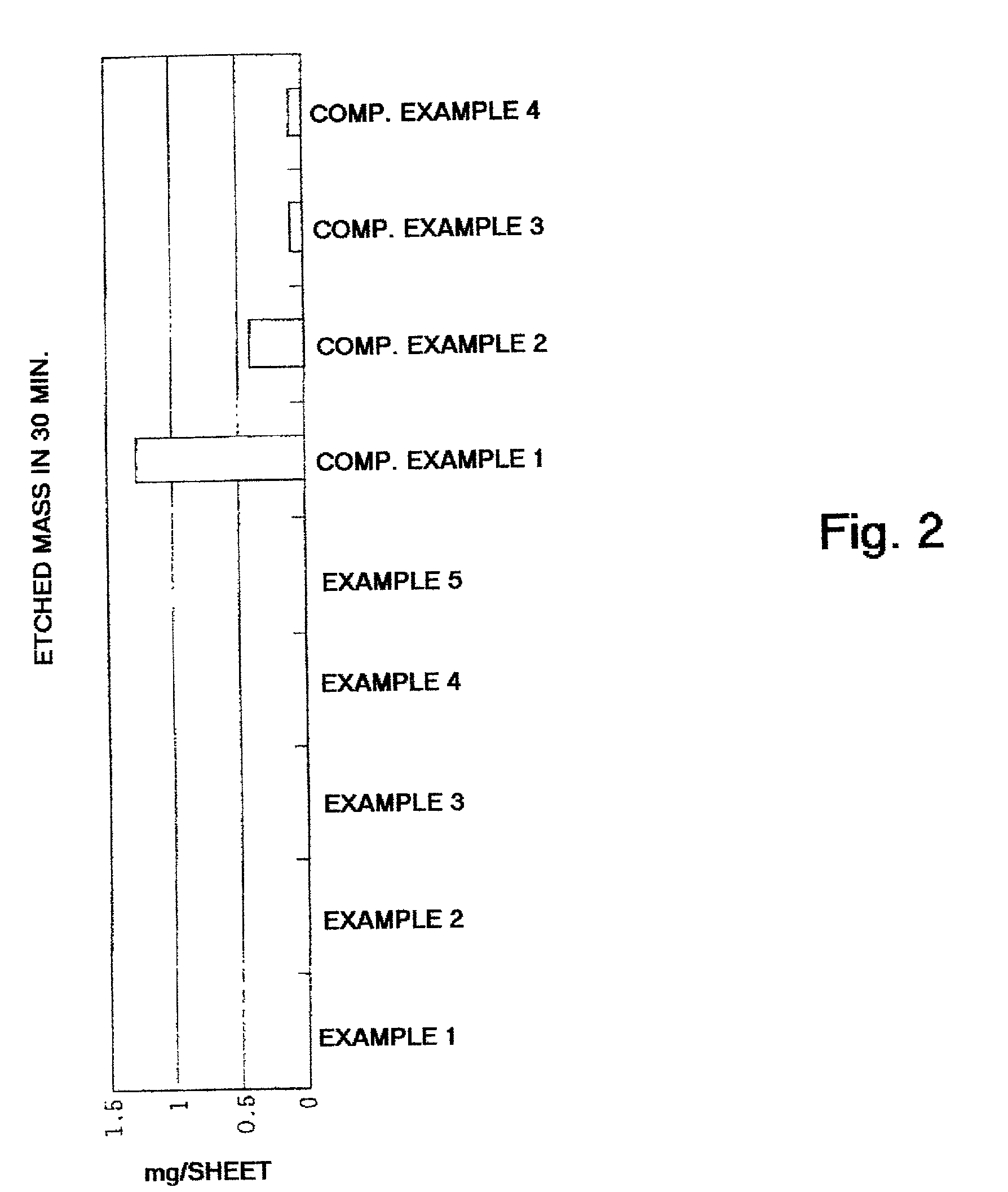
[0024] It is clarified in the process of the invention that roughening of the surface and generation of latent flaws are avoided by using above-described anode water, the electrolyte-containing anode water, the oxygen water, or the ozone water in place of acid cleaning liquid.
[0033] In the method of oscillation cleaning, ultrasonic vibration or bubbling is caused in the cleaning liquid to generate small bubbles in the cleaning liquid. Cavitation that arises when the bubbles break and disappear loosens and removes the contaminants from the substrate surface. A cleaning liquid in this cleaning method is selected from above-described cleaning liquid. Oscillation cleaning may be conducted alone, or together with immersion cleaning described below, to improve the ability to eliminate particles from the surface.
[0041] Both the immersion cleaning and the oscillation cleaning methods may be applied simultaneously to increase the cleaning effect for the glass substrate. A serial method, in which immersion cleaning is followed by oscillation cleaning, is more effective in removing the particles remaining on the substrate surface.
[0042] The temperature and time of the serial cleaning method are the same as those in each of the two methods. Nevertheless, the time duration may be shortened because of the higher efficiency expected from applying both of the immersion and oscillation cleaning procedures.
[0062] Measured result of the removal rate indicates the extent to which each of the cleaning methods is capable of removing particles, and hence, the effectiveness of each of the cleaning methods.
Problems solved by technology
Cleaning with acid tends to roughen the substrate surface due to abnormal etching and the existence of microscopic latent flaws.
The rough substrate surface disturbs stable head flight.
The latent flaws inhibit normal deposition of functional layers and adversely affects the magnetic property of that portion, resulting in reading and writing errors in those locations.
If cleaning with acid is omitted in an attempt to prevent rough surface and latent flaw generation, the abrasive grains and polishing powder are not adequately eliminated and remain on the substrate surface.
These residues on the substrate surface disturb stable head flight and cause the errors.
As a further problem, the waste water remaining from acid cleaning contains acid.
Method used
the structure of the environmentally friendly knitted fabric provided by the present invention; figure 2 Flow chart of the yarn wrapping machine for environmentally friendly knitted fabrics and storage devices; image 3 Is the parameter map of the yarn covering machine
View moreImage
Smart Image Click on the blue labels to locate them in the text.
Smart ImageViewing Examples

Examples
Experimental program
Comparison scheme
Effect test
example 2
[0092] A plurality of glass substrates and a plurality of magnetic recording media were fabricated in the same manner as in Example 1 except that anode water containing 0.5 mM of HCl was used for the cleaning liquid.
example 3
[0093] A plurality of glass substrates and a plurality of magnetic recording media were fabricated in the same manner as in Example 1 except that anode water containing 0.25 mM of malic acid was used for the cleaning liquid.
example 4
[0094] A plurality of glass substrates and a plurality of magnetic recording media were fabricated in the same manner as in Example 1 except that oxygen water containing 1,000 ppm of oxygen was used for the cleaning liquid.
the structure of the environmentally friendly knitted fabric provided by the present invention; figure 2 Flow chart of the yarn wrapping machine for environmentally friendly knitted fabrics and storage devices; image 3 Is the parameter map of the yarn covering machine
Login to View More PUM
| Property | Measurement | Unit |
|---|---|---|
| surface roughness | aaaaa | aaaaa |
| temperature | aaaaa | aaaaa |
| temperature | aaaaa | aaaaa |
Login to View More
Abstract
Abrasive grains are removed from a glass substrate for a recording medium by washing with water containing an elevated amount of oxygen atoms. The oxygen atoms may be in the form of monatomic diatomic or triatomic molecules. In one embodiment, the oxygen is formed at the anode of an electrolysis apparatus. A small amount of an electrolyte may be used in the electrolysis apparatus without interfering with the ability to clean the glass substrate without generating latent flaws. The invention also is defined as a substrate cleaned by the disclosed method and a magnetic recording medium made from the substrate.
Description
[0001] 1. Technical field of the invention[0002] The present invention relates to a method for cleaning a substrate for a magnetic recording medium used in a recording device such as fixed magnetic disk. The present invention also relates to a substrate cleaned by such a method for cleaning and a magnetic recording medium using such a substrate.[0003] Magnetic recording media, particularly magnetic disks, are experiencing rapidly increases in recording density. A magnetic disk device is randomly accessed by flying a head over the disk surface and reading recorded data from the disk while it is rotating at high speed. In order to satisfy the demands for both high recording density and high access speed, higher rotating speeds of the disks and smaller flying head heights (the distance between the disk and the head) are required. A substrate of aluminum plated with Nickel-phosphorus (Ni--P) has generally been used as a substrate for a magnetic disk. However, glass substrates are enteri...
Claims
the structure of the environmentally friendly knitted fabric provided by the present invention; figure 2 Flow chart of the yarn wrapping machine for environmentally friendly knitted fabrics and storage devices; image 3 Is the parameter map of the yarn covering machine
Login to View More Application Information
Patent Timeline
 Login to View More
 Patent Type & AuthorityApplications(United States)
IPC IPC(8): C03C17/34C03C23/00G11B5/84
CPCC03C17/34C03C23/0075G11B5/8404
InventorNAKAJIMA, NORIHIKOKURATA, NOBORUAJISHI, YOSHIHUMISHIDO, MIKI
OwnerFUJI ELECTRIC CO LTD