Unlock instant, AI-driven research and patent intelligence for your innovation.

Asymmetrical stringed instrument bridge

a stringed instrument and bridge technology, applied in stringed instruments, violins, musical instruments, etc., can solve problems such as weakening bridges, and achieve the effect of eliciting a feeling of familiarity from the user

Inactive Publication Date: 2004-05-27
PORTALPLAYER
View PDF8 Cites 4 Cited by
  • Summary
  • Abstract
  • Description
  • Claims
  • Application Information

AI Technical Summary

Benefits of technology

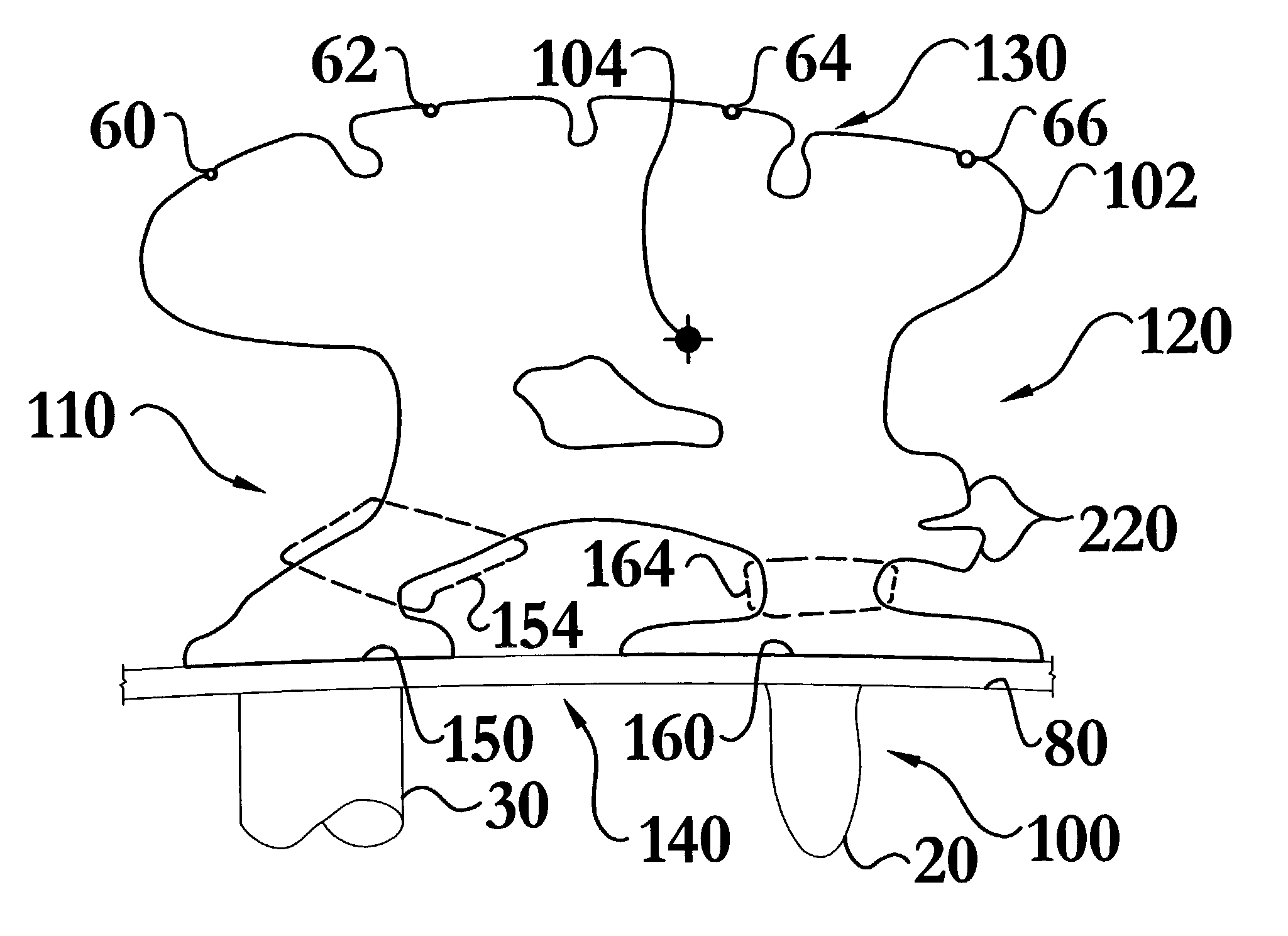
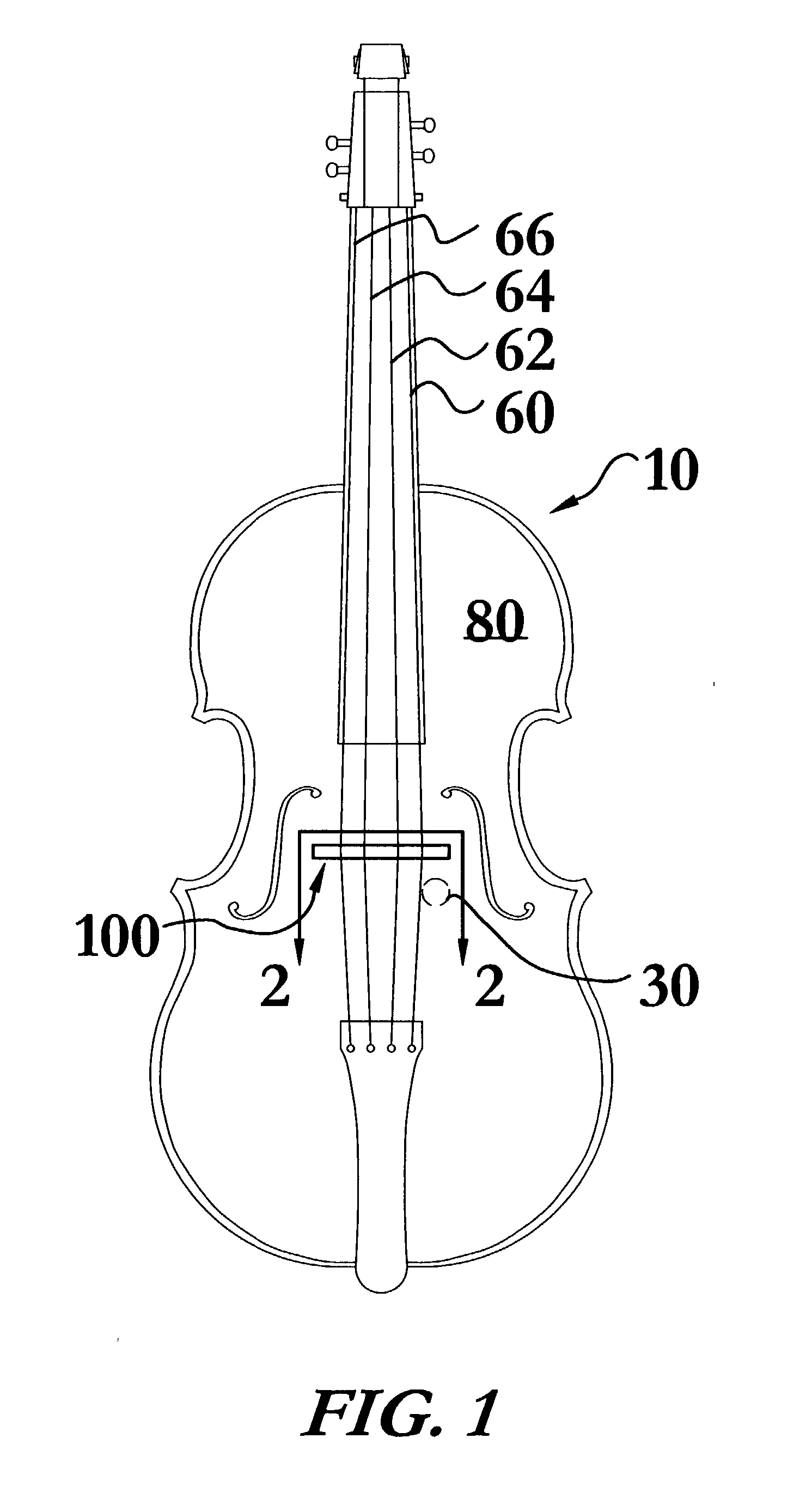
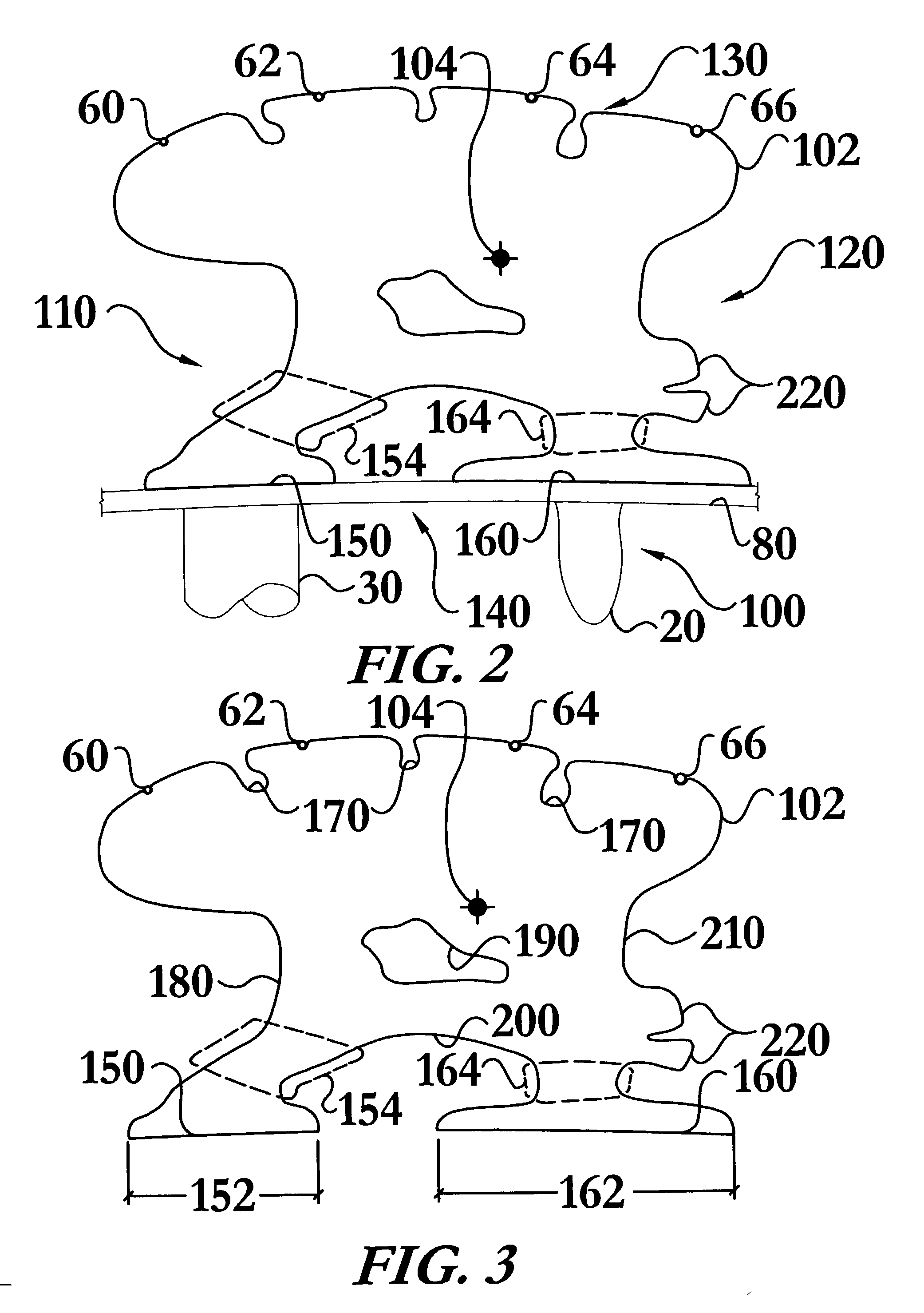
[0010] In its most general configuration, the present invention advances the state of the art with a variety of new capabilities and overcomes many of the shortcomings of prior devices in new and novel ways. In its most general sense, the present invention overcomes the shortcomings and limitations of the prior art in any of a number of generally effective configurations. In one of the many preferable configurations, the asymmetrical stringed instrument bridge incorporates, among other elements, an integral member having a centroid, a string mounting edge, a foot edge, a treble edge, and a bass edge. The asymmetrical stringed instrument bridge is adapted to rest on a belly plate of a violin, or other stringed instrument, and support a plurality of strings, including treble and bass strings, and transfer vibrational energy of the plurality of strings to the belly plate.
[0011] The asymmetrical stringed instrument bridge of the present invention is unique in that treble edge and the bass edge are asymmetric about the centroid, center of gravity, or any point on the integral member allowing more efficient transfer of the energy from the strings to the violin. The string mounting edge is adapted to releasably receive the plurality of strings. The string mounting edge is important in that it is the only point upon which the strings contact the asymmetrical stringed instrument bridge.
[0012] The string mounting edge may be formed with at least one horizontal tuning recess. The at least one horizontal tuning recess allows the asymmetrical stringed instrument bridge to vibrate more at the top of the bridge than traditional bridge designs. In one exemplary embodiment, the string mounting edge is formed to include a horizontal tuning recess between each pair of strings, resulting in a total of three horizontal tuning recesses. The added flexibility near the string mounting edge improves the sound generated and the amount of energy transferred by the asymmetrical stringed instrument bridge, while still allowing the strings to work together. Prior attempts to improve the vibrational qualities of bridges near the string mounting edge have involved thinning out the bridge in the vicinity of the string mounting edge, often resulting in weakened bridges. Each of the at least one horizontal tuning recesses may be formed into a shape that maximizes the transfer of vibrational energy of the neighboring strings and allows control of the influence that one string may have upon another. In other words, the shape of each recess may be unique depending on the location on the string mounting edge, therefore allowing the string mounting edge to be effectively tuned to create preferred predetermined tones. In one preferred embodiment, the at least one horizontal tuning recess will generally extend into the integral member up to approximately fifty percent of the maximum height of the integral member.

Problems solved by technology

Prior attempts to improve the vibrational qualities of bridges near the string mounting edge have involved thinning out the bridge in the vicinity of the string mounting edge, often resulting in weakened bridges.

Method used

the structure of the environmentally friendly knitted fabric provided by the present invention; figure 2 Flow chart of the yarn wrapping machine for environmentally friendly knitted fabrics and storage devices; image 3 Is the parameter map of the yarn covering machine
View more

Image

Smart Image Click on the blue labels to locate them in the text.
Viewing Examples
Smart Image
  • Asymmetrical stringed instrument bridge
  • Asymmetrical stringed instrument bridge
  • Asymmetrical stringed instrument bridge

Examples

Experimental program
Comparison scheme
Effect test

Embodiment Construction

[0026] The asymmetrical stringed instrument bridge of the instant invention enables a significant advance in the state of the art. The preferred embodiments of the apparatus accomplish this by new and novel arrangements of elements that are configured in unique and novel ways and which demonstrate previously unavailable but preferred and desirable capabilities.

[0027] The detailed description set forth below in connection with the drawings is intended merely as a description of the presently preferred embodiments of the invention, and is not intended to represent the only form in which the present invention may be constructed or utilized. The description sets forth the designs, functions, means, and methods of implementing the invention in connection with the illustrated embodiments. It is to be understood, however, that the same or equivalent functions and features may be accomplished by different embodiments that are also intended to be encompassed within the spirit and scope of th...

the structure of the environmentally friendly knitted fabric provided by the present invention; figure 2 Flow chart of the yarn wrapping machine for environmentally friendly knitted fabrics and storage devices; image 3 Is the parameter map of the yarn covering machine
Login to View More

PUM

No PUM Login to View More

Abstract

An asymmetrical stringed instrument bridge incorporating, among other elements, an integral member, a string mounting edge, a foot edge, a treble edge, and a bass edge. The asymmetrical stringed instrument bridge is adapted to rest on a belly plate of a violin, or other stringed instrument, and support a plurality of strings. The asymmetrical stringed instrument bridge may include a plurality of tuning recesses along the edges and apertures in the integral member so as enable one to acoustically tune the bridge while taking into account the unique attributes of each string to optimize the energy transfer and movement of the bridge. The plurality of recesses may also form a treble foot, treble leg, bass foot, and bass leg.

Description

[0001] The present invention relates to the field of stringed musical instruments; particularly, to an asymmetrical stringed instrument bridge that improves the sound generated by such instruments.[0002] Musicians have long-recognized the need for innovations to improve the sound generated from musical instruments. Many musical instruments have remained relatively unchanged in design and quality of sound generated since their advent. Such long-felt needs have been particularly prevalent in the field of stringed instruments and more particularly bowed string instruments such as the violin family, including, but not limited to, the violin, viola, cello, and bass violin.[0003] A violin generally consists of a sounding box having two sound holes and a neck. Four strings extend from the distal end of the neck to a tailpiece. The strings are attached to individual tuning pegs at the distal end of the neck. The tailpiece is attached to the sounding box and secures the strings. The strings ...

Claims

the structure of the environmentally friendly knitted fabric provided by the present invention; figure 2 Flow chart of the yarn wrapping machine for environmentally friendly knitted fabrics and storage devices; image 3 Is the parameter map of the yarn covering machine
Login to View More

Application Information

Patent Timeline
no application Login to View More
IPC IPC(8): G10D3/04
CPCG10D3/04
Inventor VAN DUSEN, TIM
Owner PORTALPLAYER