
Device for combination of light of different wavelengths
a technology of light and wavelength, applied in the field of devices for combining light of different wavelengths, can solve the problem of deciding whether to call this filter edge filter, etc., and achieve the effect of cost-effective production
- Summary
- Abstract
- Description
- Claims
- Application Information
AI Technical Summary
Benefits of technology
Problems solved by technology
Method used
Image

Examples
Embodiment Construction
[0048] The invention will be explained as follows in further detail by example and in conjunction with the figures.
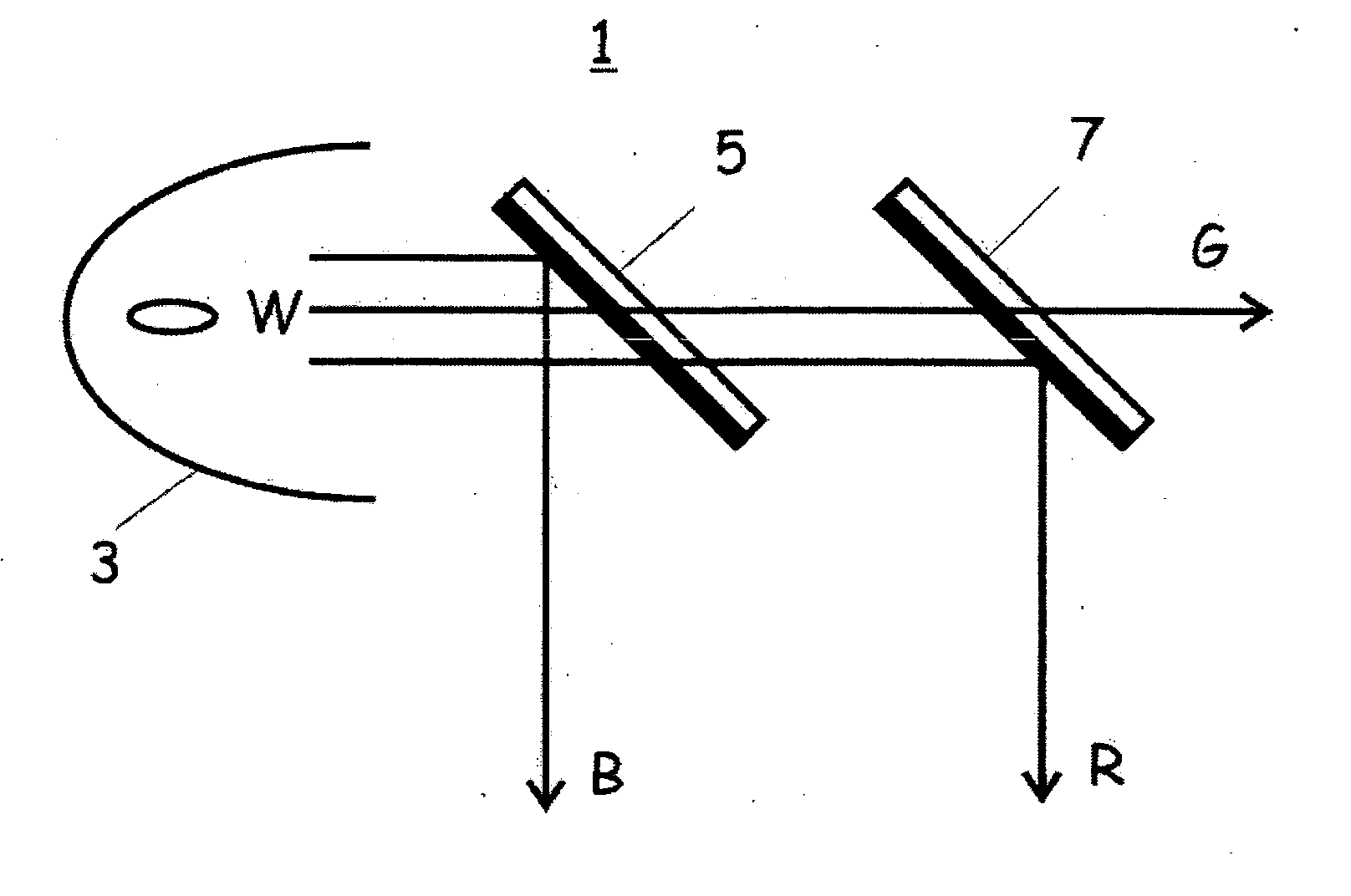
[0049]FIG. 1a illustrates schematically the condition according to the prior art in the case of a white light source. In the illumination configuration 1 of FIG. 1a, a white light source is shown, which radiates white light W. A longpass filter 5 is placed downstream in the light path at an angle of 45° with the filter edge at approximately 500 nm for the reflection of blue light B and transmission of green light G and red light R. A shortpass filter 7 is placed further downstream into the light path at an orientation of 45° with edge position at approximately 600 nm, which transmits green light G and reflects red light R.
[0050]FIG. 1b depicts schematically an illumination configuration 10 according to the prior art with respect to narrowband light sources to be combined. The blue LED 11, the red LED 13 and the green LED 15 are shown, whose light is combined by means ...
PUM
 Login to View More
 Abstract
Description
Claims
Application Information
 Login to View More