
Surfactant
- Summary
- Abstract
- Description
- Claims
- Application Information
AI Technical Summary
Benefits of technology
Problems solved by technology
Method used
Image

Examples
examples 1 and 2
[0339] Into a column filled with a cation exchange resin “Amberlite IR-120B” (manufactured by Organo Corporation) in a chromatograph tube having the diameter of 3 cm and length of 50 cm and being allowed to stand perpendicularly, at 25° C., 105 parts of an aqueous solution of a naphthalenesulfonic acid formalin condensate sodium salt “Demol NL” (manufactured by Kao Corporation) adjusted to have 10% solid content were gradually added from the above of the column in small amounts. An eluent once put through the ion exchange resin was put through it again from the above of the column. This operation was repeatedly carried out until the sodium content of the eluent determined using ICP (ICPS-8000, manufactured by Shimadzu Corporation) became less than 1 ppm, and 100 parts of a 9% aqueous solution of the naphthalenesulfonic acid formalin condensate was obtained.
[0340] Next, into a reactor which is capable of adjusting temperatures and equipped with a stirring device, 100 parts of the 9%...
example 3
[0341] A 9% aqueous solution of the naphthalenesulfonic acid formalin condensate was obtained in the same manner as in Example 1. Into a reactor which is capable of adjusting temperatures and equipped with a stirring device, 100 parts of the 9% aqueous solution of the naphthalenesulfonic acid formalin condensate were charged, 3.7 parts of guanidine carbonate (manufactured by Wako Pure Chemicals Industries, Ltd.) were added and the mixture was heated and stirred at 50° C. for 10 minutes. Then, 103 parts of the surfactant of the present invention comprising an 11% aqueous solution of the naphthalenesulfonic acid formalin condensate guanidine salt (S2) (pH=6.4 at 25° C.) were obtained. In addition, the weight average molecular weight of (S2) was 5000.
example 4
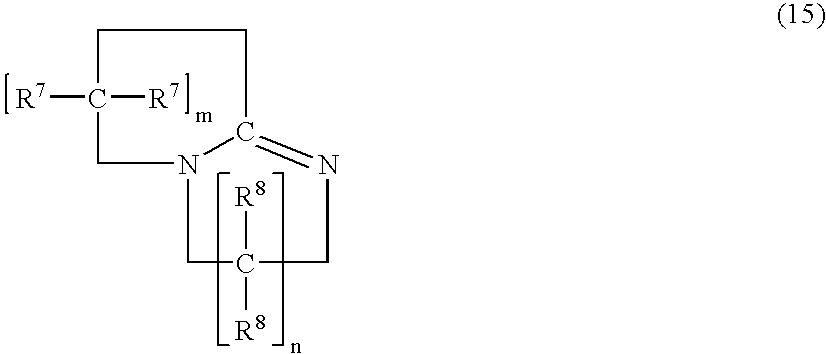
[0342] 100 parts of a 9% aqueous solution of the polystyrenesulfonic acid were obtained in the same manner as in Example 1 except that a polystyrenesulfonic acid sodium salt “POLITY PS-1900” (manufactured by Lion Corporation) was used instead of a naphthalenesulfonic acid formalin condensate sodium salt. Into a reactor which is capable of adjusting temperatures and equipped with a stirring device, 100 parts of the 9% aqueous solution of polystyrenesulfonic acid were charged, 7.4 parts of DBU were added and the mixture was stirred at 25° C. for 10 minutes. Then, 107 parts of the surfactant of the present invention comprising a 15% aqueous solution of the polystyrenesulfonic acid DBU salt (S3) were obtained (pH=6.5 at 25° C.). In addition, the weight average molecular weight of (S3) was 14000.
PUM
| Property | Measurement | Unit |
|---|---|---|
| Force | aaaaa | aaaaa |
| Electric potential / voltage | aaaaa | aaaaa |
| Electric potential / voltage | aaaaa | aaaaa |
Abstract
Description
Claims
Application Information
 Login to View More