
Compact Terahertz Spectrometer Using Optical Beam Recycling and Heterodyne Detection
- Summary
- Abstract
- Description
- Claims
- Application Information
AI Technical Summary
Benefits of technology
Problems solved by technology
Method used
Image

Examples
Embodiment Construction
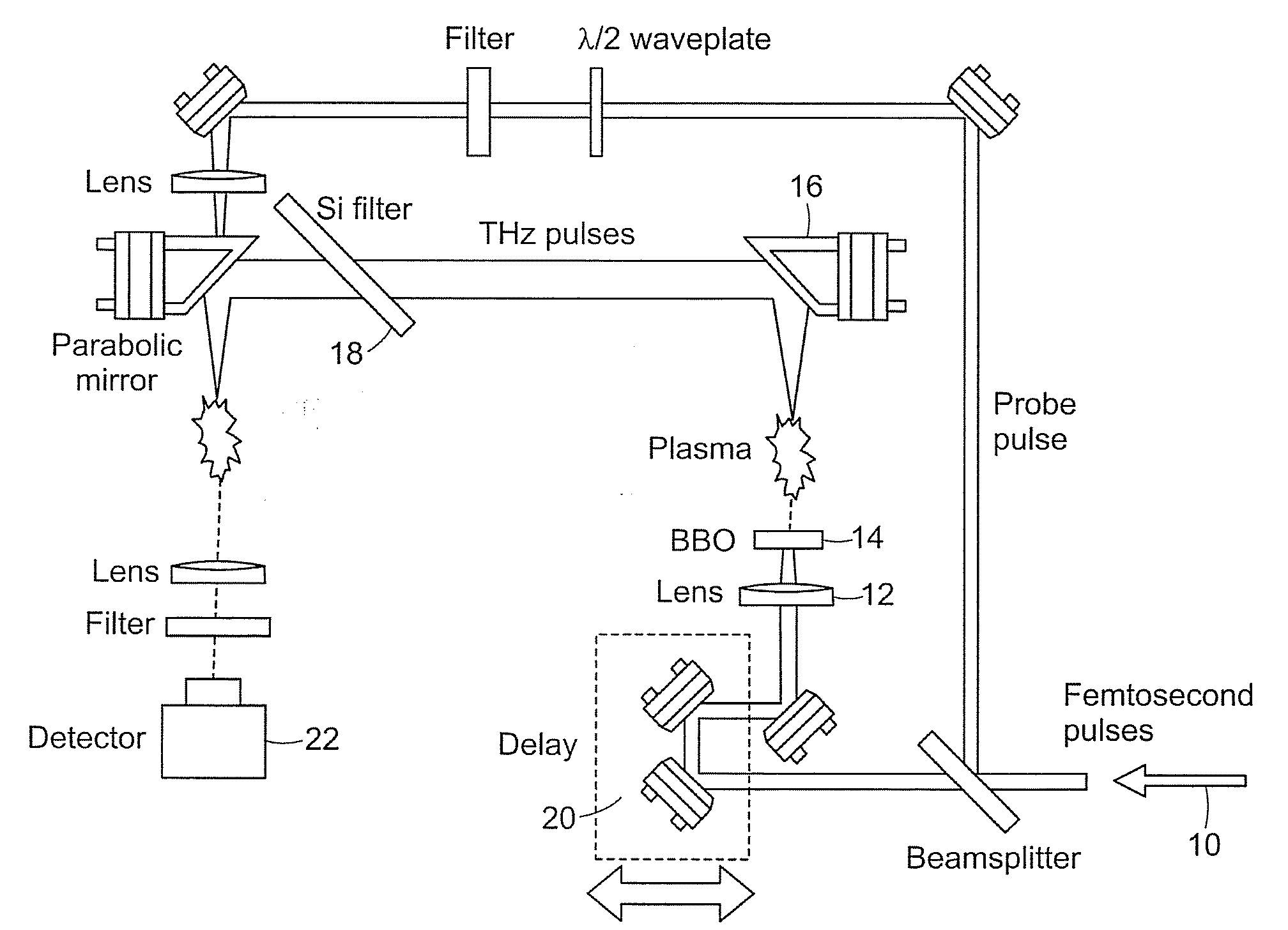
[0024]Perhaps the greatest advantage for using air as a THz wave sensor is the flexibility of selecting sensing location, since air is everywhere. Similar to the generation of THz waves in the air by third-order nonlinear susceptibility, we also propose to detect the THz waves in air with a third-order nonlinear optical process. There are several possible configurations for the third-order nonlinear optical process, but initially we will focus on the following two experimental configurations: (1) Detection of the rotation of the probe pulse by THz waves, and (2) Detection of second-harmonics generated through the nonlinear interaction of the air, THz waves and the probe pulse. The former requires two optical probe pulses: one at the fundamental frequency and the other at the second-harmonic frequency. The measurement of the rotation of polarization is widely used as a sensitive detection technique particularly in THz detection using electro-optic crystals such as ZnTe or GaP. The la...
PUM
 Login to View More
 Abstract
Description
Claims
Application Information
 Login to View More