
Magnetic sheet and production method thereof
a technology of magnetic sheet and production method, applied in the field of magnetic sheet, can solve problems such as failures of electronic equipment, and achieve the effects of preventing opening and closing failures of covers, reducing bekk, and excellent surface lubricity
- Summary
- Abstract
- Description
- Claims
- Application Information
AI Technical Summary
Benefits of technology
Problems solved by technology
Method used
Image

Examples
example 1
Preparation of Magnetic Sheet
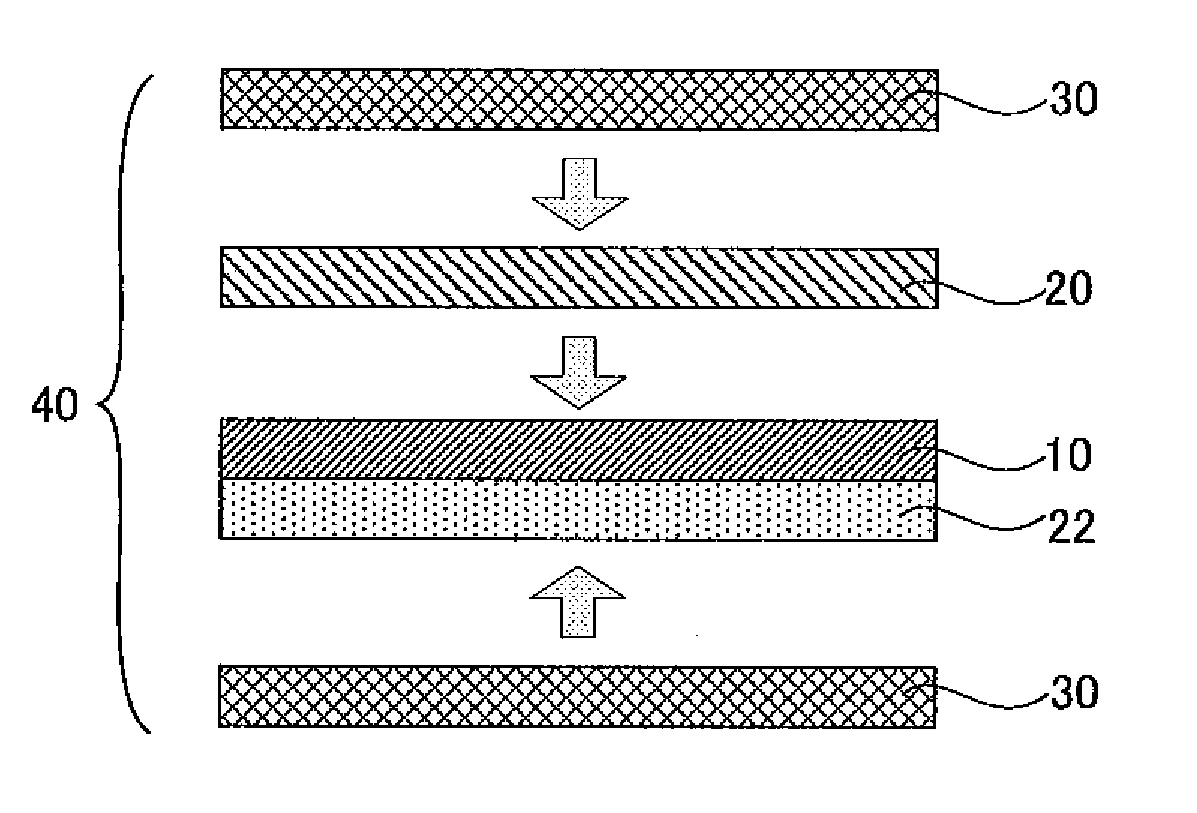
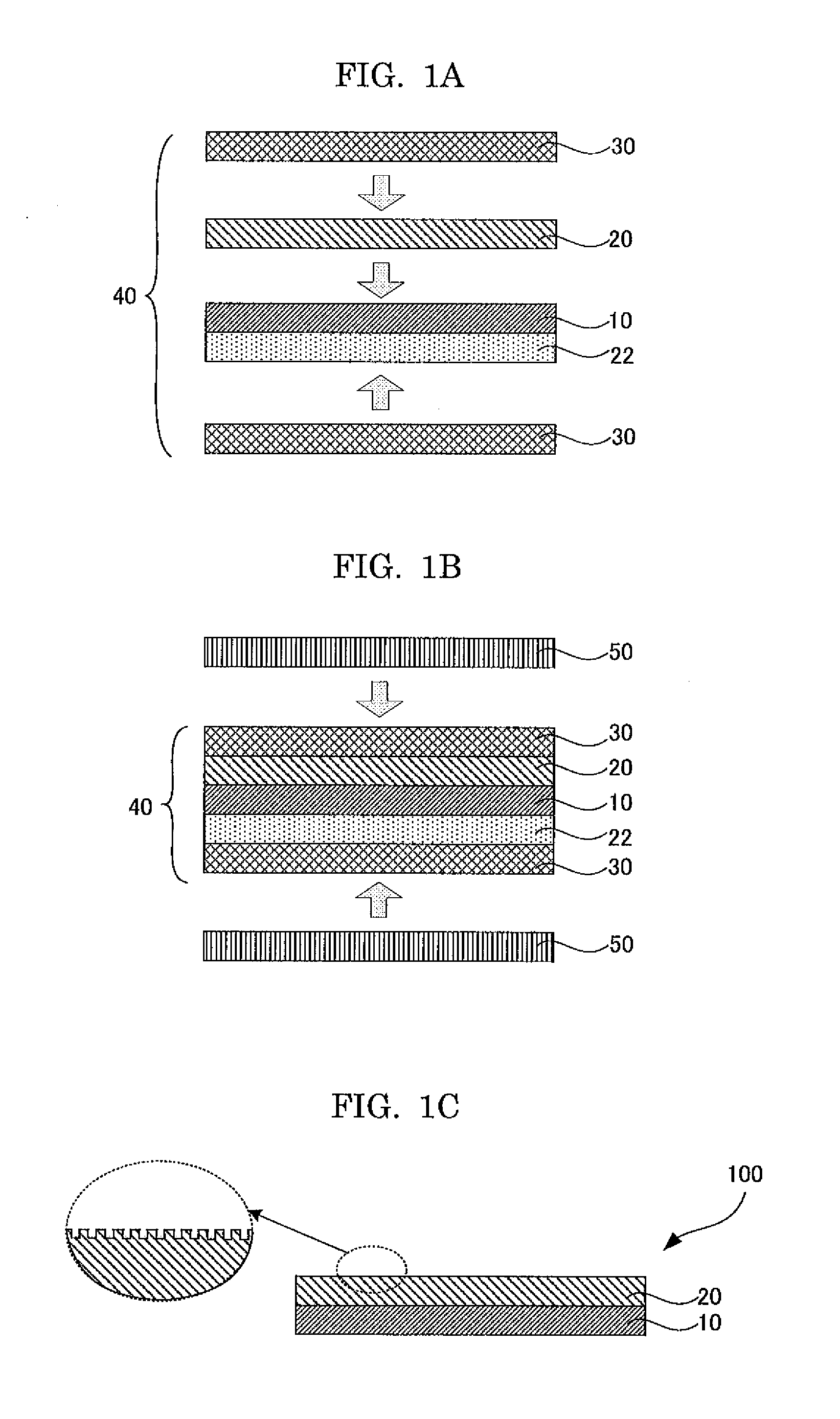
[0110]At first, in 270 parts by mass of toluene and 120 parts by mass of ethyl acetate, 83 parts by mass of acryl rubber having epoxy groups (SG80H-3, manufactured by Nagase ChemteX Corporation), 23 parts by mass of epoxy resin (EPICOAT (now named as jER®) 1031S, manufactured by Japan Exposy Resins Co., Ltd.), and 6.9 parts by mass of an epoxy curing agent (HX3748, manufactured by Asahi Kasei Chemicals Corporation) were dissolved so as to prepare a resin composition. To the resin composition, 550 parts by mass of flat magnetic powder (SP-1, manufactured by MATE CO., LTD.) as the magnetic powder, and the obtained mixture was mixed so as to prepare a magnetic composition.
[0111]The thus obtained magnetic composition was applied onto a polyester film a surface of which had been lubrication treated (a release PET; corresponds to a release layer 22 mentioned later) as the base, and dried at the temperature ranging from a room temperature to 115° C. to thereby ...
example 2
Preparation of Magnetic Sheet
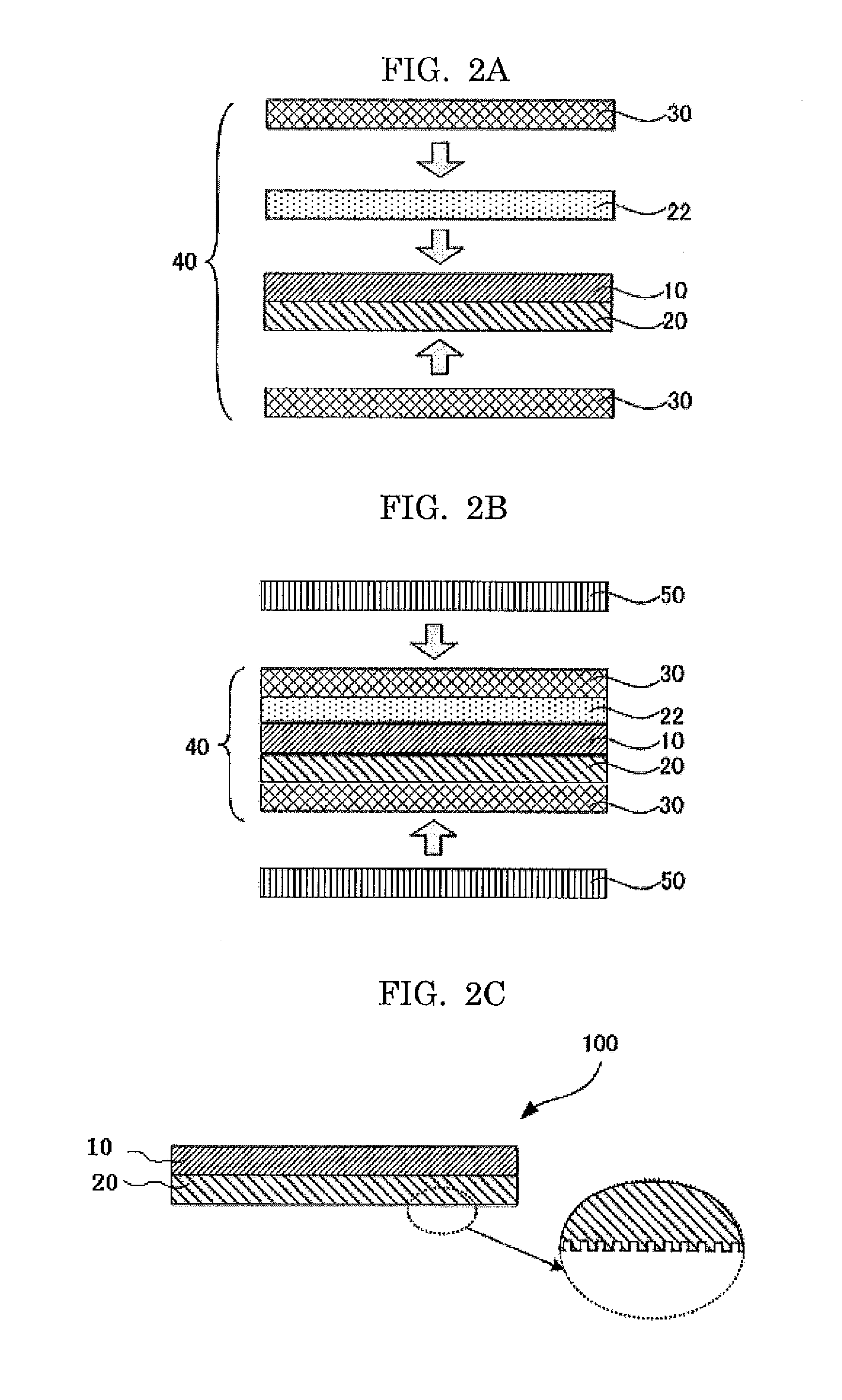
[0117]A magnetic sheet was prepared in the same manner as in Example 1, provided that the convex-concave forming layer 20 used in Example 1 was replaced with a polyester film a surface of which had been matte processed shown in Table 1.
example 3
Preparation of Magnetic Sheet
[0118]A magnetic sheet was prepared in the same manner as in Example 1, provided that the convex-concave forming layer 20 used in Example 1 was replaced with a polyester film which had not been lubrication processed shown in Table 1.
PUM
| Property | Measurement | Unit |
|---|---|---|
| thickness | aaaaa | aaaaa |
| thickness | aaaaa | aaaaa |
| thickness | aaaaa | aaaaa |
Abstract
Description
Claims
Application Information
 Login to View More