
Fuel additive for improved performance of direct fuel injected engines
a direct fuel injection, additive technology, applied in the direction of fuels, lubricant compositions, liquid carbonaceous fuels, etc., can solve the problems of undesirable deposits in the fuel composition of direct fuel injection diesel engines, the effect of reducing the amount of deposits formed and improving the power recovery of the engin
- Summary
- Abstract
- Description
- Claims
- Application Information
AI Technical Summary
Benefits of technology
Problems solved by technology
Method used
Image

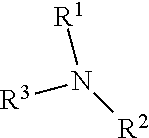
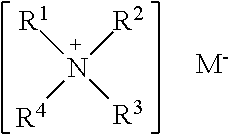
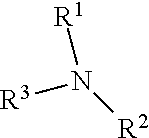
Examples
##ventive example 1
Inventive Example 1
(C8)3NMe
[0060]Trioctylmethylammonium chloride (70 grams) was mixed with 130 grams of heptane. The mixture was extracted five times with 70 grams of sodium acetate (about 16% wt. in water). Volatiles from the resulting organic layer were removed under reduced pressure to give a quat acetate. FTIR showed strong peaks at 1578 and 1389cm−1, characteristic of a carboxylate salt.
##ventive example 2
Inventive Example 2
(C12)2NMe2
[0061]A commercial quaternary ammonium product (C12)2NMe2+NO2− was vacuum distilled to remove volatiles to give the desired product.
##ventive example 3
Inventive Example 3
Dimethyloctadecyl-(2-hydroxyhexyl)ammonium acetate
[0062]A mixture of C18—N-Me2 (118 g), 39 grams of 1,2-epoxyhexane, 26 grams of acetic acid, and 76 grams of 2-ethylhexanol were heated slowly to 90° C. under inert atmosphere. The mixture was heated at 90° C. for 1.5 hours. Volatiles were then removed under reduced pressure to give desired product.
[0063]In the following example, an injector deposit test was performed on a diesel engine using an industry standard diesel engine fuel injector test, CEC F-98-08 (DW10) as described below.
[0064]A DW10 test that was developed by Coordinating European Council (CEC) was used to demonstrate the propensity of fuels to provoke fuel injector fouling and was also used to demonstrate the ability of certain fuel additives to prevent or control these deposits. Additive evaluations used the protocol of CEC F-98-08 for direct injection, common rail diesel engine nozzle coking tests. An engine dynamometer te...
PUM
 Login to View More
 Abstract
Description
Claims
Application Information
 Login to View More