
Vacuum insulated glass (VIG) unit including nano-composite pillars, and/or methods of making the same
a vacuum insulated glass and nano-composite technology, applied in the direction of parallel plane units, doors/windows, building components, etc., can solve the problems of undesirable high temperature and long heating time of the entire assembly used in the formulation of edge seals b>4, and adversely affect certain low-e coatings
- Summary
- Abstract
- Description
- Claims
- Application Information
AI Technical Summary
Benefits of technology
Problems solved by technology
Method used
Image

Examples
Embodiment Construction
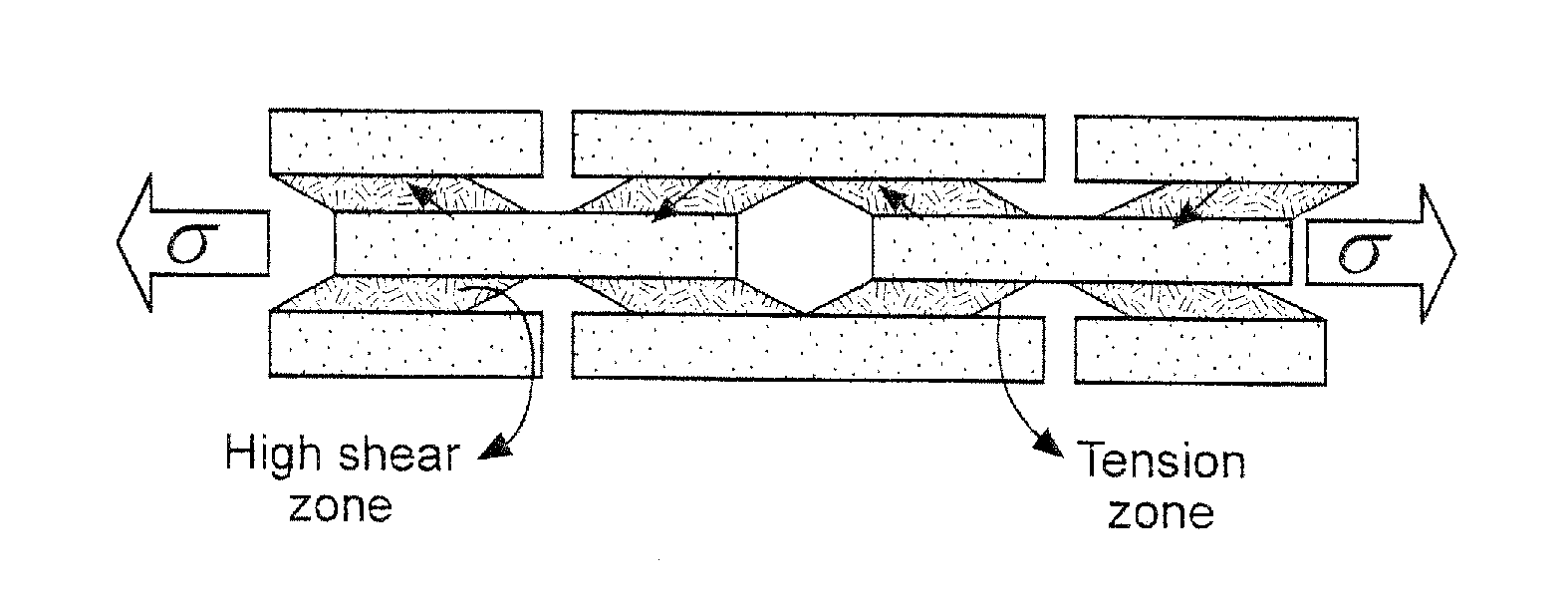
[0031]It will be appreciated that from a structural perspective, it would be advantageous to provide a VIG unit with a high stiffness and high damping behavior when it is subjected to dynamic loading. Further, it would be advantageous to provide the VIG unit with a high storage modulus to dissipate the energy. High damping or loss factor (tan δ) expressed as the ratio of loss modulus to the storage modulus is also desirable when attempting to avoid catastrophic failure of the VIG unit. Certain example embodiments therefore incorporate high Tg materials (such as, for example, MoSi2, graphite platelets, etc.) and / or heat resistant polymers (such as, for example, aramids, silicones, etc.) in composite pillar arrangements. Alternatively, or in addition, certain example embodiments may incorporate carbon nanotubes (CNTs) in composite pillar arrangements, where such CNTs may be oriented such that they are generally perpendicular or generally parallel to the top and / or bottom bases of the ...
PUM
| Property | Measurement | Unit |
|---|---|---|
| thick | aaaaa | aaaaa |
| thick | aaaaa | aaaaa |
| temperature | aaaaa | aaaaa |
Abstract
Description
Claims
Application Information
 Login to View More