System and Web Security Agent Method for Certificate Authority Reputation Enforcement

a certificate authority and agent method technology, applied in the field of system and web security agent method for certificate authority reputation enforcement, can solve the problems of fraudulent digital certificate issued, client presents error message to user, and still potentially affects internet users attempting to access websites belonging to legitimate certificate owners

US20130145158A1Inactive Publication Date: 2013-06-06BARRACUDA NETWORKS
6 Cites 2 Cited by

Patent Information

Authority / Receiving Office
US · United States
Patent Type
Applications(United States)
Current Assignee / Owner
Publication Date
2013-06-06
Estimated Expiration
Not applicable · inactive patent

Smart Images

  • Figure 1
    Figure 1
  • Figure 2
    Figure 2
  • Figure 3
    Figure 3
Patent Text Reader

Abstract

Network security administrators are enabled to revoke certificates with their customizable certificate authority reputation policy store which is informed by an independent certificate authority reputation server when a CA is deprecated or has fraudulent certificate generation. The custom policy store overrides trusted root certificate stores accessible to an operating system web networking layer or to a third party browser. Importing revocation lists or updating browsers or operating system is made redundant. The apparatus protects an endpoint from a man-in-the-middle attack when a certificate authority has lost control over certificates used in TLS.
Need to check novelty before this filing date? Find Prior Art

Description

RELATED APPLICATIONS

[0001] Priority is claimed from parent application System and Web Security Agent Method for Certificate Authority Reputation Enforcement Z-PTNTR201121 Ser. No. 13 / 225,371 filed 2 Sep. 2011 which received an election restriction requirement and Proxy Apparatus for Certificate Authority Reputation Enforcement in the Middle Z-PTNTR201122 Ser. No. 13,225,432 filed 3 Sep. 2011.BACKGROUND Conventional Transport Level Security

[0002] Transport Layer Security (TLS) is the most widely deployed protocol for securing communications in a non-secure environment, such as on the World Wide Web. The TLS protocol is used by most E-commerce and financial web sites, and is signified by the security lock icon that appears at the bottom of a web browser whenever TLS is activated. TLS guarantees privacy and authenticity of information exchanged between a web server and a web browser.

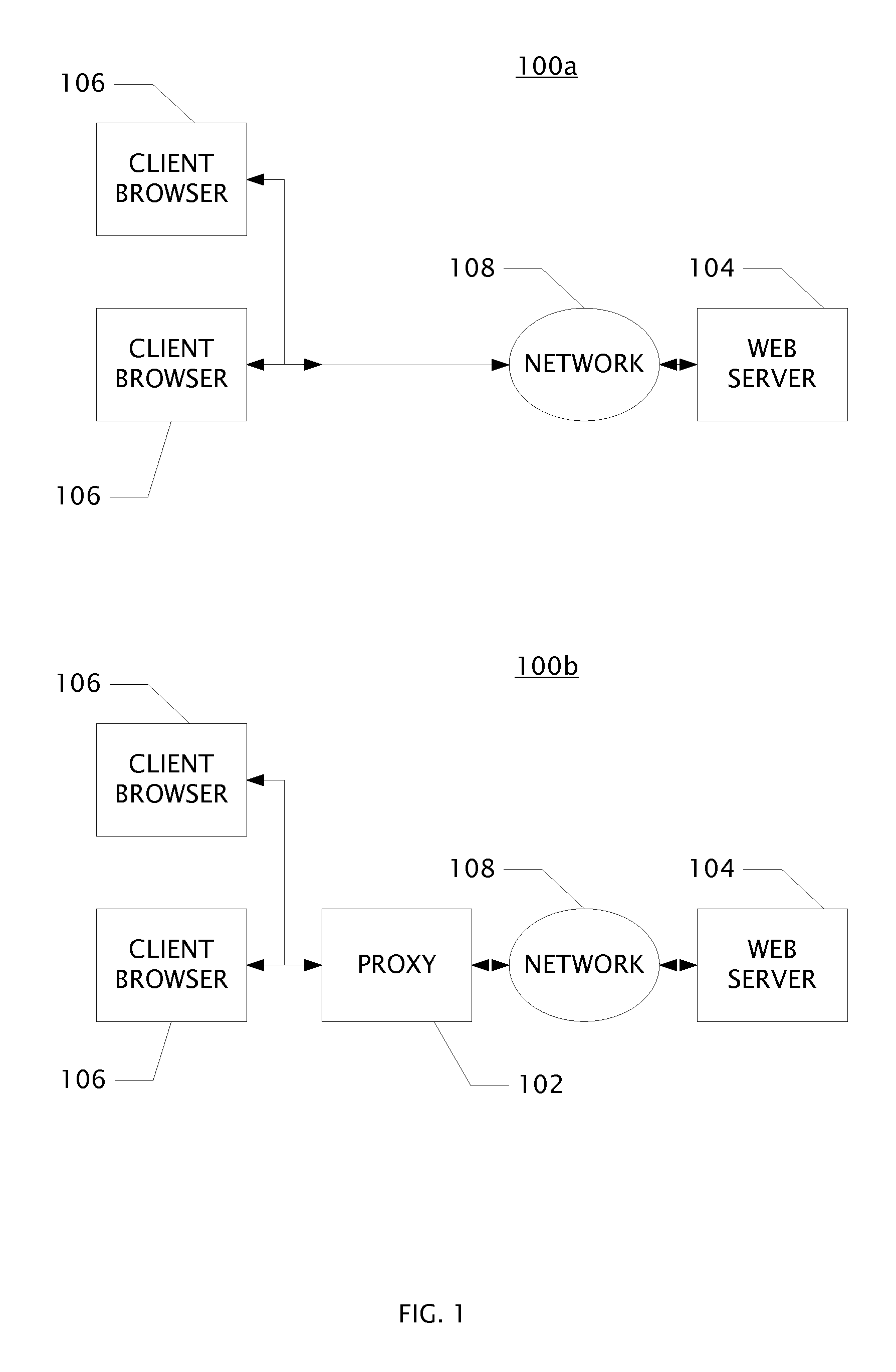
[0003] FIG. 1 is a block diagram that shows two standard network architectures 100a and 100b, a web server...

Examples

Embodiment Construction

[0022]An aspect of the invention is an apparatus disposed between a website having a certificate signed by a certificate authority and an endpoint which requests a TLS connection to the website. The apparatus is comprised of circuits which may be embodied as one or more processors configured by software program products encoded in a non-transitory computer readable medium. An aspect of the invention is the computer executed method steps for receiving, transforming, and transmitting electronic signals in a network attached apparatus.

[0023]One aspect of this invention is an apparatus to enforce trust policy for certificate authorities comprising:[0024]a (Barracuda) certificate authority reputation server;[0025]a certificate authority reputation custom policy store coupled to the ca reputation server, and a proxy[0026]the proxy coupled to the custom policy store and further coupled to a operating system web networking layer circuit within an endpoint; wherein the apparatus is communica...