Unlock instant, AI-driven research and patent intelligence for your innovation.

Two-dimensional absolute encoder and scale

a scale and encoder technology, applied in the field of two-dimensional absolute encoders and scales, can solve the problems of inability to achieve high resolution comparable to that of incremental encoders, and the application of incremental encoders in the field of machine tools and robots is particularly limited

Active Publication Date: 2014-03-13
CANON KK
View PDF3 Cites 38 Cited by
  • Summary
  • Abstract
  • Description
  • Claims
  • Application Information

AI Technical Summary

Benefits of technology

The patent describes a high-resolution two-dimensional absolute encoder that can detect the position of a scale with precision. The encoder includes a scale with multiple marks arranged in two directions, a detector to detect the rows of these marks, and a processor to determine the absolute positions of the scale based on the detector's output. The processor generates a code sequence for each direction and uses it to determine the position of the scale in that direction. This technology allows for accurate position detection in two dimensions.

Problems solved by technology

The application of incremental encoders to the fields of machine tools and robots is particularly limited, because incremental encoders cannot obtain absolute position information without first detecting an origin.
The two-dimensional absolute encoders disclosed in Japanese Patent Laid-Open No. 11-248489, PCT Japanese Translation Patent Publication No. 2008-525783, and Japanese Patent Laid-Open No. 2004-333498 all require a scale on which two-dimensional patterns each representing an absolute position are discretely arranged, and thus cannot easily achieve high resolution comparable to that of incremental encoders.

Method used

the structure of the environmentally friendly knitted fabric provided by the present invention; figure 2 Flow chart of the yarn wrapping machine for environmentally friendly knitted fabrics and storage devices; image 3 Is the parameter map of the yarn covering machine
View more

Image

Smart Image Click on the blue labels to locate them in the text.
Viewing Examples
Smart Image
  • Two-dimensional absolute encoder and scale
  • Two-dimensional absolute encoder and scale
  • Two-dimensional absolute encoder and scale

Examples

Experimental program
Comparison scheme
Effect test

first embodiment

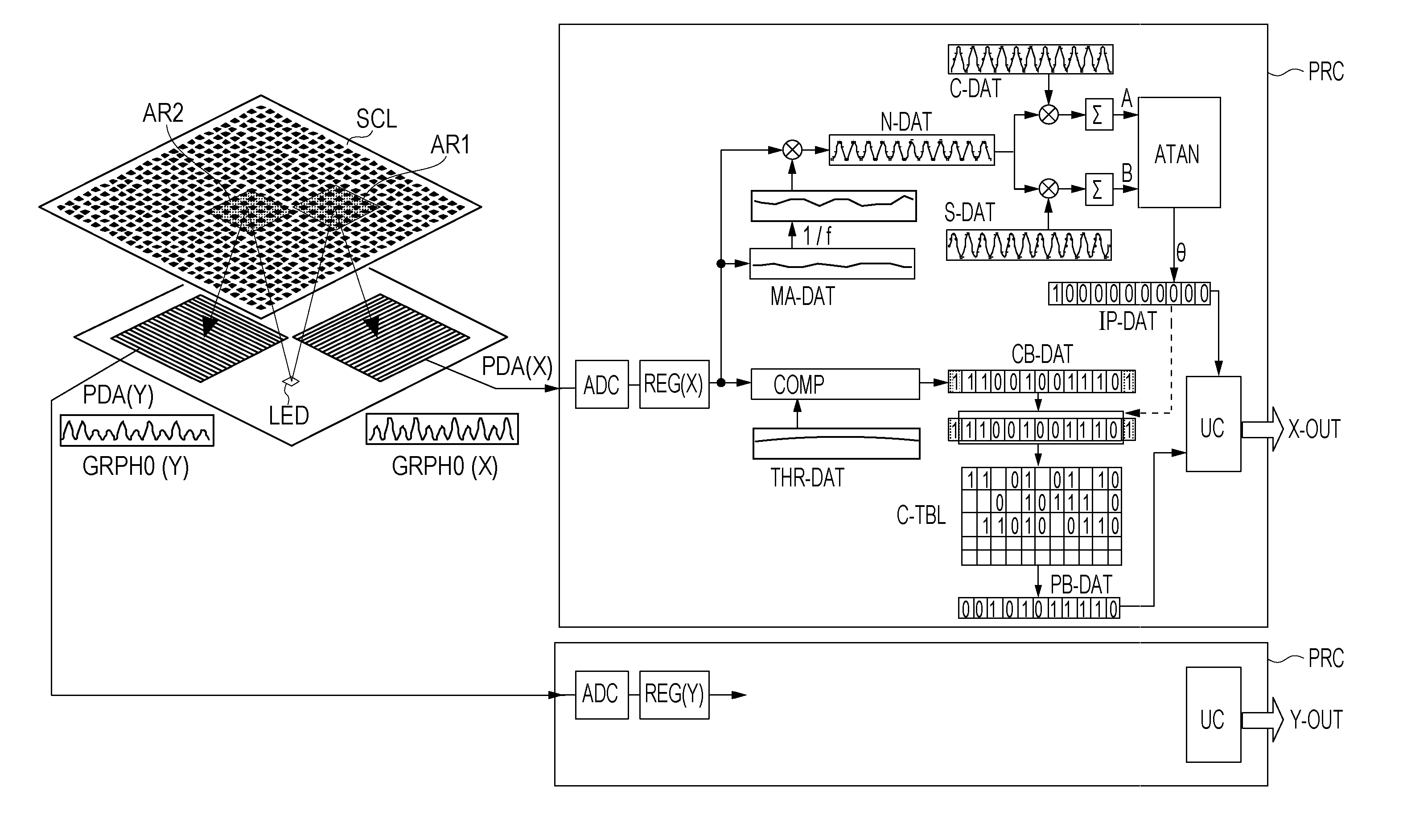
[0017]FIG. 1 illustrates a configuration of a two-dimensional absolute encoder according to a first embodiment.

[0018]As illustrated in FIG. 1, a two-dimensional scale SCL (lower surface) is illuminated with diverging light beams from a light-emitting element LED, and the reflected light is magnified and projected onto a one-dimensional light-receiving element array PDA(X) and a one-dimensional light-receiving element array PDA(Y).

[0019]As illustrated in FIG. 2, in the two-dimensional scale SCL for the two-dimensional absolute encoder, a plurality of square reflective portions (marks) are two-dimensionally arranged on a non-reflective substrate (having a reflectance of 0%) at predetermined pitches along two directions (first and second directions) orthogonal to each other. Reflection characteristics (reflectances) of the reflective portions have tones (gradation or grey scale) that follow the following rules.

[0020]1. Cyclic codes (also referred to as circulating codes) are created fo...

second embodiment

[0041]FIG. 3 illustrates a configuration of a two-dimensional scale according to a second embodiment. The second embodiment differs from the first embodiment in terms of the configuration of the two-dimensional scale. As illustrated in FIG. 3, in the two-dimensional scale SCL, a plurality of square reflective portions (marks) are two-dimensionally arranged on a non-reflective substrate (having a reflectance of 0%) at predetermined pitches along two directions (first and second directions) orthogonal to each other. Reflectances of the reflective portions have tones that follow the following rules.

[0042]1. Cyclic codes are created for each of the X and Y axes, and the code values of the cyclic codes for the X axis are associated with the code values of the cyclic codes for the Y axis, in a one-to-one (1:1) correspondence, at respective coordinate (or grid) points; and

[0043]2. a reflectance of a reflective portion at each grid point is defined for a combination of a code of an X coordi...

third embodiment

[0052]FIGS. 4A and 4B each illustrate a configuration of a two-dimensional scale according to a third embodiment. The third embodiment differs from the first embodiment in terms of the configuration of the two-dimensional scale. As illustrated in FIG. 4A, in the two-dimensional scale SCL, a plurality of square reflective portions (marks) are two-dimensionally arranged on a non-reflective substrate (having a reflectance of 0%) at predetermined pitches along two directions (first and second directions) orthogonal to each other. Reflectances of the reflective portions have tones that follow the following rules.

[0053]1. Cyclic codes are created for each of the X and Y axes, and the code values of the cyclic codes for the X axis are associated with the code values of the cyclic codes for the Y axis, in a one-to-one (1:1) correspondence, at respective coordinate (or grid) points; and

[0054]2. a reflectance of a reflective portion at each grid point is defined for a combination of a code of...

the structure of the environmentally friendly knitted fabric provided by the present invention; figure 2 Flow chart of the yarn wrapping machine for environmentally friendly knitted fabrics and storage devices; image 3 Is the parameter map of the yarn covering machine
Login to View More

PUM

No PUM Login to View More

Abstract

A two-dimensional absolute encoder includes a scale having marks arranged thereon along first and second directions different from each other, a detector configured to perform first detection that detects rows of a first number of marks arranged in the first direction and second detection that detects rows of a second number of marks arranged in the second direction, and a processor configured to determine absolute positions of the scale in the first and second directions based on outputs from the detector. Each of the marks has one of different characteristic values each corresponding to a combination of a quantized first code for indicating a position in the first direction and a quantized second code for indicating a position in the second direction, the number of the different characteristic values being smaller than the number of the combinations.

Description

BACKGROUND OF THE INVENTION[0001]1. Field of the Invention[0002]One disclosed aspect of the embodiments relates to a two-dimensional absolute encoder and a scale.[0003]2. Description of the Related Art[0004]Incremental and absolute encoders have been used, for example, to measure the position of a stage of a mechanical apparatus. The application of incremental encoders to the fields of machine tools and robots is particularly limited, because incremental encoders cannot obtain absolute position information without first detecting an origin. On the other hand, absolute encoders do not need to detect an origin because they may obtain absolute position information.[0005]Typically, to obtain a position of an object in two dimensions (in the X and Y directions) using an absolute encoder, two absolute linear encoders are attached to respective orthogonal side faces of a stage. However, it is often required to mount a two-dimensional scale on one surface, such as an upper or lower surface,...

Claims

the structure of the environmentally friendly knitted fabric provided by the present invention; figure 2 Flow chart of the yarn wrapping machine for environmentally friendly knitted fabrics and storage devices; image 3 Is the parameter map of the yarn covering machine
Login to View More

Application Information

Patent Timeline
no application Login to View More
IPC IPC(8): G01D5/347
CPCG01D5/34776G01D5/2455G01D5/34792
Inventor ISHIZUKA, KOOGASAWARA, MAKIKO
Owner CANON KK