Quenched and partitioned high-carbon steel wire

a high-carbon steel wire, partitioned technology, applied in the direction of low internal friction springs, magnetic materials, magnetic bodies, etc., can solve the problems of high cost of steel wires of wo2011/004913, process has not yet been applied to high-carbon steel wires, and the percentage of retained austenite is less, so as to improve the resistance to fracture and damage tolerance, good contact fatigue properties, hardness and ductility

a high-carbon steel wire, partitioned technology, applied in the direction of low internal friction springs, magnetic materials, magnetic bodies, etc., can solve the problems of high cost of steel wires of wo2011/004913, process has not yet been applied to high-carbon steel wires, and the percentage of retained austenite is less, so as to improve the resistance to fracture and damage tolerance, good contact fatigue properties, hardness and ductility

US20140227546A1Inactive Publication Date: 2014-08-14NV BEKAERT SA

Image

Smart Image Click on the blue labels to locate them in the text.
Viewing Examples
Smart Image
  • Quenched and partitioned high-carbon steel wire
  • Quenched and partitioned high-carbon steel wire
  • Quenched and partitioned high-carbon steel wire

Examples

Experimental program
Comparison scheme
Effect test

Embodiment Construction

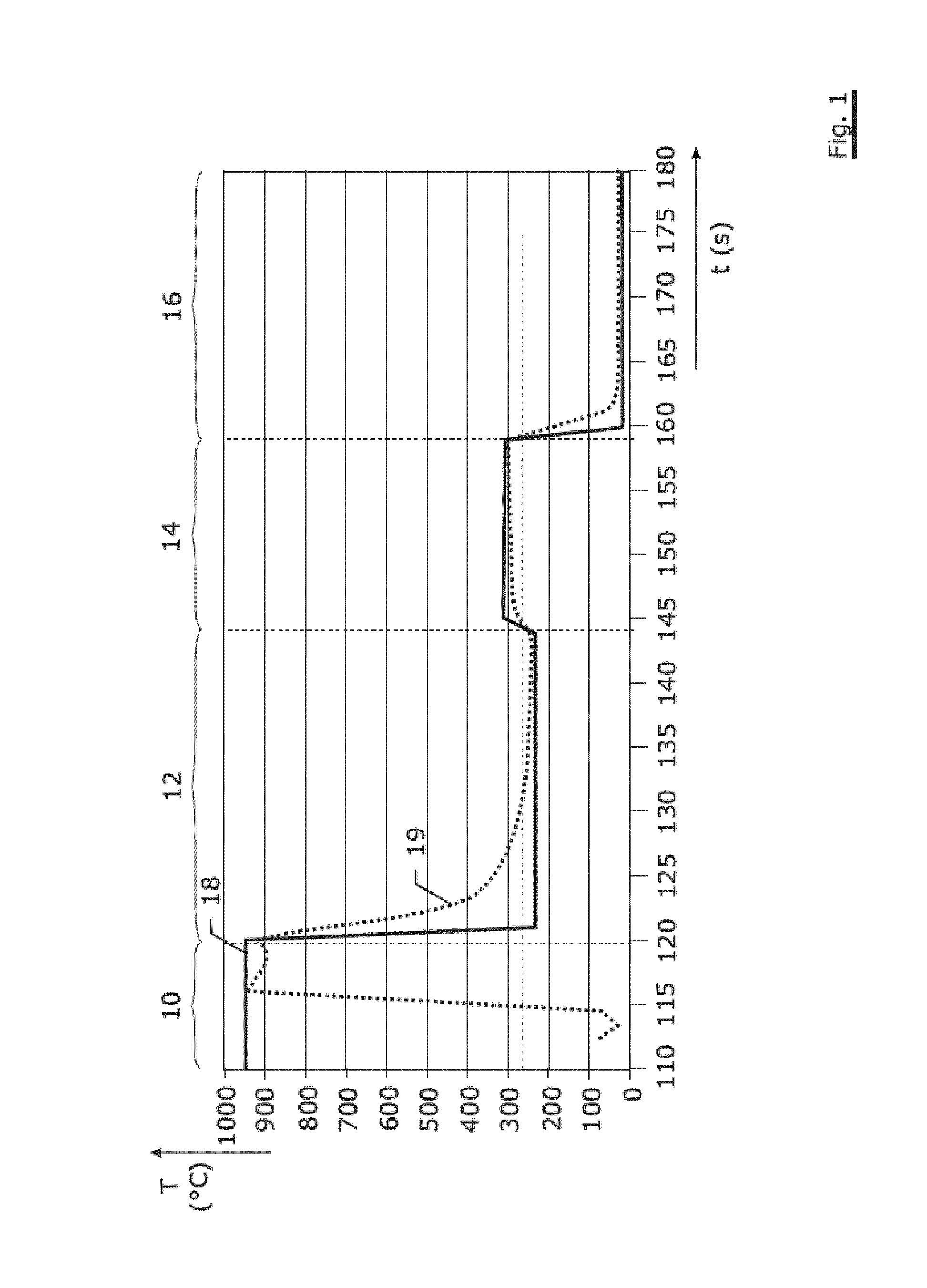
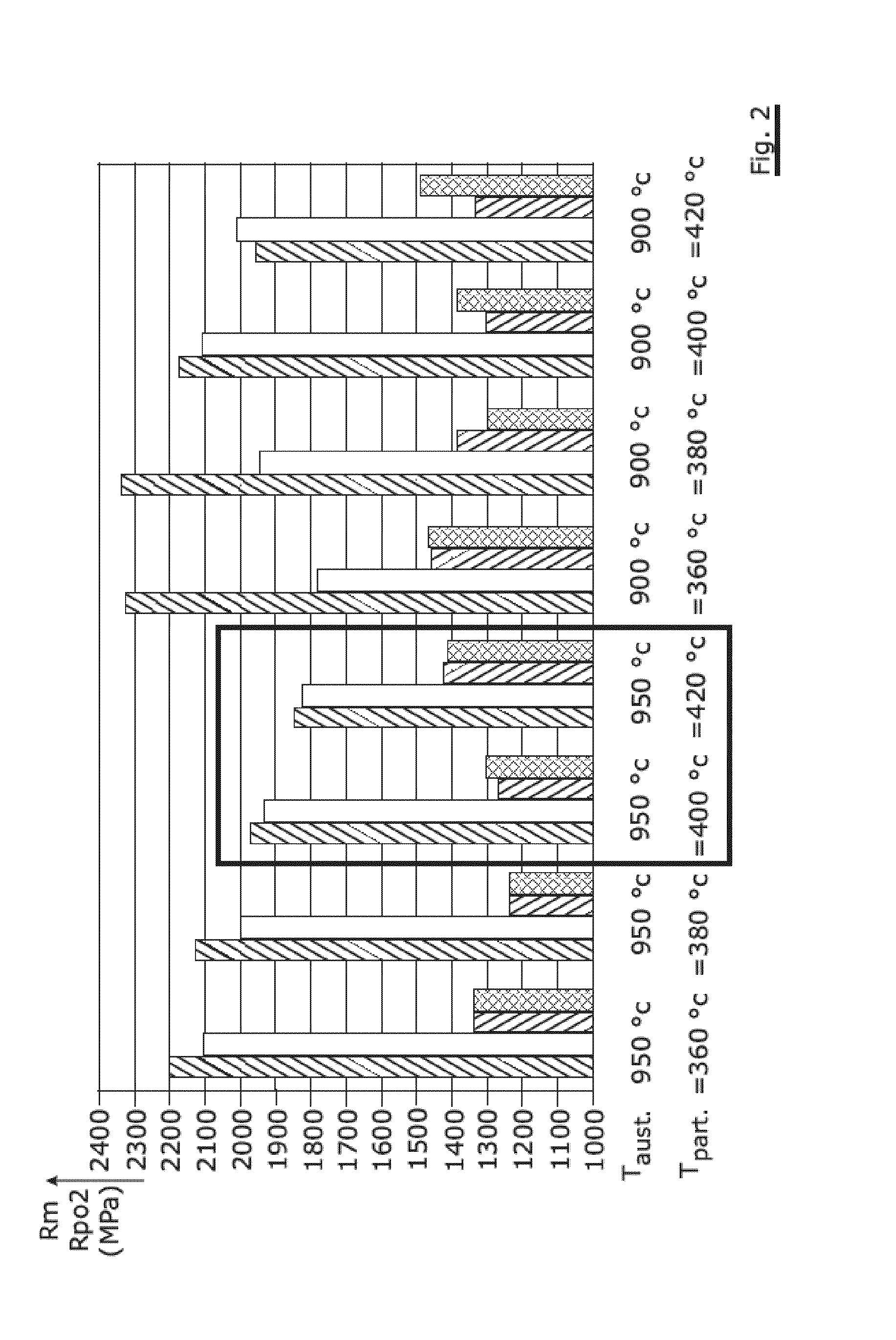
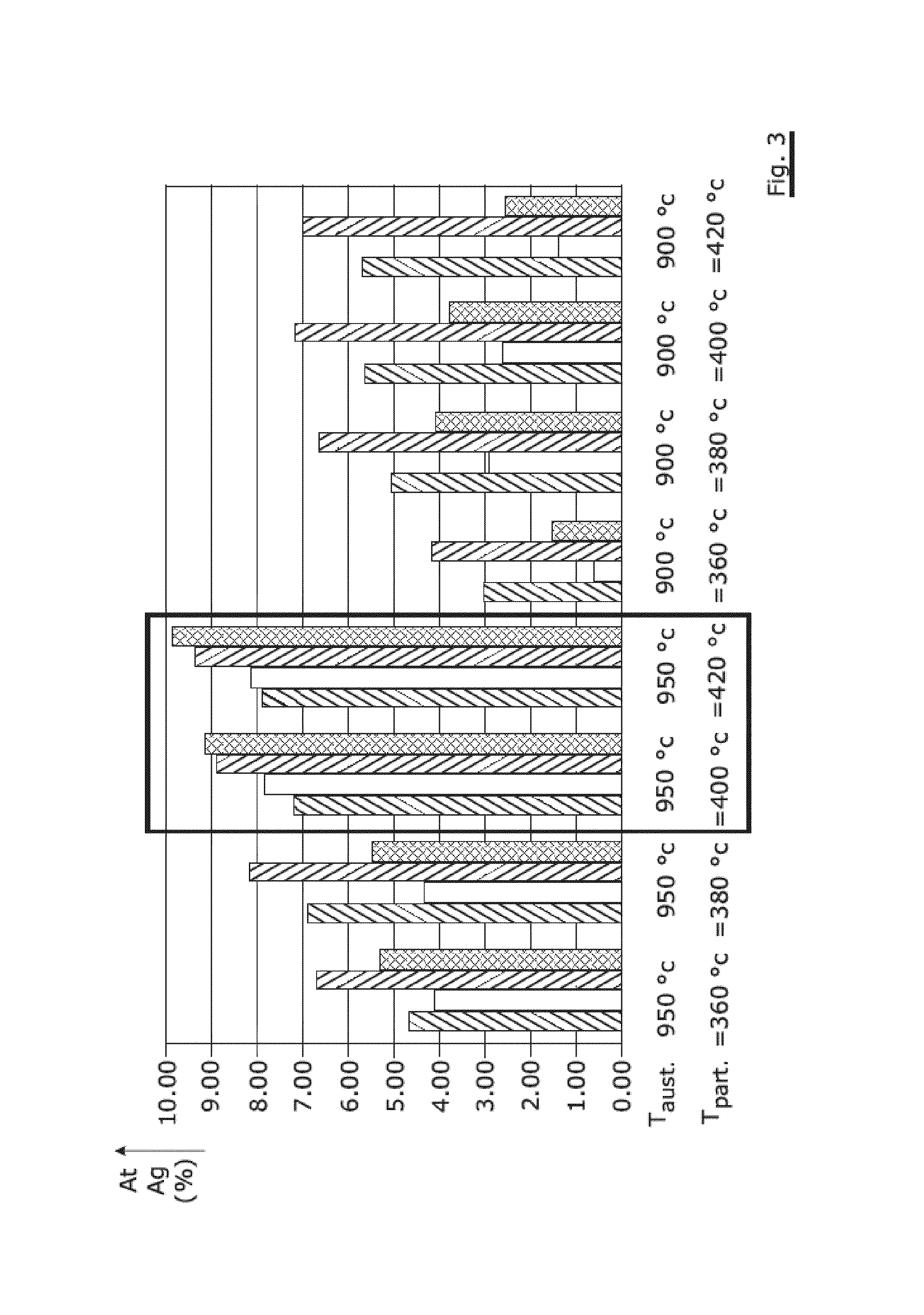
[0062]FIG. 1 illustrates a suitable temperature versus time curve applied to a drawn steel wire with a diameter of 3.60 mm and with following steel composition:[0063]% C=0.55[0064]% Si=1.62[0065]% Mn=0.70[0066]% Cr=0.77

the balance being iron and unavoidable impurities (% S and % P below 0.020 and weight percentages of other elements below 0.10)

[0067]The starting temperature of martensite transformation Ms of this steel is about 280° C. and the temperature Mf, at which martensite formation ends is about 170° C.

[0068]The various steps of the process are as follows:[0069]a first austenitizing step (10) during which the steel wire stays in a furnace at about 950° C. during 120 seconds,[0070]a second quenching step (12) for partial martensite transformation at a temperature below 280° C. during less than 25 seconds;[0071]a third partitioning step (14) for moving carbon atoms from the martensite phase to the austenite phase to stabilize this at a temperature above 300° C. during about 15 ...

the structure of the environmentally friendly knitted fabric provided by the present invention; figure 2 Flow chart of the yarn wrapping machine for environmentally friendly knitted fabrics and storage devices; image 3 Is the parameter map of the yarn covering machine
Login to View More

PUM

PropertyMeasurementUnit
Temperatureaaaaaaaaaa
Login to View More

Abstract

A high-carbon steel wire has as steel composition: a carbon content ranging from 0.40 weight percent to 0.85 weight percent, a silicon content ranging from 1.0 weight percent to 2.0 weight percent, a manganese content ranging from 0.40 weight percent to 1.0 weight percent, and a chromium content ranging from 0.0 weight percent to 1.0 weight percent. The remainder is iron. This steel wire has as metallurgical structure a volume percentage of retained austenite ranging from 4 percent to 20 percent, while the remainder is tempered primary martensite and untempered secondary martensite. The steel wire is obtained by partitioning after quenching.

Description

TECHNICAL FIELD[0001]The present invention relates to a high-carbon steel wire, to a process for manufacturing a high-carbon steel wire and to various uses or applications of such a high-carbon steel wire as spring wire, rope wire, wire in flexible pipe and wire in impact absorption applications.BACKGROUND ART[0002]WO2011 / 004913 discloses a steel wire for a high-strength spring. The steel wire has following composition: carbon between 0.67% and 0.75%, silicon between 2.0% and 2.5%, manganese between 0.5% and 1.2%, chromium between 0.8% and 1.3%, vanadium between 0.03% and 0.20%, molybdenum between 0.05% and 0.25%, tungsten between 0.05% and 0.30% with a particular relationship between manganese and vanadium and between molybdenum and tungsten. All percentages are percentages by weight. The metallographic structure of this steel wire comprises between 6% and 15% of retained austenite with a remainder of martensite.[0003]This steel wire is manufactured by first austenitizing the steel...

Claims

the structure of the environmentally friendly knitted fabric provided by the present invention; figure 2 Flow chart of the yarn wrapping machine for environmentally friendly knitted fabrics and storage devices; image 3 Is the parameter map of the yarn covering machine
Login to View More

Application Information

Patent Timeline
14 Aug 2014
Publication
US20140227546A1
IPC
C21D8/06; F16F7/00; F16F1/02; F16L11/02; D07B1/06
CPC
C21D8/065; F16L11/02; D07B2201/2009; F16F1/021; F16F7/00; D07B1/068; C21D8/06; C21D9/52
Inventors
MESPLONT, CHRISTOPHE; VAN RAEMDONCK, WALTHER