Unlock instant, AI-driven research and patent intelligence for your innovation.

Minimizing result set size when converting from asymmetric to symmetric requests

a result set and symmetric request technology, applied in the field of data analysis, can solve the problems of inefficiency of conventional batch tuple request and the drawback of returning more data than batch tuple reques

Inactive Publication Date: 2014-09-18
IBM CORP
View PDF17 Cites 0 Cited by
  • Summary
  • Abstract
  • Description
  • Claims
  • Application Information

AI Technical Summary

Benefits of technology

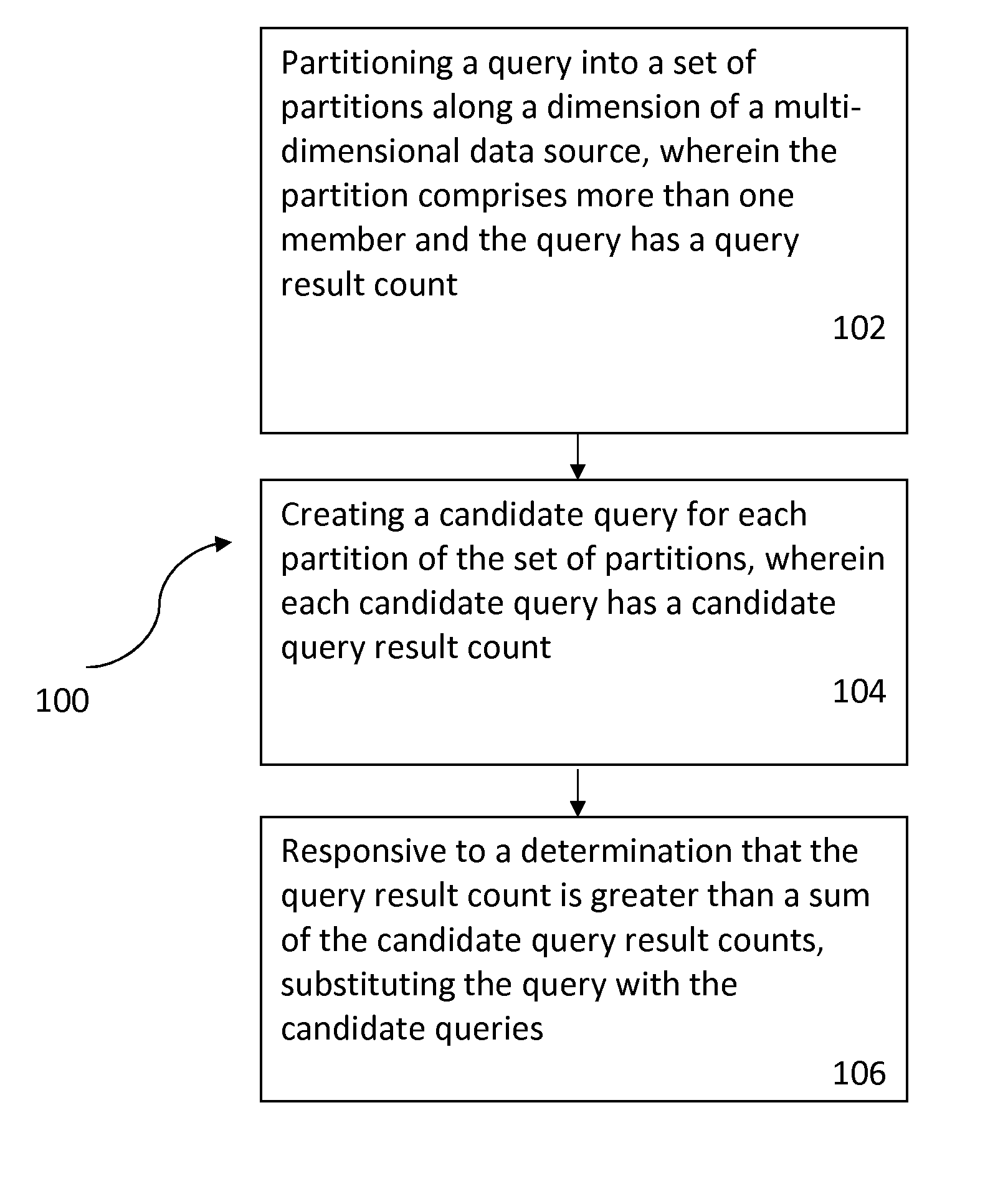
The patent describes a method, computer system, and computer program product for converting asymmetric requests into symmetric requests. This involves dividing a query into smaller parts called partitions, each containing multiple members and having a specific result count. Candidate queries are then created for each partition, each with a different result count. Once the result count for the original query is determined to be larger than a sum of the result counts for the individual candidate queries, the original query is substituted with the created alternative queries. This allows for efficient processing and better performance in queries involving large amounts of data.

Problems solved by technology

However, this conventional batch tuple request is inefficient because it is common for multiple tuples to share member references.
This conventional method has the drawback of returning more data than the batch tuple request.

Method used

the structure of the environmentally friendly knitted fabric provided by the present invention; figure 2 Flow chart of the yarn wrapping machine for environmentally friendly knitted fabrics and storage devices; image 3 Is the parameter map of the yarn covering machine
View more

Image

Smart Image Click on the blue labels to locate them in the text.
Viewing Examples
Smart Image
  • Minimizing result set size when converting from asymmetric to symmetric requests
  • Minimizing result set size when converting from asymmetric to symmetric requests
  • Minimizing result set size when converting from asymmetric to symmetric requests

Examples

Experimental program
Comparison scheme
Effect test

Embodiment Construction

[0013]The present invention relates to data analysis, and more particularly, to minimizing result set size when converting from asymmetric to symmetric requests. The following description is presented to enable one of ordinary skill in the art to make and use the invention and is provided in the context of a patent application and its requirements. Various modifications to the preferred embodiment and the generic principles and features described herein will be readily apparent to those skilled in the art. Thus, the present invention is not intended to be limited to the embodiments shown but is to be accorded the widest scope consistent with the principles and features described herein.

[0014]A method, computer system, and computer program product in accordance with the present invention minimizes a result set size when converting from asymmetric to symmetric requests. In a multi-dimensional database or data source, a set of tuples are converted from an asymmetric batch tuple request...

the structure of the environmentally friendly knitted fabric provided by the present invention; figure 2 Flow chart of the yarn wrapping machine for environmentally friendly knitted fabrics and storage devices; image 3 Is the parameter map of the yarn covering machine
Login to View More

PUM

No PUM Login to View More

Abstract

A method, system, and a computer program product for converting asymmetric requests into symmetric requests are disclosed. In a first aspect, the method comprises a computer partitioning a query into a set of partitions along a dimension of a multi-dimensional data source, wherein each partition of the set of partitions comprises more than one member and the query has a query result count. The method includes the computer creating a candidate query for each partition of the set of partitions, wherein each candidate query has a candidate query result count. Responsive to a determination that the query result count is greater than a sum of the candidate query result counts, the method includes the computer substituting the query with the candidate queries.

Description

FIELD OF THE INVENTION[0001]The present invention relates to data analysis, and more particularly, to minimizing result set size when converting from asymmetric to symmetric requests.BACKGROUND[0002]In a two dimensional matrix of data cells, each cell has two defining features: a function (e.g. tuple function) and a value. The function is editable by a user and when run, an associated value is returned and displayed in the cell. In a multidimensional database, a tuple is comprised of a set of data members from different dimensions, where one of the dimensions contains measure members (e.g. tuple, ([Products].[All Products], [Years].[All Years], [Measure].[Revenue]).[0003]When a cell with a tuple function is run, the value of the tuple is looked up in a local cache. If a local cache of a data processing system contains no value for the tuple, the tuple is requested from a server. The cache can be cleared at any time and a collection of cells or all of the cells can be refreshed in on...

Claims

the structure of the environmentally friendly knitted fabric provided by the present invention; figure 2 Flow chart of the yarn wrapping machine for environmentally friendly knitted fabrics and storage devices; image 3 Is the parameter map of the yarn covering machine
Login to View More

Application Information

Patent Timeline
no application Login to View More
Patent Type & Authority Applications(United States)
IPC IPC(8): G06F17/30
CPCG06F17/30389G06F16/242G06F16/278G06F16/283G06F16/2453G06F16/2456
Inventor EL-MOSLIMANY, AHMAD E.
Owner IBM CORP