
Transgenic animals with customizable traits
a technology of genetic modification and animals, applied in the field of genetic modification of animals, can solve the problems of increasing or reducing activity of carotene dyes, which have never been naturally found in animals,
- Summary
- Abstract
- Description
- Claims
- Application Information
AI Technical Summary
Benefits of technology
Problems solved by technology
Method used
Image

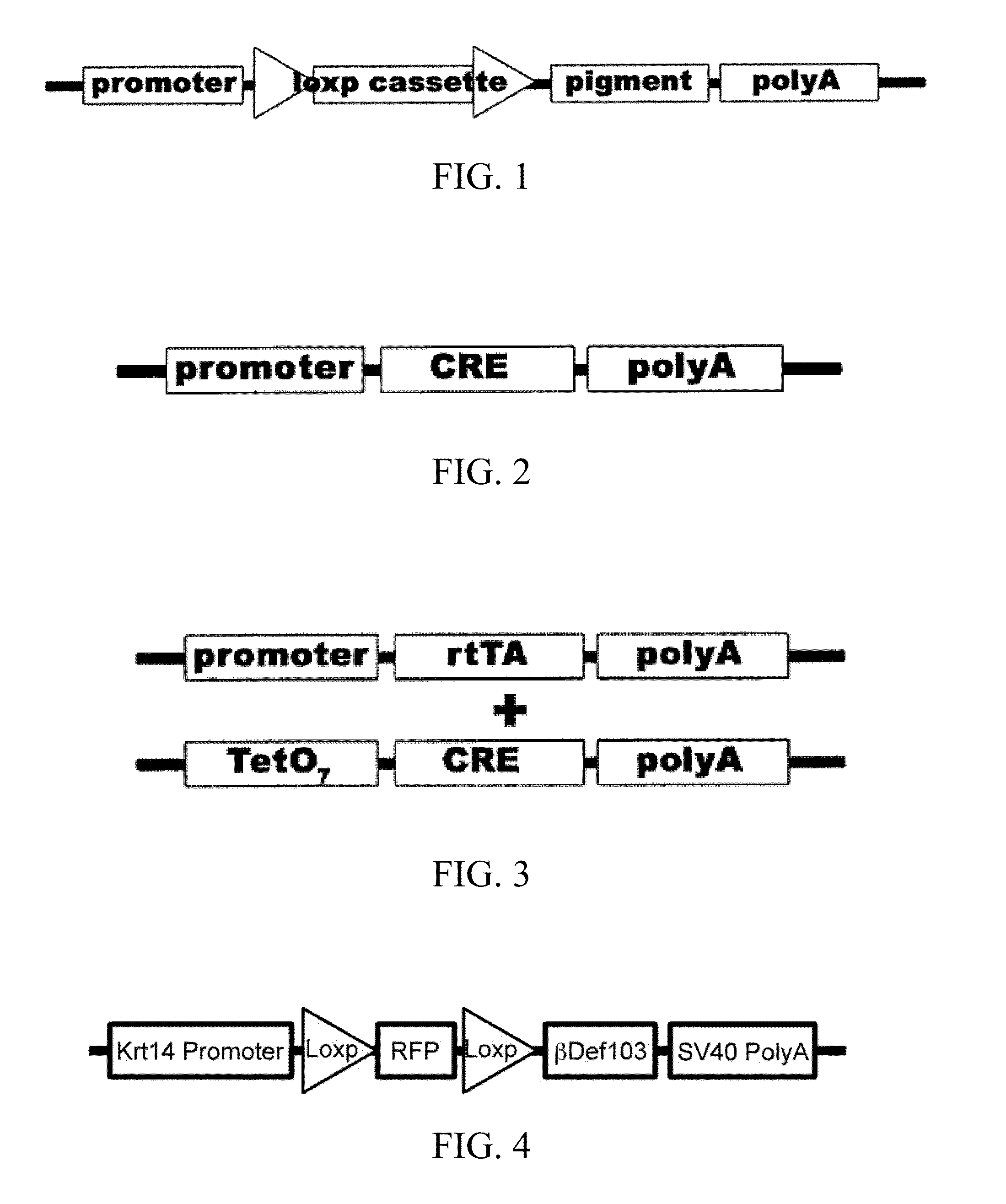
Examples
example 1
Customization of Skin or Fur Pigmentation in Animals
[0258]This Example provides embodiments of genetic constructs for customizing skin and fur pigmentation in animals.
Animals with Customized Pigmentation and Pattern in the Skin or Fur
[0259]C3H / HeJ murine strain with a brown (“Agouti” coloration) skin color are genetically engineered to express the following three constructs: 1) a construct comprising a keratin-14 specific promoter, a loxp cassette comprising a nucleic acid encoding a red fluorescent protein, a pigment cassette comprising a nucleic acid encoding a dominant black (ΔG23) beta defensin 103 protein, and an SV40 (with intron) polyadenylation sequence; 2) a construct comprising a nucleic acid molecule encoding a reverse tetracycline transactivator (rtTA), operably linked to a keratin-14 specific promoter that initiates the transcription of the nucleic acid encoding rtTA, and an SV40 polyadenylation sequence; and 3) a construct comprising an agouti signaling protein (ASP), ...
example 2
Mice with Customized Fur Color and Pattern
[0266]This Example shows the creation of genetically-modified mice whose fur color can be permanently altered through the transdermal application of HTNCre—a recombinase that can easily cross cell membranes.
[0267]FIG. 4 shows a genetic construct for creating customized patterns and color in mouse skin or fur. The construct comprises a Keratin14 promoter, which is expressed in all skin fibroblasts, to drive the dominant black form of signaling molecule beta-Def103; the expression of beta-Def103 is blocked by a Loxp excisable nucleic acid encoding ring finger protein (RFP) (the RFP is used as a marker).
[0268]Agouti mice are genetically-engineered to express a transgene encoding the “dominant black” signaling molecule βDef103, and the transgene expression is activated by the application of recombinase.
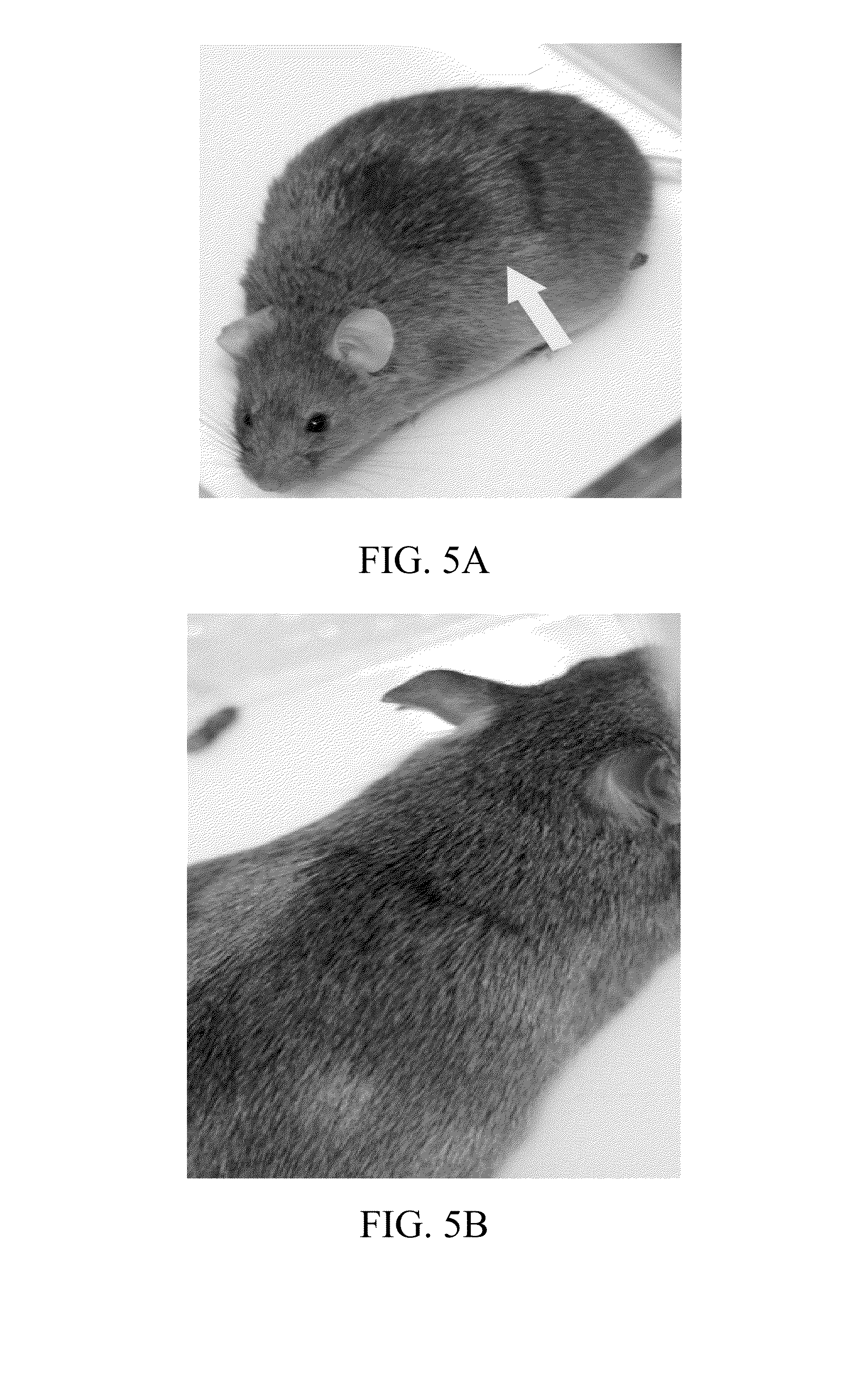
[0269]FIGS. 5A and 5B are photographs that show two genetically-engineered mice in which the expression of the dominant black pigment protein is ...
example 3
Customized Skin Color and Pattern for Cattle Identification
[0271]In the cattle industry, a robust method of birth processing for individual identification has become increasingly important for proof of ownership, herd management, tracking of animal movements, and perhaps, most importantly, animal disease traceability.
[0272]This Example provides transgenic cattle having customized skin color and patterns that can be used as a code (e.g., bar code) for cattle identification. The transgenic cattle can be created using the method described in Example 2. As shown in Example 2, transdermal or intradermal application of recombinase to transgenic mice whose genomic comprises a Cre-LoxP recombination system induce customizable changes in coat color after birth.
[0273]FIG. 7 shows a construct design for creating customized pattern or color identification in cattle. The construct comprises a nucleic acid molecule encoding a dominant negative Rab7, operably linked to a MC1R promoter and under th...
PUM
| Property | Measurement | Unit |
|---|---|---|
| color | aaaaa | aaaaa |
| length | aaaaa | aaaaa |
| structural strength | aaaaa | aaaaa |
Abstract
Description
Claims
Application Information
 Login to View More