Differential-to-single-end converter
- Summary
- Abstract
- Description
- Claims
- Application Information
AI Technical Summary
Benefits of technology
Problems solved by technology
Method used
Image



Examples
Embodiment Construction
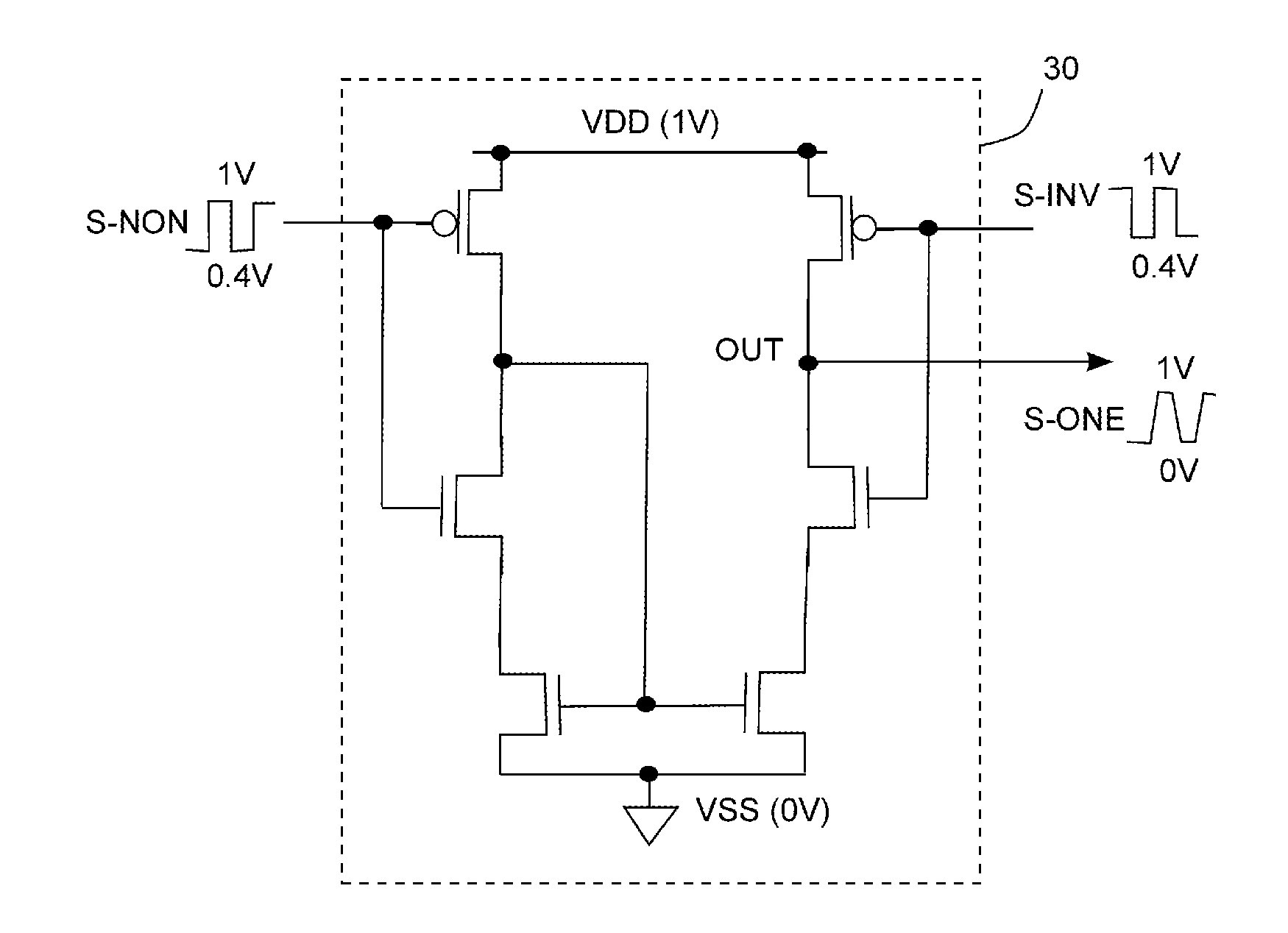
[0015]FIG. 2 shows a differential-to-single-end converter 20 according to an embodiment of the present invention. As shown in FIG. 2, the differential-to-single-end converter 20 includes two NMOS transistors N11 and N12, and four PMOS transistors P11, P12, P21 and P22. In one embodiment, element sizes of the NMOS transistors N11 and N12 are substantially the same; element sizes of the PMOS transistors P11 and P12 are substantially the same; element sizes of the PMOS transistors P21 and P22 are substantially the same.
[0016]The NMOS transistors N11 and N12 are a differential pair, whose gates are respectively driven by a non-inverted signal S-NON and an inverted signal S-INV of a differential signal. The NMOS transistor N11 and N12 have their sources jointly coupled to a power line VSS, and their drains not coupled to each other. Operation statuses of the NMOS transistors N11 and N12 are complementary. For example, the NMOS transistor N12 is turned off when the NMOS transistor N11 is ...
PUM
 Login to View More
 Abstract
Description
Claims
Application Information
 Login to View More