
Timepiece spring made of austenitic stainless steel
a technology of stainless steel and timepiece springs, which is applied in the direction of horology, instruments, and electromechanical clocks, can solve the problems of difficult transformation and difficult implementation of alloy types, and achieve the effects of improving ductility, less expensive, and being easy to produce on industrial scal
- Summary
- Abstract
- Description
- Claims
- Application Information
AI Technical Summary
Benefits of technology
Problems solved by technology
Method used
Image

Examples
Embodiment Construction
[0063]The invention concerns the field of timepiece movements, and in particular springs for storing energy, return or shock absorber springs: spiral springs such as a mainspring, or striking spring, or suchlike or a flat spring such as a jumper, shock absorber or suchlike.
[0064]It is an object of the invention to address the problem of producing timepiece springs having extreme longevity, small dimensions and notably spiral springs having a thickness of less than 0.200 mm.
[0065]A very long campaign of tests is required to test theoretically suitable alloys and to set the parameter(s) permitting feasibility with the required performance and dimensions.
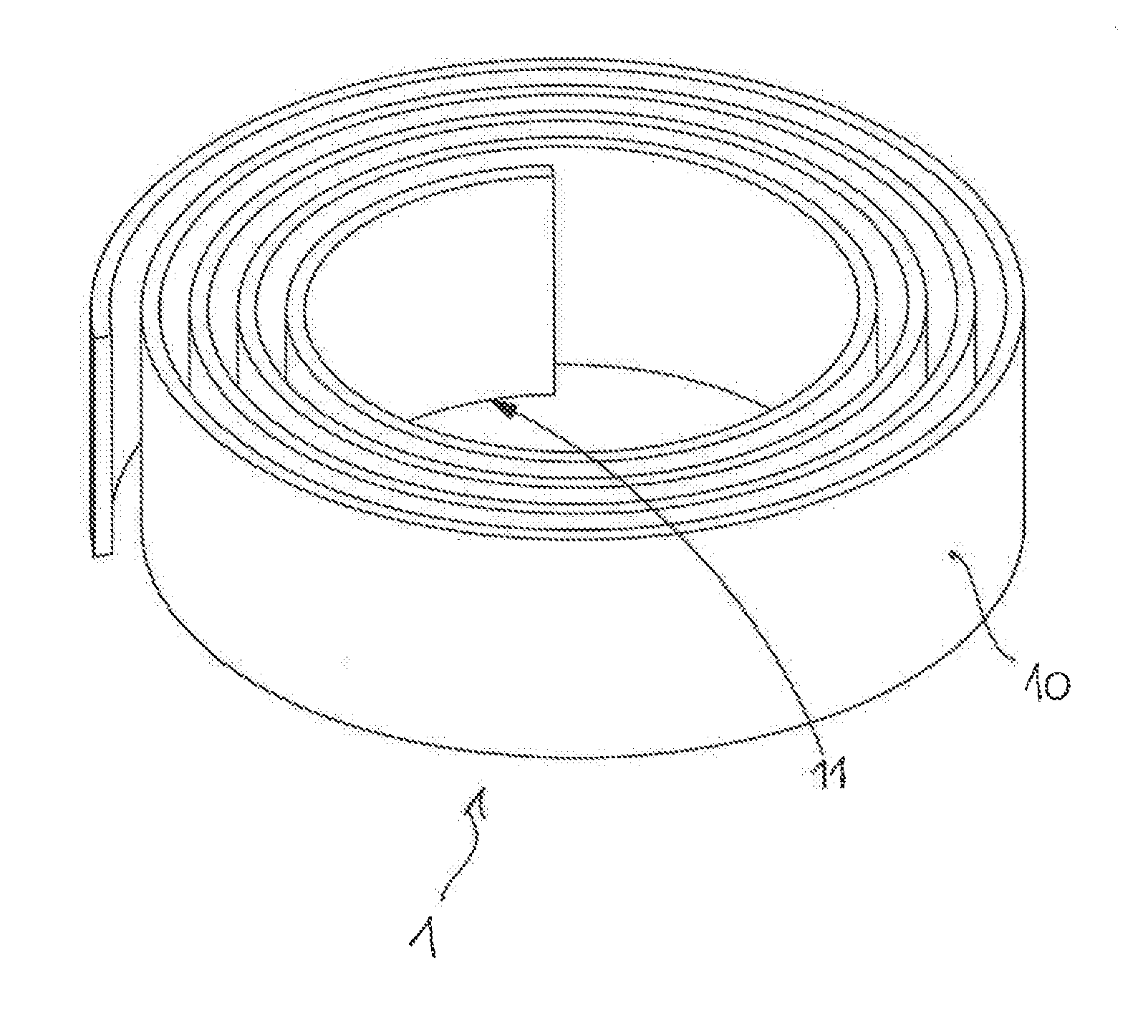
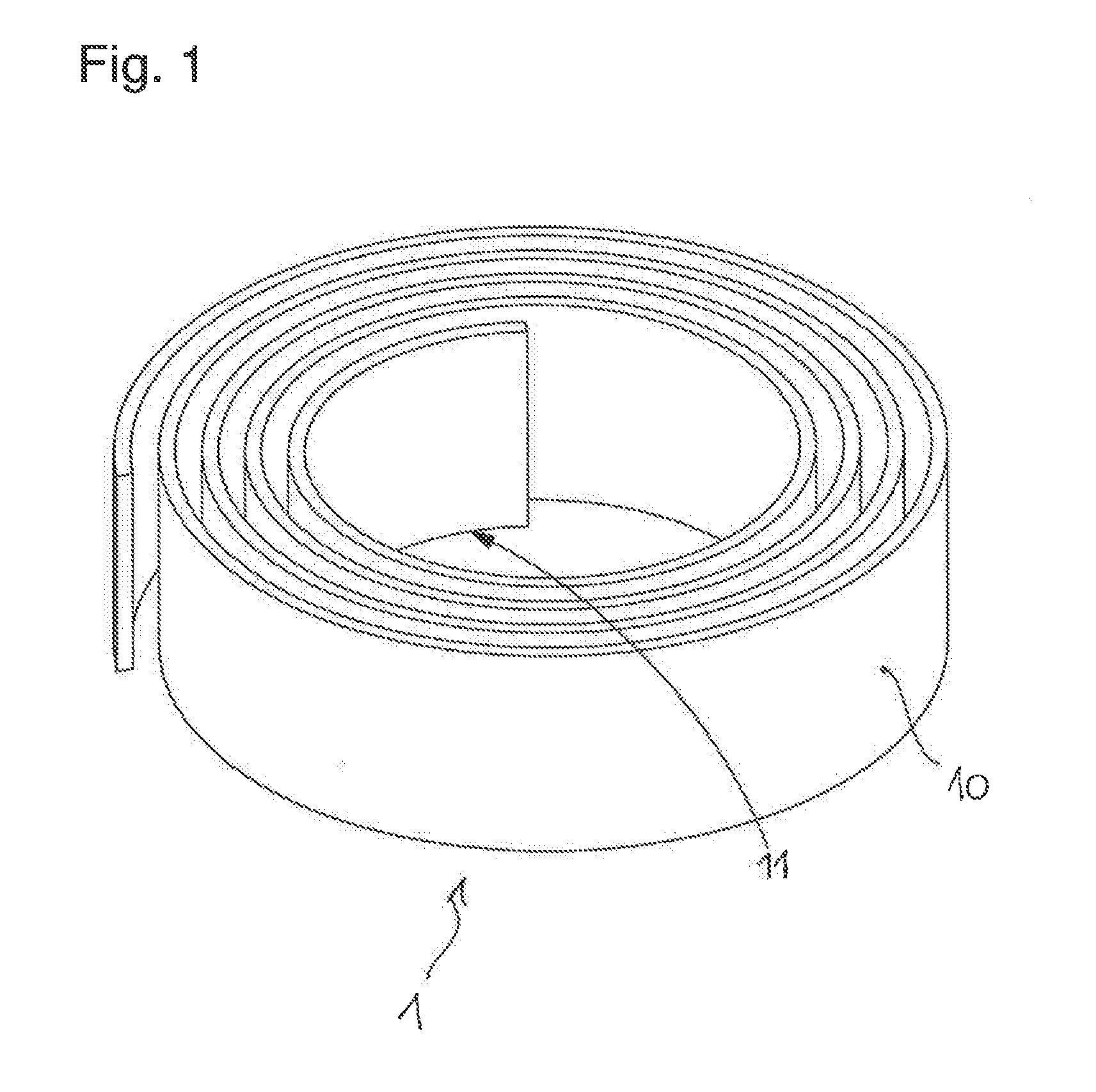
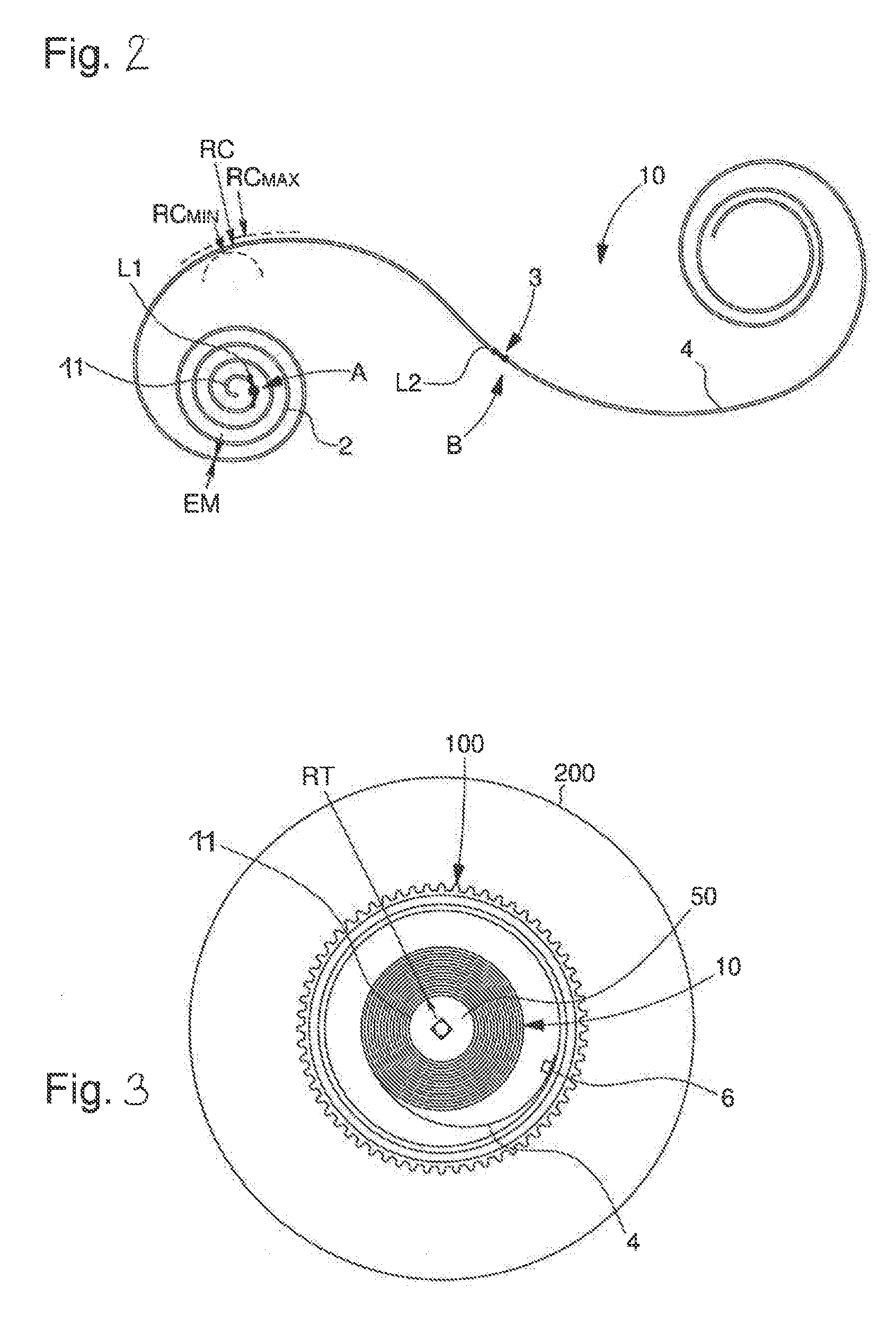
[0066]More specifically, the problem is amplified with regard to the production of a spiral spring 1 having an inner coil 11 adapted, in the case of a barrel, to a core or an arbour 50 of very small diameter, less than 4.3 mm and notably less than 1.5 mm, or even less than 1.2 mm in so called barrels with “reduced core diameter”, or in...
PUM
| Property | Measurement | Unit |
|---|---|---|
| thickness | aaaaa | aaaaa |
| thickness | aaaaa | aaaaa |
| thickness | aaaaa | aaaaa |
Abstract
Description
Claims
Application Information
 Login to View More