Multivalent and multispecific gitr-binding fusion proteins
Active Publication Date: 2017-01-26
INHIBRX INC
View PDF0 Cites 69 Cited by
Summary
Abstract
Description
Claims
Application Information
AI Technical Summary
This helps you quickly interpret patents by identifying the three key elements:
Problems solved by technology
Method used
Benefits of technology
Benefits of technology
The patent text describes a new type of molecule called a "GITR-targeting molecule" that can target a protein called GITR. These molecules are different from traditional antibodies because they require a crosslinking agent to activate them. The new molecules have the advantage of requiring less of the crosslinking agent and avoiding the issue of heavy chain mis-pairing. The new molecules can also be designed to target other proteins in the immune system, such as OX40 or CD27, and can be used to enhance tumor destruction or treat inflammatory conditions. Overall, the new molecules have improved properties and can better activate the immune system compared to traditional antibodies.
Problems solved by technology
Importantly, to properly agonize this receptor family often requires higher order clustering, and conventional bivalent antibodies are not ideal for this.
Method used
the structure of the environmentally friendly knitted fabric provided by the present invention; figure 2 Flow chart of the yarn wrapping machine for environmentally friendly knitted fabrics and storage devices; image 3 Is the parameter map of the yarn covering machine
View more
Image
Smart Image Click on the blue labels to locate them in the text.
Viewing Examples
Smart Image
Click on the blue label to locate the original text in one second.
Reading with bidirectional positioning of images and text.
Smart Image
Examples
Experimental program
Comparison scheme
Effect test
example 1
GITR-Targeting Molecules Bind GITR
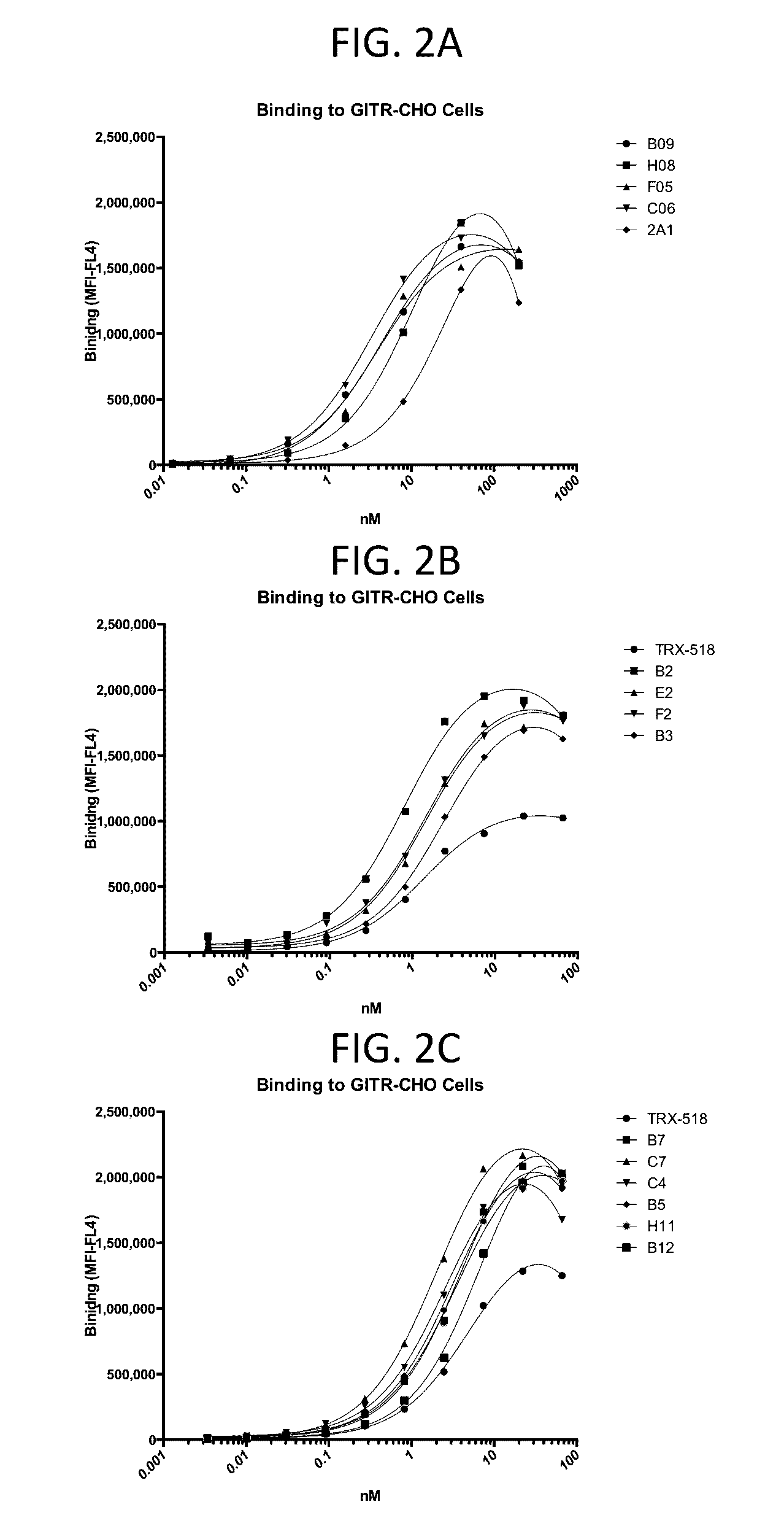
[0178]As shown in FIGS. 2A, 2B, and 2C, various GITR-targeting fusion proteins of the disclosure bind to GITR expressed on CHO cells as assessed by flow cytometry. The GITR antibody, TRX-518, was used as a control for these studies.
[0179]The binding affinities of the GITR-targeting molecules referred to herein as hzC06v1.1 (SEQ ID NO: 42), hzC06v1.2 (SEQ ID NO: 43), hzC06v1.3 (SEQ ID NO: 44), hzC06v1.4 (SEQ ID NO: 45), hzC06v2.1 (SEQ ID NO: 46), hzC06v2.2 (SEQ ID NO: 47), hzC06v2.3 (SEQ ID NO: 48), hzC06v2.4 (SEQ ID NO: 49), hzC06v3 (SEQ ID NO: 50), hzC06v3.1 (SEQ ID NO: 51), hzC06v3.2 (SEQ ID NO: 52), hzC06v3.3 (SEQ ID NO: 53), hzC06v3.4 (SEQ ID NO: 54), hzC06v3.5 (SEQ ID NO: 55), hzC06v3.6 (SEQ ID NO: 56), hzC06v3.7 (SEQ ID NO: 57), hzC06v3.8 (SEQ ID NO: 58), hzC06v3.9 (SEQ ID NO: 59), hzC06v3.10 (SEQ ID NO: 60), hzC06v3.11 (SEQ ID NO: 61), hzC06v3.12 (SEQ ID NO: 62), hzC04v4.1 (SEQ ID NO: 63), hzC04v4.1.2 (SEQ ID NO: 64), hzC04v4.2 (SEQ ID NO: 65...
example 2
GITR-Targeting Molecules Block the Interaction Between GITR and GITR-L
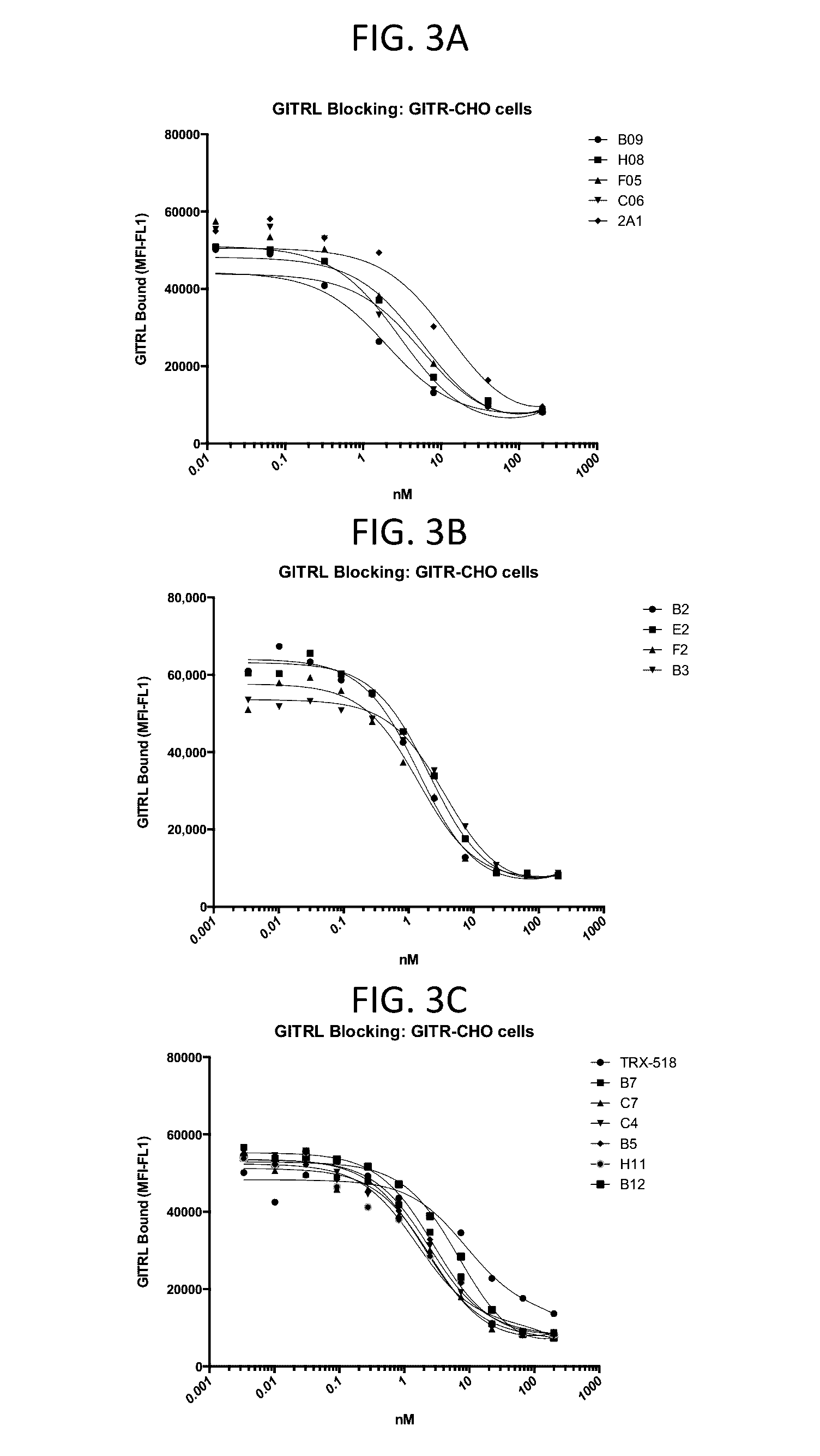
[0180]As shown in FIGS. 3A, 3B, and 3C, various GITR-targeting fusion proteins of the disclosure were able to block the interaction between GITRL and GITR. Briefly, in these studies, a flow cytometryassay using GITR expressing CHO cells and recombinant GITRL was used to implement to assess blocking capacity. The GITR antibody, TRX-518, was used as a control for these studies.
example 3
Binding Affinities of GITR-Targeting Molecules for Human and Cynomolgus GITR
[0181]The binding affinities of the GITR-targeting molecule referred to herein as bivalent hzC06v3.9-hIgG1 or 2×hzC06v3.9-IgG1 Fc (SEQ ID NO: 93) for human and cynomolgus GITR extracellular domain human IgG1 fusion protein (GITR-Fc) were determined by surface plasmonresonance. Briefly, biotinylated human and cynomolgus GITR-Fc were captured on the chip surface and then bivalent hzC06v3.9-hIgG1 was injected at 10 concentrations (0 nM-600 nM) at 40 ul / min for 120 seconds. Dissociation was followed for 240 seconds. ka1, kd1, and KD1 are reported in the table below.
the structure of the environmentally friendly knitted fabric provided by the present invention; figure 2 Flow chart of the yarn wrapping machine for environmentally friendly knitted fabrics and storage devices; image 3 Is the parameter map of the yarn covering machine
Login to View More
PUM
Property
Measurement
Unit
Fraction
aaaaa
aaaaa
Fraction
aaaaa
aaaaa
Fraction
aaaaa
aaaaa
Login to View More
Abstract
This disclosure generally provides molecules that specifically engage glucocorticoid-induced TNFR-related protein (GITR), a member of the TNF receptor superfamily (TNFRSF). More specifically, the disclosure relates to multivalent and / or multispecific molecules that bind at least GITR.
Description
RELATED APPLICATIONS[0001]This application claims the benefit of U.S. Provisional Application No. 62 / 195,822, filed Jul. 23, 2015, the contents of which are incorporated herein by reference in their entirety.INCORPORATION OF SEQUENCE LISTING[0002]The contents of the text file named “INHI022001 US_ST25.txt,” which was created on Jul. 22, 2016 and is 209 KB in size, are hereby incorporated by reference in their entirety.FIELD OF THE INVENTION[0003]This disclosure generally provides molecules that specifically engage glucocorticoid-induced TNFR-related protein (GITR), a member of the TNF receptor superfamily (TNFRSF). More specifically, the disclosure relates to multivalent and / or multispecific molecules that bind at least GITR.BACKGROUND OF THE INVENTION[0004]The tumor necrosis factorreceptor superfamily consists of several structurally related cell surface receptors. Activation by multimeric ligands is a common feature of many of these receptors. Many members of the TNFRSF have ther...
Claims
the structure of the environmentally friendly knitted fabric provided by the present invention; figure 2 Flow chart of the yarn wrapping machine for environmentally friendly knitted fabrics and storage devices; image 3 Is the parameter map of the yarn covering machine
Login to View More
Application Information
Patent Timeline
Application Date:The date an application was filed.
Publication Date:The date a patent or application was officially published.
First Publication Date:The earliest publication date of a patent with the same application number.
Issue Date:Publication date of the patent grant document.
PCT Entry Date:The Entry date of PCT National Phase.
Estimated Expiry Date:The statutory expiry date of a patent right according to the Patent Law, and it is the longest term of protection that the patent right can achieve without the termination of the patent right due to other reasons(Term extension factor has been taken into account ).
Invalid Date:Actual expiry date is based on effective date or publication date of legal transaction data of invalid patent.


 Login to View More