This helps you quickly interpret patents by identifying the three key elements:
Problems solved by technology
Method used
Benefits of technology
Benefits of technology
[0012]Thus, by adding a petroleum-derived wax and a fatty acid metal salt having a specific carbon number relationshi
Problems solved by technology
Wax has a deterioration suppressing effect such as ozone resistance, and on the other hand, whitens a rubber surface by blooming on the rubber surface, becoming a factor of poor appearance of a tire.
However, this patent document denies the use of a petroleum-derived wax, and does not disclose to adjust the carbon number of a petroleum-derived wax and the carbon number of a fatty acid metal salt.
However, accordi
Method used
the structure of the environmentally friendly knitted fabric provided by the present invention; figure 2 Flow chart of the yarn wrapping machine for environmentally friendly knitted fabrics and storage devices; image 3 Is the parameter map of the yarn covering machine
View more
Image
Smart Image Click on the blue labels to locate them in the text.
Viewing Examples
Smart Image
Click on the blue label to locate the original text in one second.
Reading with bidirectional positioning of images and text.
Smart Image
Examples
Experimental program
Comparison scheme
Effect test
examples
[0039]Examples of the present embodiment are described below, but the present invention is not construed as being limited to those examples.
first example
[0040]Banbury mixer was used. Compounding ingredients other than sulfur and a vulcanization accelerator were added to and kneaded with a diene rubber according to the formulations (parts by mass) shown in Table 1 below in a first mixing step (discharge temperature: 160° C.). Sulfur and a vulcanization accelerator were added to and kneaded with the kneaded material obtained above in a final mixing step (discharge temperature: 90° C.). Thus, a rubber composition was prepared. The details of each component in Table 1 are as follows.
[0041]SBR: Styrene-butadiene rubber, “SBR1723” manufactured by JSR Corporation
[0042]BR: Butadiene rubber, “BR 150” manufactured by Ube Industries, Ltd.
[0043]Carbon black 1: HAF, “SEAST 3” manufactured by Tokai Carbon Co., Ltd.
[0044]Silica: “NIPSIL AQ” manufactured by Tosoh Silica Corporation
[0045]Oil: “JOMO PROCESS NC140” manufactured by JX Nippon Oil & Sun-Energy Corporation
[0046]Silane coupling agent: “Si75” manufactured by Evonik
[0047]Zinc flower: “Zinc F...
second example
[0077]Banbury mixer was used. Rubber compositions were prepared in the same manner as in First Example according to the formulations (parts by mass) shown in Table 2 below. The details of each component in Table 2 are as follows (the details of the same components as shown in Table 1 are the same as described above).
[0078]NR: Natural rubber, RSS#3
[0079]Carbon black 2: FEF, “SEAST SO” manufactured by Tokai Carbon Co., Ltd.
[0080]Age resister 2: “ANTIGEN RD-G” manufactured by Sumitomo Chemical Co., Ltd.
[0081]Vulcanization accelerator NS: “NOCCELER NS-P” manufactured by Ouchi Shinko Chemical Industrial Co., Ltd.
[0082]Each rubber composition was vulcanized at 160° C. for 20 minutes to prepare each test piece, and appearance (whitening) and ozone resistance of each test piece were evaluated. Each evaluation method is the same as described above.
the structure of the environmentally friendly knitted fabric provided by the present invention; figure 2 Flow chart of the yarn wrapping machine for environmentally friendly knitted fabrics and storage devices; image 3 Is the parameter map of the yarn covering machine
Login to View More
PUM
Property
Measurement
Unit
Percent by mass
aaaaa
aaaaa
Electrical resistance
aaaaa
aaaaa
Carbon number
aaaaa
aaaaa
Login to View More
Abstract
A rubber composition for a tire comprises a diene rubber, a petroleum-derived wax and a fatty acid metal salt, wherein the difference (Δ=Cmw−Cmf) obtained by subtracting the carbon number (Cmf) of a constituent fatty acid contained the most in the fatty acid metal salt from the carbon number (Cmw) of a hydrocarbon contained the most in the petroleum-derived wax is −10 or more and 8 or less. The rubber composition can suppress whitening of a rubber surface while maintaining ozone resistance. A pneumatic tire has a rubber part comprising the rubber composition, wherein the rubber part is at least one selected from the group consisting of a tread rubber, a side wall rubber, and a rim strip.
Description
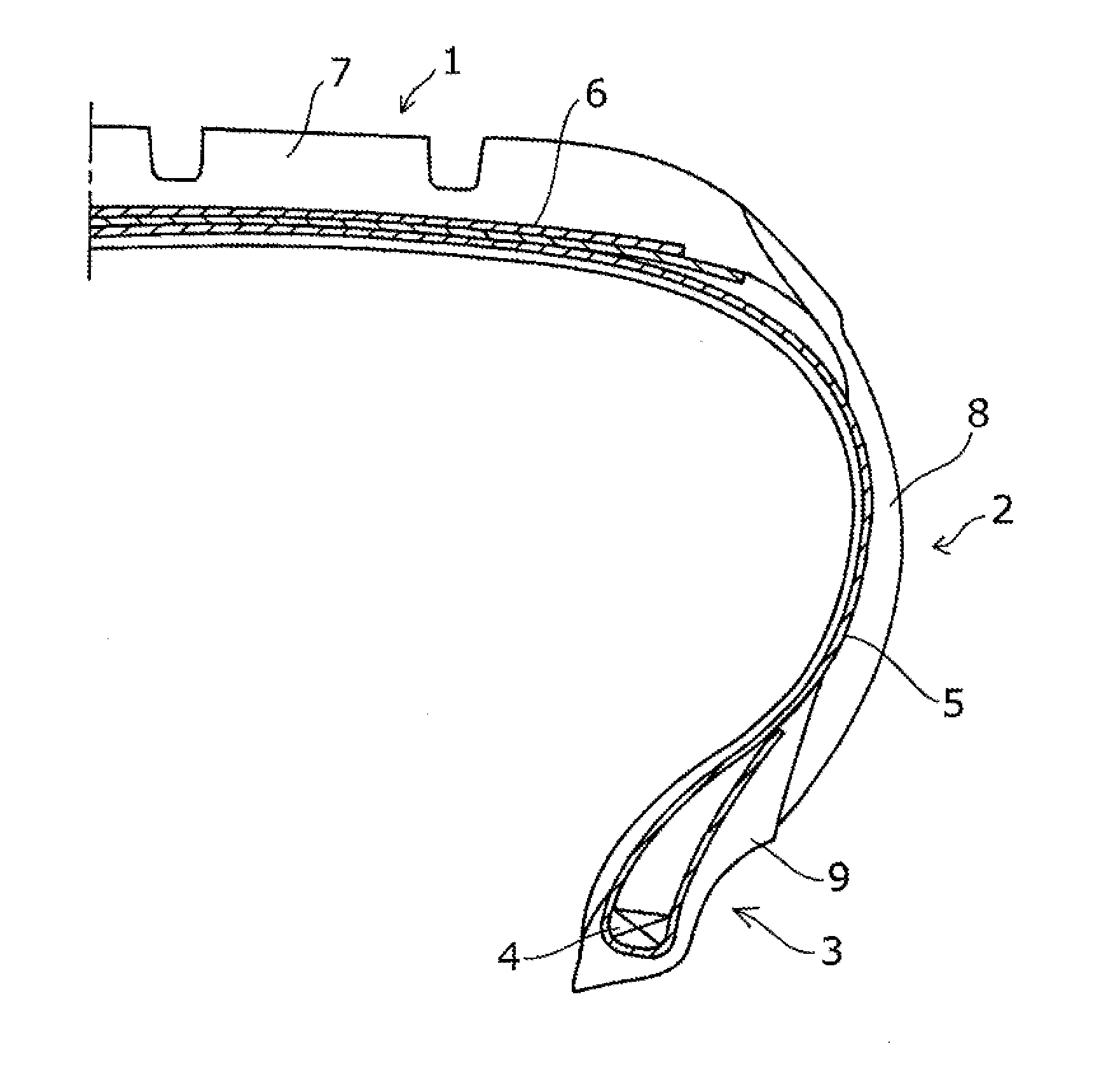
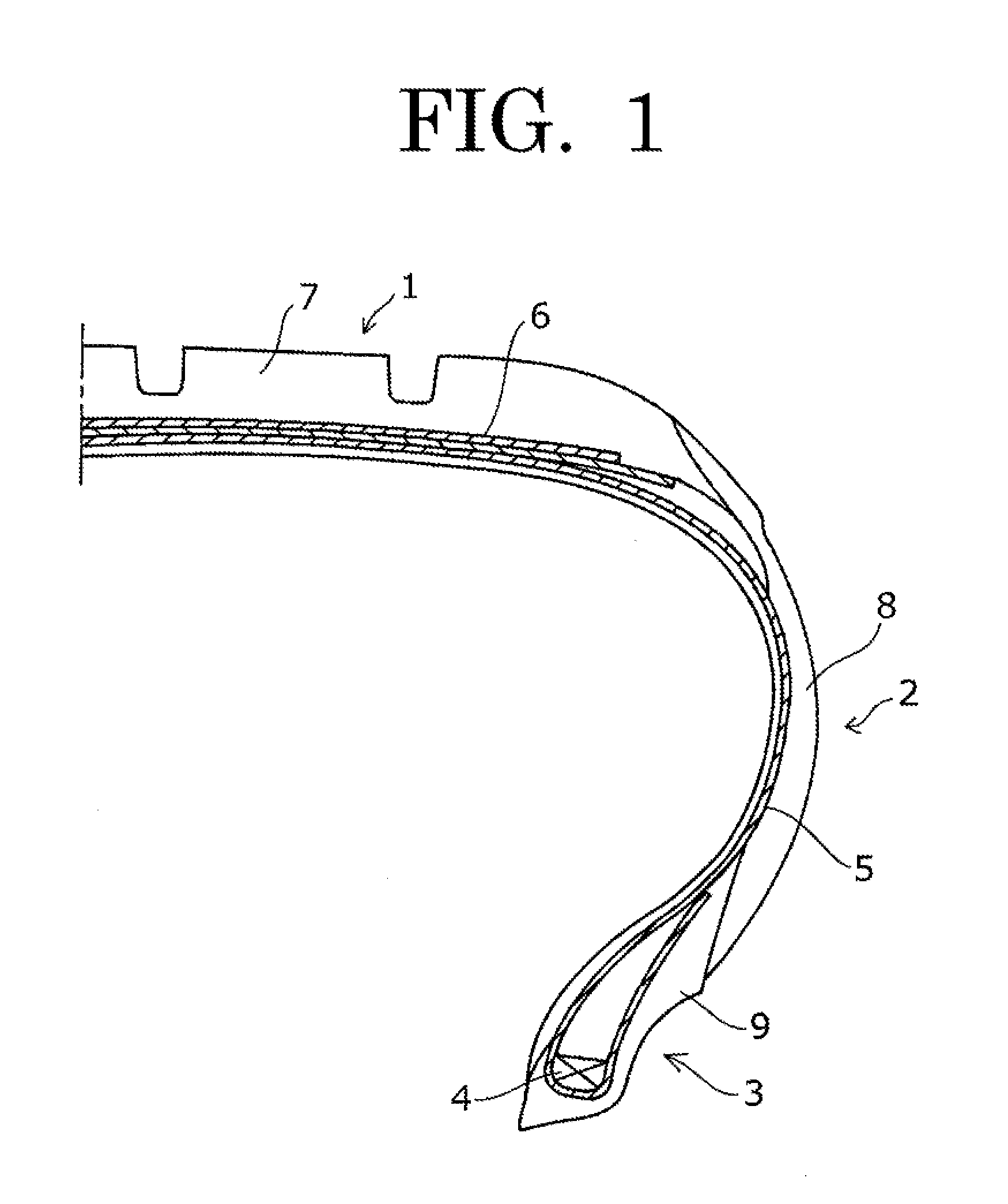
CROSS-REFERENCE TO RELATED APPLICATIONS[0001]This application is based upon and claims the benefit of priority from the prior Japanese Patent Application Nos. 2015-147924, filed on Jul. 27, 2015 and 2016-98081, filed on May 16, 2016; the entire contents of all of which are incorporated herein by reference.BACKGROUND[0002]1. Technical Field[0003]The present invention relates to a rubber composition for a tire and a pneumatic tire using the rubber composition[0004]2. Related Art[0005]A rubber composition forming a tread rubber, side wall rubber and rim strip of a pneumatic tire contains a wax in order to suppress deterioration by ozone and ultraviolet rays in the air. Wax has a deterioration suppressing effect such as ozone resistance, and on the other hand, whitens a rubber surface by blooming on the rubber surface, becoming a factor of poor appearance of a tire. For this reason, the rubber composition is required to suppress whitening while maintaining ozone resistance.[0006]To supp...
Claims
the structure of the environmentally friendly knitted fabric provided by the present invention; figure 2 Flow chart of the yarn wrapping machine for environmentally friendly knitted fabrics and storage devices; image 3 Is the parameter map of the yarn covering machine
Login to View More
Application Information
Patent Timeline
Application Date:The date an application was filed.
Publication Date:The date a patent or application was officially published.
First Publication Date:The earliest publication date of a patent with the same application number.
Issue Date:Publication date of the patent grant document.
PCT Entry Date:The Entry date of PCT National Phase.
Estimated Expiry Date:The statutory expiry date of a patent right according to the Patent Law, and it is the longest term of protection that the patent right can achieve without the termination of the patent right due to other reasons(Term extension factor has been taken into account ).
Invalid Date:Actual expiry date is based on effective date or publication date of legal transaction data of invalid patent.


 Login to View More