
Monitoring shelves with pressure and light sensors
a technology of applied in the field of monitoring shelves with pressure and light sensors, can solve the problems of non-uniform compliance among retailers and significant compliance gaps, and achieve the effect of increasing future sales
- Summary
- Abstract
- Description
- Claims
- Application Information
AI Technical Summary
Benefits of technology
Problems solved by technology
Method used
Image

Examples
first embodiment
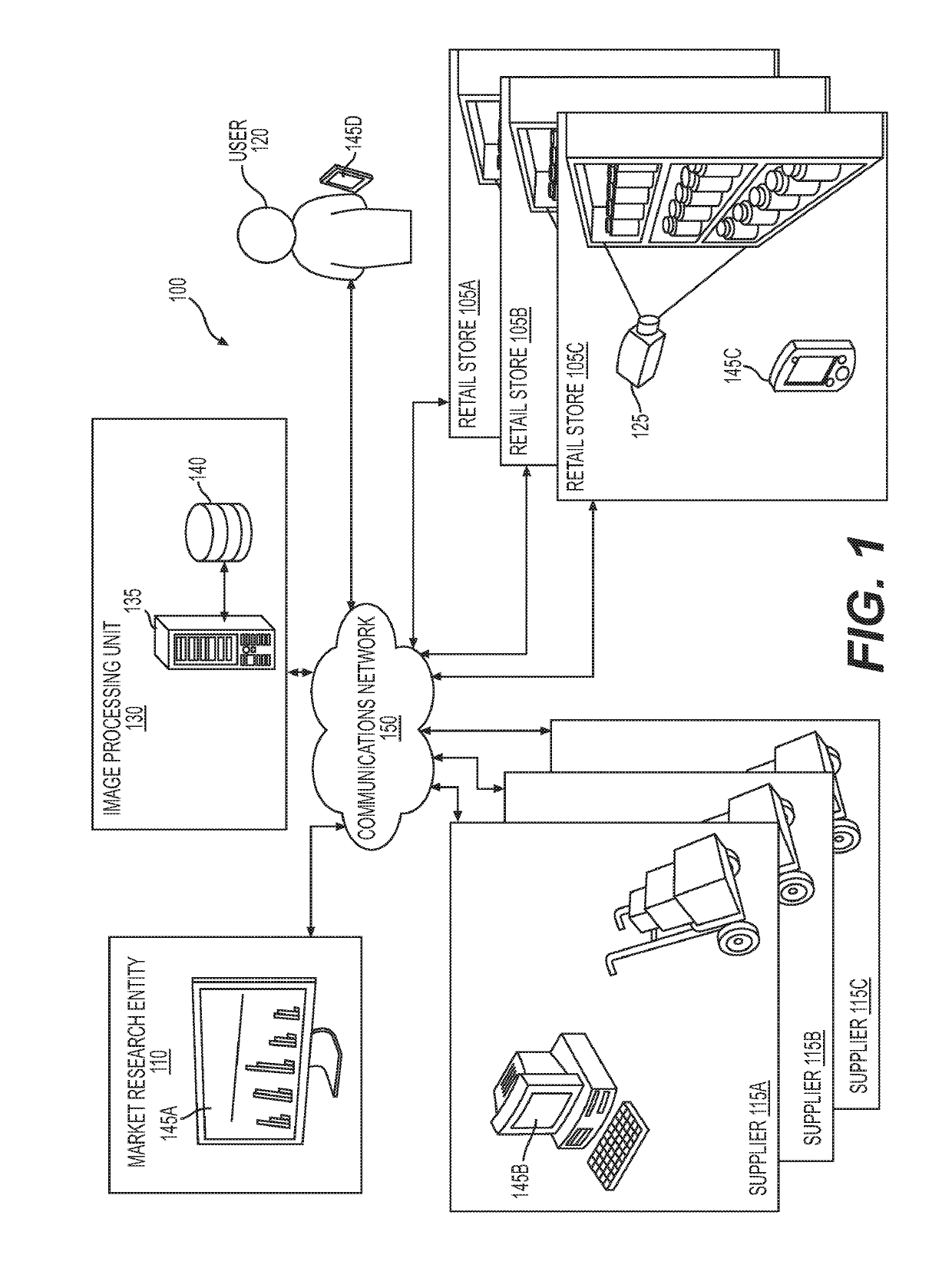
[0147]With reference to FIG. 4B and consistent with the present disclosure, server 135 may receive image data captured by users 120. In a first embodiment, server 135 may receive image data acquired by store employees. In one implementation, a handheld device of a store employee (e.g., capturing device 125D) may display a real-time video stream captured by the image sensor of the handheld device. The real-time video stream may be augmented with markings identifying to the store employee an area-of-interest that needs manual capturing of images. One of the situations in which manual image capture may be desirable may occur where the area-of-interest is outside the fields of view of a plurality of cameras fixedly connected to store shelves in aisle 400. In other situations, manual capturing of images of an area-of-interest may be desirable when a current set of acquired images is out of date (e.g., obsolete in at least one respect) or of poor quality (e.g., lacking focus, obstacles, l...
second embodiment
[0148]In a second embodiment, server 135 may receive image data acquired by crowd sourcing. In one exemplary implementation, server 135 may provide a request to a detected mobile device for an updated image of the area-of-interest in aisle 400. The request may include an incentive (e.g., $2 discount) to user 120 for acquiring the image. In response to the request, user 120 may acquire and transmit an up-to-date image of the area-of-interest. After receiving the image from user 120, server 135 may transmit the accepted incentive or agreed upon reward to user 120. The incentive may comprise a text notification and a redeemable coupon. In some embodiments, the incentive may include a redeemable coupon for a product associated with the area-of-interest. Server 135 may generate image-related data based on aggregation of data from images received from crowd sourcing and from images received from a plurality of cameras fixedly connected to store shelves. Additional details of this embodime...
PUM
 Login to View More
 Abstract
Description
Claims
Application Information
 Login to View More