
Video encoding and decoding acceleration utilizing imu sensor data for cloud virtual reality
a technology of imu sensor and virtual reality, applied in the field of video encoding and decoding acceleration utilizing imu sensor data for cloud virtual reality, can solve the problems of mass user access, video compression requires processing time, and the total cost of ownership of popularizing vr amongst mass users, so as to achieve faster video encoding, and improve video quality and compression rate
- Summary
- Abstract
- Description
- Claims
- Application Information
AI Technical Summary
Benefits of technology
Problems solved by technology
Method used
Image

Examples
Embodiment Construction
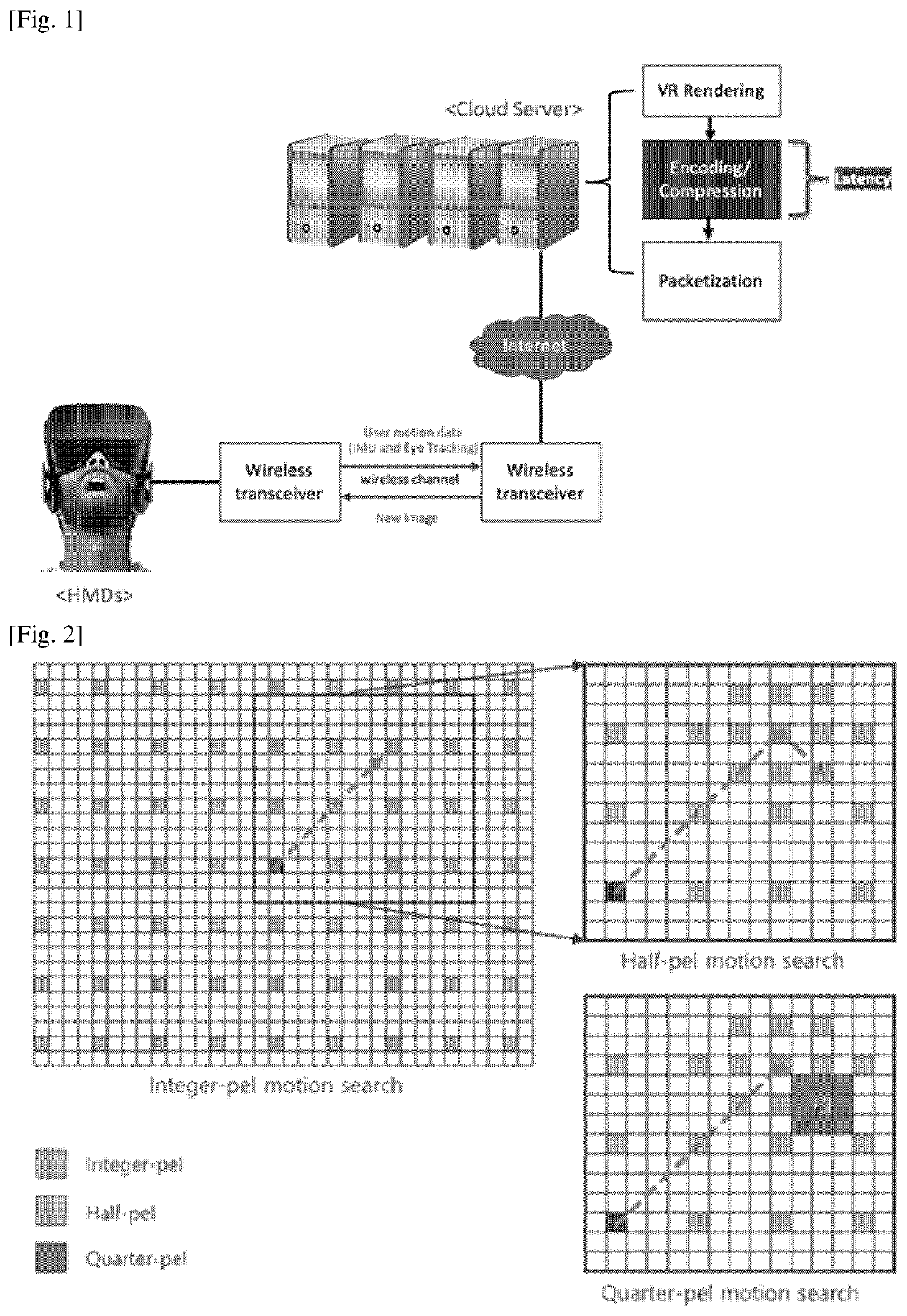
[0058]Application of cloud gaming to Virtual Reality (VR) system (Cloud VR) enables the users to experience and enjoy VR content without owning a high-end PC. Cloud VR which utilize hi-spec computer as a server to generate and stream VR content to thin clients is one of promising solution for widespread adoption of VR. FIG. 1 shows Cloud VR System Architecture.
[0059]However, there are some limitations and weaknesses of this cloud VR solution. Since it is client / server-based system, there must be some added latency for content processing and transferring. The latency in VR system (motion-to-photon latency) should be less than 20 ms to make a great VR experience and reduce user's nausea. Therefore, in the cloud VR, real-time computer graphic (CG) rendering and the encoding (compression) of rendered image should be processed within the extremely short period to minimize the overall motion-to-photon latency.
[0060]Video Encoding and Compression
[0061]Typical motion estimation (ME) compris...
PUM
 Login to View More
 Abstract
Description
Claims
Application Information
 Login to View More