

Identification model learning device, identification device, identification model learning method, identification method, and program
a learning device and identification model technology, applied in the field of identification model learning devices, can solve the problems of reducing data amount, affecting the accuracy of learning data collection, and incurring considerable financial and time costs, and achieve the effect of improving the identification model
- Summary
- Abstract
- Description
- Claims
- Application Information
AI Technical Summary
Benefits of technology
Problems solved by technology
Method used
Image



Examples
example 1
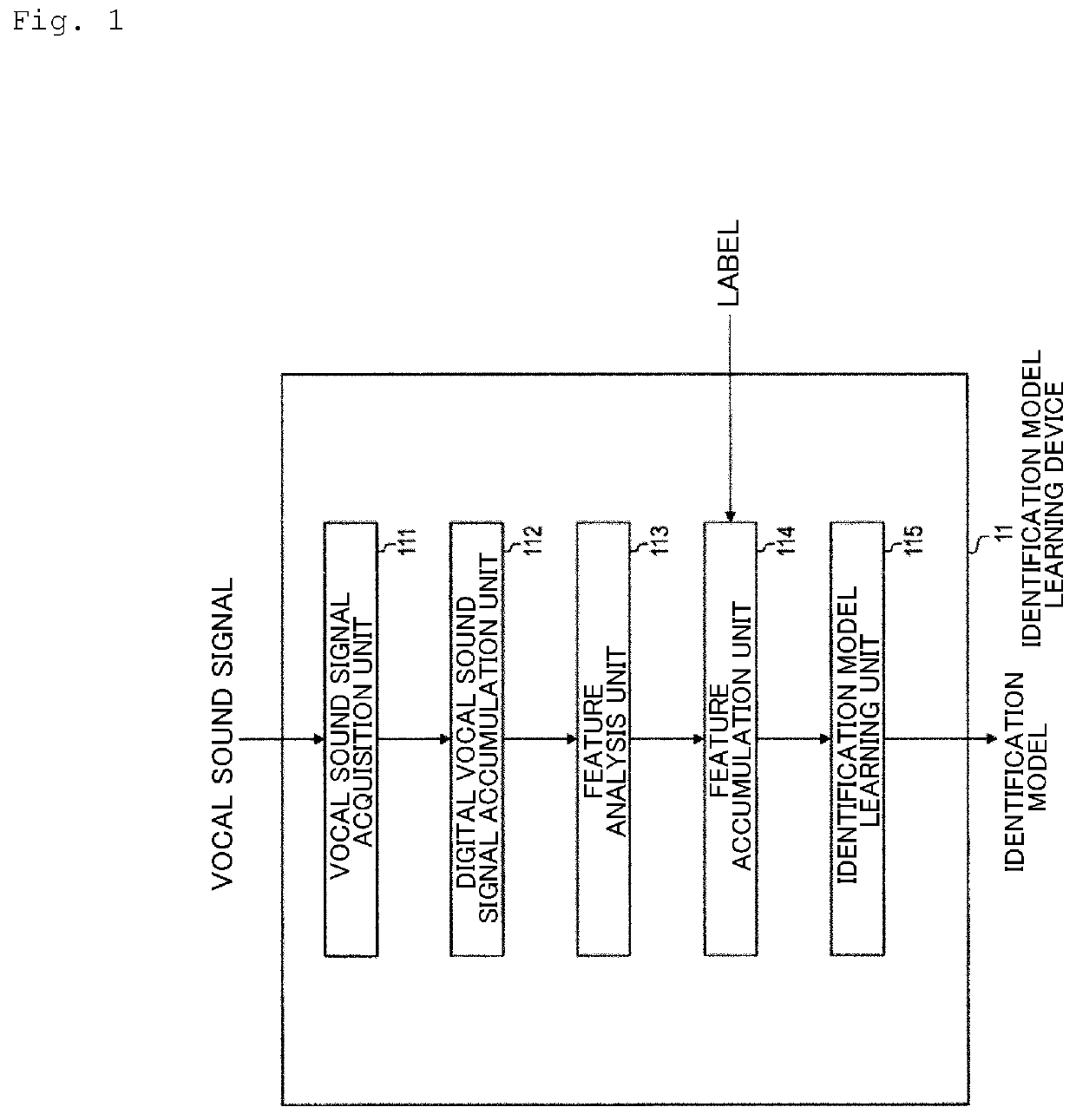
[0026]In Example 1, a vocal sound is assumed to be input in a speech unit in advance. Identification of the input speech is realized directly using time-series features extracted in a frame unit of the input speech, without outputting a posterior probability in each frame unit. Specifically, optimized identification is realized directly in a speech unit by inserting a layer (for example, a global max-pooling layer or the like) for integrating matrixes (or vectors) of intermediate layers output for each frame in a model such as a neural network.
[0027]As described above, it is possible to realize a statistical model for output and optimization in a speech unit rather than a statistical model for output and optimization in a vocal sound frame unit. With such a model structure, identification can be performed independently of the length or the like of a non-speech section.
[0028][Identification Model Learning Device]
[0029]Hereinafter, a configuration of an identification model learning d...
example 2
[0048]In Example 2, a situation in which learning data of a particular speech vocal sound has not an amount sufficient to learn an identification model will be assumed. In Example 2, non-particular speech vocal sounds which can be obtained easily and in bulk are all used and an identification model is learned setting the non-particular speech vocal sounds as an imbalance data condition. In general, when a class classification model is learned under the imbalance data condition and the same learning method as that of a balance data condition is applied, a model identified with a major class (a class with a large learning data amount and a non-particular speech herein) may be learned although any speech vocal sound is input. Accordingly, a learning method (for example, Reference NPL 1) in which learning can be performed correctly even under the imbalance data condition is considered to be applied.[0049](Reference NPL 1: “A systematic study of the class imbalance problem in convolution...
example 3
[0070]Examples 1 and 2 can be combined. That is, the structure of the identification model that outputs the identification result in the speech unit using the integration layer may be adopted as in Example 1. Further, the learning data may be sampled and the imbalance data learning may be performed as in Example 2. Hereinafter, a configuration of an identification model learning device according to Example 3 which is a combination Examples 1 and 2 will be described with reference to FIG. 11. As illustrated in the drawing, an identification model learning device 31 according to this example includes the vocal sound signal acquisition unit 111, the digital vocal sound signal accumulation unit 112, the feature analysis unit 113, the feature accumulation unit 114, the learning data sampling unit 215, and an imbalance data learning unit 316. The configurations other than the imbalance data learning unit 316 are common to those of Example 2. Hereinafter, an operation of the imbalance data...
PUM
 Login to View More
 Abstract
Description
Claims
Application Information
 Login to View More