Ultrasound transducer temperature compensation methods, apparatus and programs

US6314380B1Inactive Publication Date: 2001-11-06ROBERT BOSCH CORP
3 Cites 44 Cited by

Patent Information

Authority / Receiving Office
US · United States
Current Assignee / Owner
Publication Date
2001-11-06
Estimated Expiration
Not applicable · inactive patent

Smart Images

  • Figure 1
    Figure 1
  • Figure 2
    Figure 2
  • Figure 3
    Figure 3
Patent Text Reader

Abstract

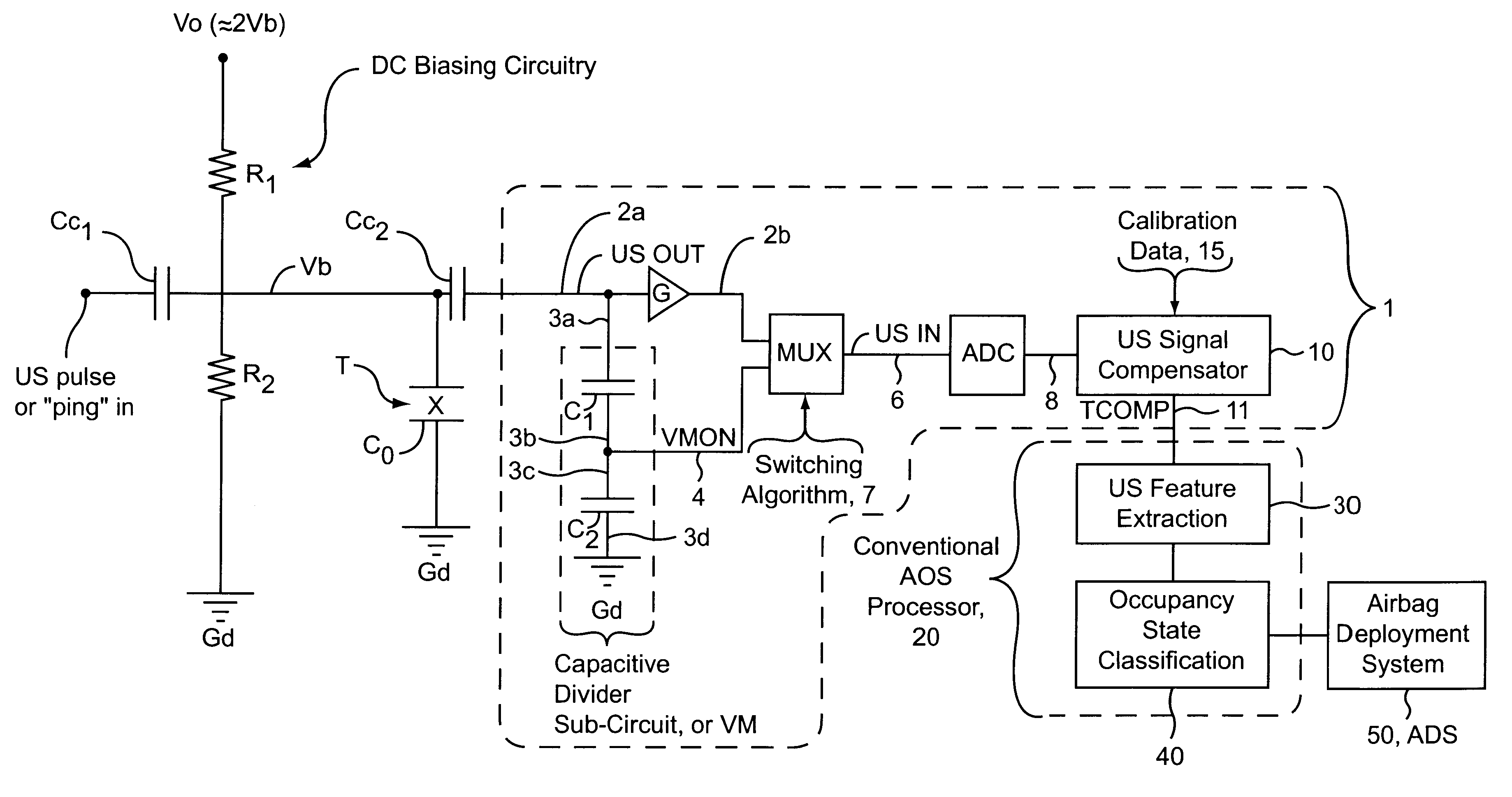
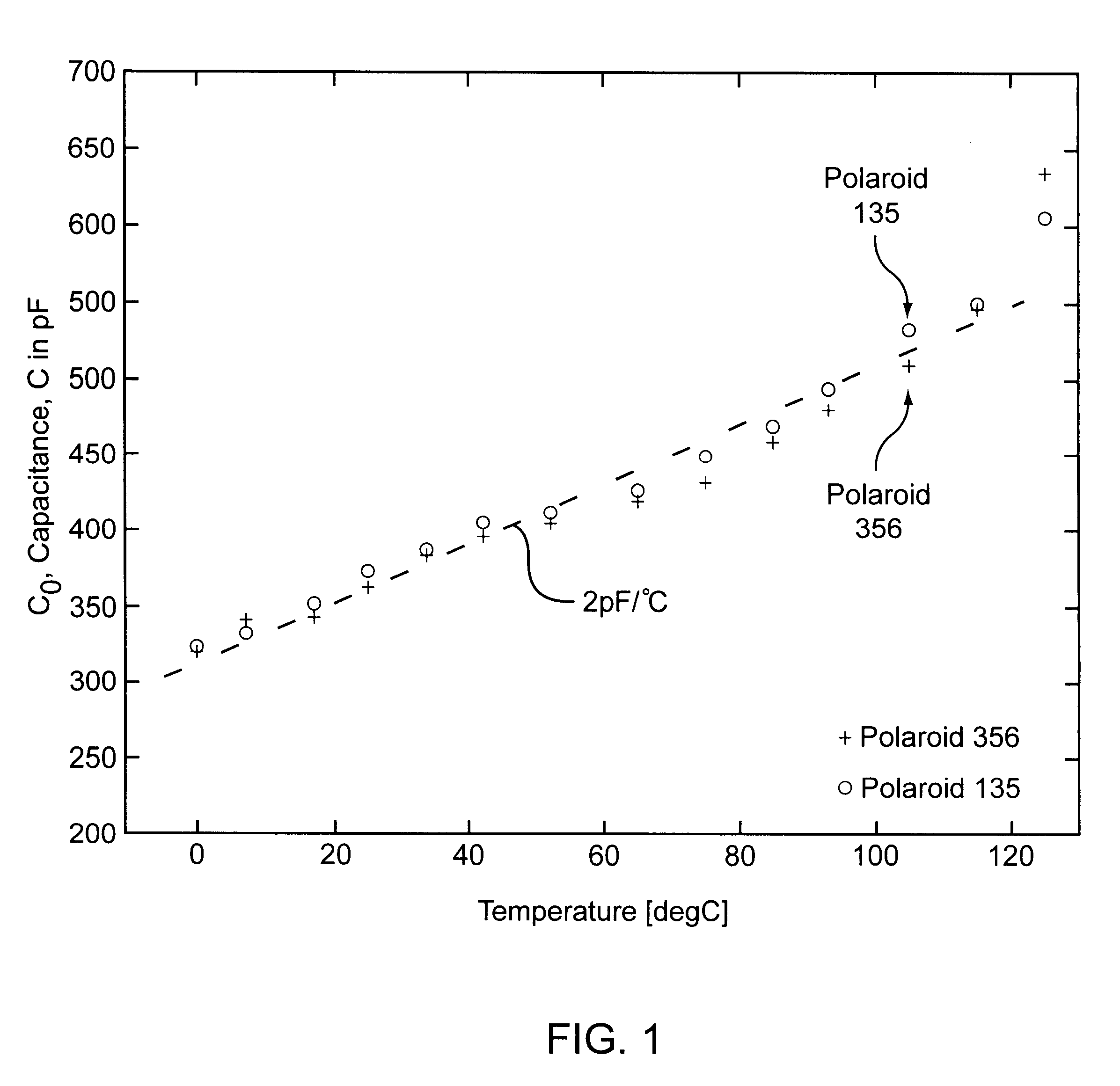
Method, apparatus and computer programs are described for compensating for the effect of temperature on the sensitivity of electrostatic ultrasound (US) transducers, particularly as used in an automotive occupancy sensing (AOS) systems for sensing the nature or type of occupant and the location of the occupant with respect to the vehicle interior. The invention permits the AOS to classify the occupancy state of the vehicle from a US echo signal substantially free of the effects of temperature on signal amplitude. A capacitive divider or voltage monitor is employed to measure the capacitance of the transducer. The voltage monitor output is used by the scaling algorithm of a compensator to determine the scaling factor to be applied to the US transducer signal to compensate for the effect of temperature on the transducer sensitivity. Calibration procedures and software are disclosed for determining the coefficients of the scaling algorithm to compensate for temperature effects and also to compensate for installation factors, transducer manufacturing variations, and circuit board effects. The system disclosed is useful for other types of signal processing in addition to temperature compensation of AOS ultrasonic signals, and may be used in other ranging devices such as cameras, golf or binocular range finders, and measuring devices and instruments.
Need to check novelty before this filing date? Find Prior Art

Description

The invention relates to ultrasound (US) transducer temperature compensation methods, apparatus and programs, and more particularly to US transducers used in automotive occupancy sensing (AOS) systems for sensing the nature or type of occupant and the location of the occupant with respect to the vehicle interior. The system disclosed is useful for other types of signal processing in addition to temperature compensation of AOS ultrasound signals, and may be used in other ranging devices such as cameras, golf or binocular range finders, and measuring devices and instruments.Studies have revealed that there is a class of automotive accidents causing injuries associated with airbag deployment and with the nature and position of the vehicle occupant, particularly with respect to airbags deployed adjacent to seats occupied by children or infants in car seats. Automotive occupancy sensor (AOS) systems used in conjunction with airbag deployment systems (ADS) have been developed to regulate ...

Examples

Embodiment Construction

The following detailed description illustrates the invention by way of example, not by way of limitation of the principles of the invention. This description will clearly enable one skilled in the art to make and use the invention, and describes several embodiments, adaptations, variations, alternatives and uses of the invention, including what is presently believed to be the best mode of carrying out the invention.

In this regard, the invention is illustrated in the several figures, and is of sufficient complexity that the many parts, interrelationships, and sub-combinations thereof simply cannot be fully illustrated in a single patent-type drawing. For clarity and conciseness, several of the drawings show in schematic, or omit, parts that are not essential in that drawing to a description of a particular feature, aspect or principle of the invention being disclosed. Thus, the best mode embodiment of one feature may be shown in one drawing, and the best mode of another feature will ...