
Polycyclic aryl and heteroaryl substituted benzenes useful for selective inhibition of the coagulation cascade
a technology of benzene and polycyclic aryl, which is applied in the direction of phosphorous compound active ingredients, drug compositions, extracellular fluid disorders, etc., can solve the problems of ischemic necrosis of the tissue supplied by the artery, myocardial infarction or heart attack, tissue drained by the vein to become edematous and inflamed, and achieve the effect of preventing thrombosis and treating thrombosis
- Summary
- Abstract
- Description
- Claims
- Application Information
AI Technical Summary
Benefits of technology
Problems solved by technology
Method used
Image

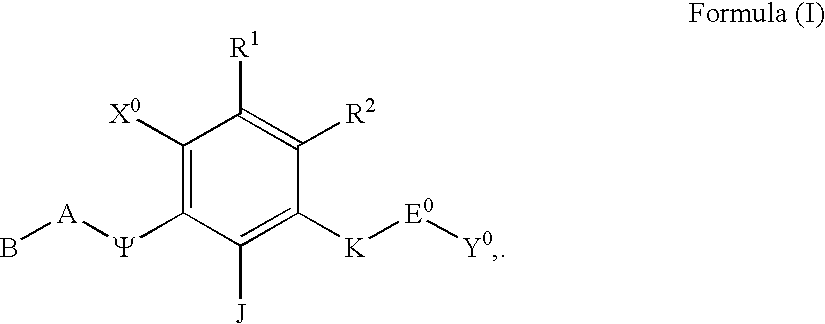
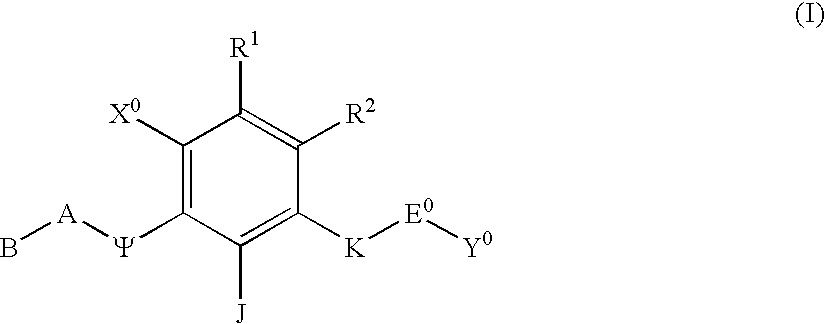
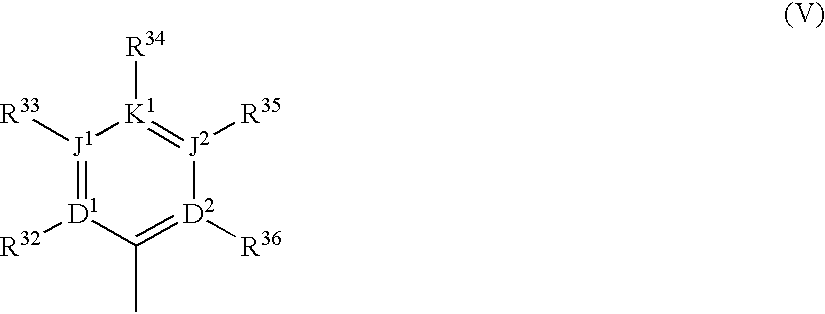
Examples
example 1
Triethylamine (8.3 mL, 0.060 mol) was added to a solution of 2-fluoro-5-nitrobenzoic acid (5.0 g, 0.027 mol) and thiophenol (2.8 mL, 0.027 mol) in tetrahydrofuran. After stirring at reflux for 20 hours, a saturated solution of ammonium chloride was added until solution became neutral. The solution was extracted with dichloromethane and the organic layer was washed with water, brine, dried over magnesium sulfate, and filtered. The solvent was removed by evaporation to afford 8.85 g (87%) of a yellow solid of product EX-1A; 1H NMR ppm: 1.40 (t, 9H), 3.21 (q, 6H), 6.75 (d, 1H, J=8.7 Hz), 7.47 (m, 3H), 7.57 (m, 2H), 7.85 (d, 1H, J=8.7 Hz), 8.85 (d, 1H, J=2.4 Hz).
Oxalyl chloride (7.7 mL, 0.088 mol) was added to a solution of the acid EX-1A (6.68 g, 0.017 mol) in dichloromethane followed by a drop of dimethylformamide. After stirring at room temperature for 1 hour, the solvent was removed by evaporation to afford the acid chloride. The acid chloride was redissolved into dichloromethane an...
example 2
Using the procedure of Example 1, use of 4-dimethylaminobenzylamine afforded 30.0 mg (70%) of a white solid of product; 1H NMR ppm: 2.95 (s, 6H), 4.35 (s, 2H), 4.44 (d, 2H), 6.70 (d, 2H), 7.23 (m, 16H), 7.62 (s, 1H); HPLC purity (retention time): >99% (3.15 min); HRMS calcd for C29H29O3N3S2 (M++H) 532.1729, found 532.1681.
example 3
Using the procedure of Example 1, use of 4-pyridymethylamine afforded 30.5 mg (62%) of a white solid of product; 1H NMR ppm: 4.35 (s, 2H), 4.55 (d, 2H), 7.13 (d, 2H), 7.26 (m, 13H), 7.66 (s, 2H), 8.39 (d, 2H); HPLC purity (retention time): >99% (3.00 min); HRMS calcd for C26H23O3N3S2 (M++H) 490.1259, found 490.1222.
PUM
| Property | Measurement | Unit |
|---|---|---|
| fluidity | aaaaa | aaaaa |
| aggregation | aaaaa | aaaaa |
| general structure | aaaaa | aaaaa |
Abstract
Description
Claims
Application Information
 Login to View More