Execution of fixed point instructions using a decimal floating point unit

a floating point unit and fixed point technology, applied in the field of computer systems, can solve problems such as adversely affecting performan

US8572141B2Inactive Publication Date: 2013-10-29INT BUSINESS MASCH CORP
13 Cites 4 Cited by

Patent Information

Authority / Receiving Office
US · United States
Patent Type
Patents(United States)
Current Assignee / Owner
Publication Date
2013-10-29
Estimated Expiration
Not applicable · inactive patent

Smart Images

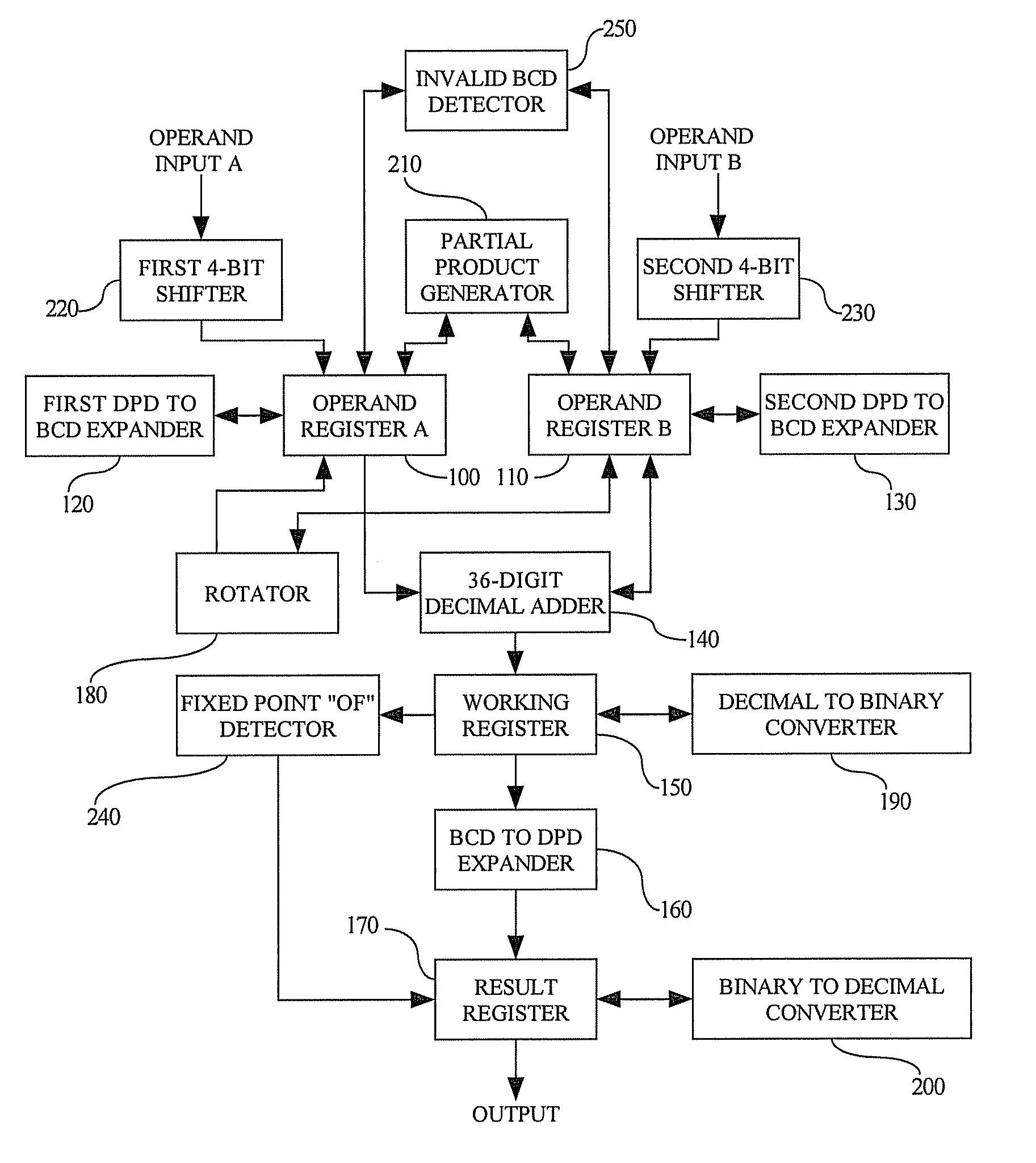
  • Figure 1
    Figure 1
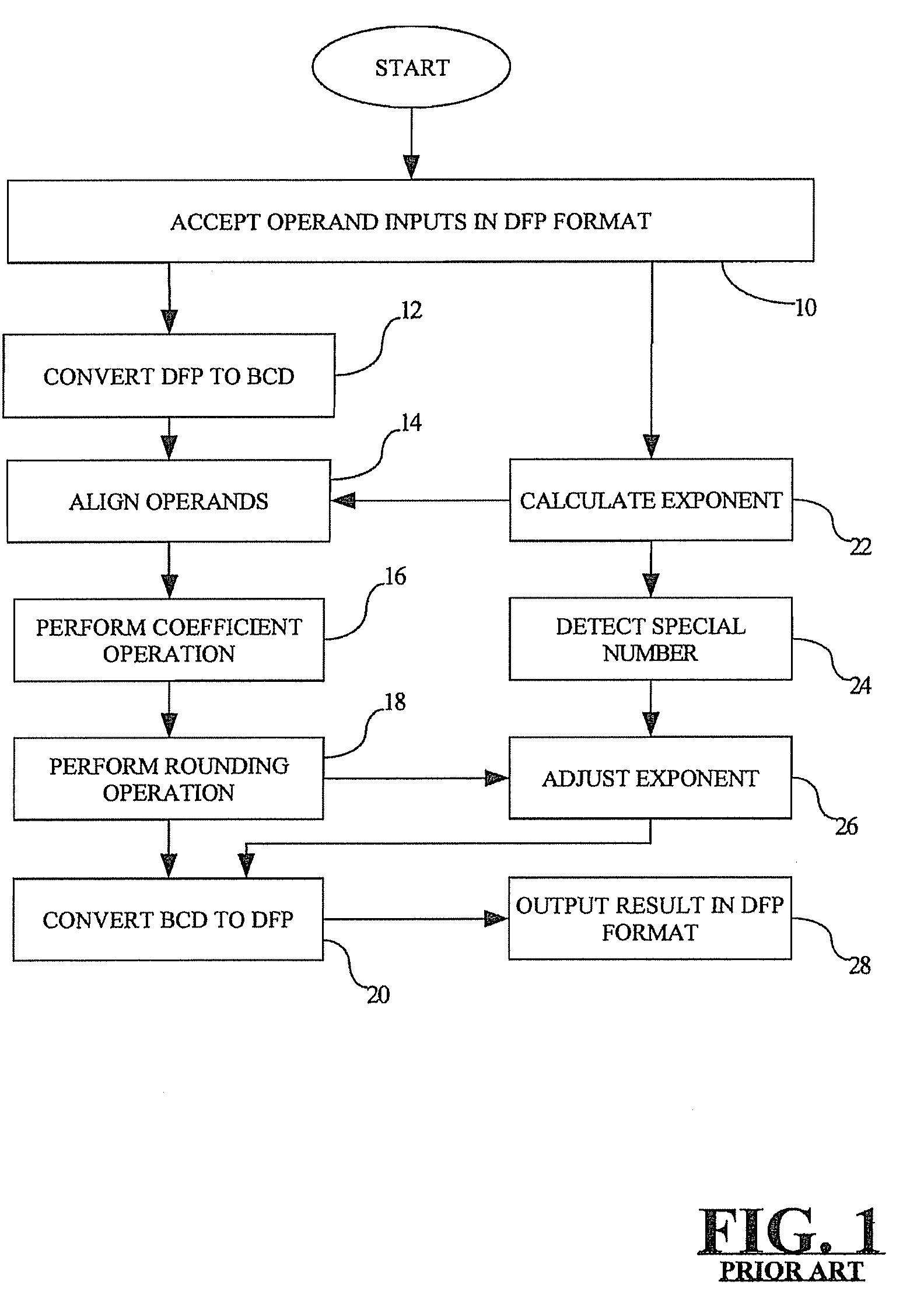
  • Figure 2
    Figure 2
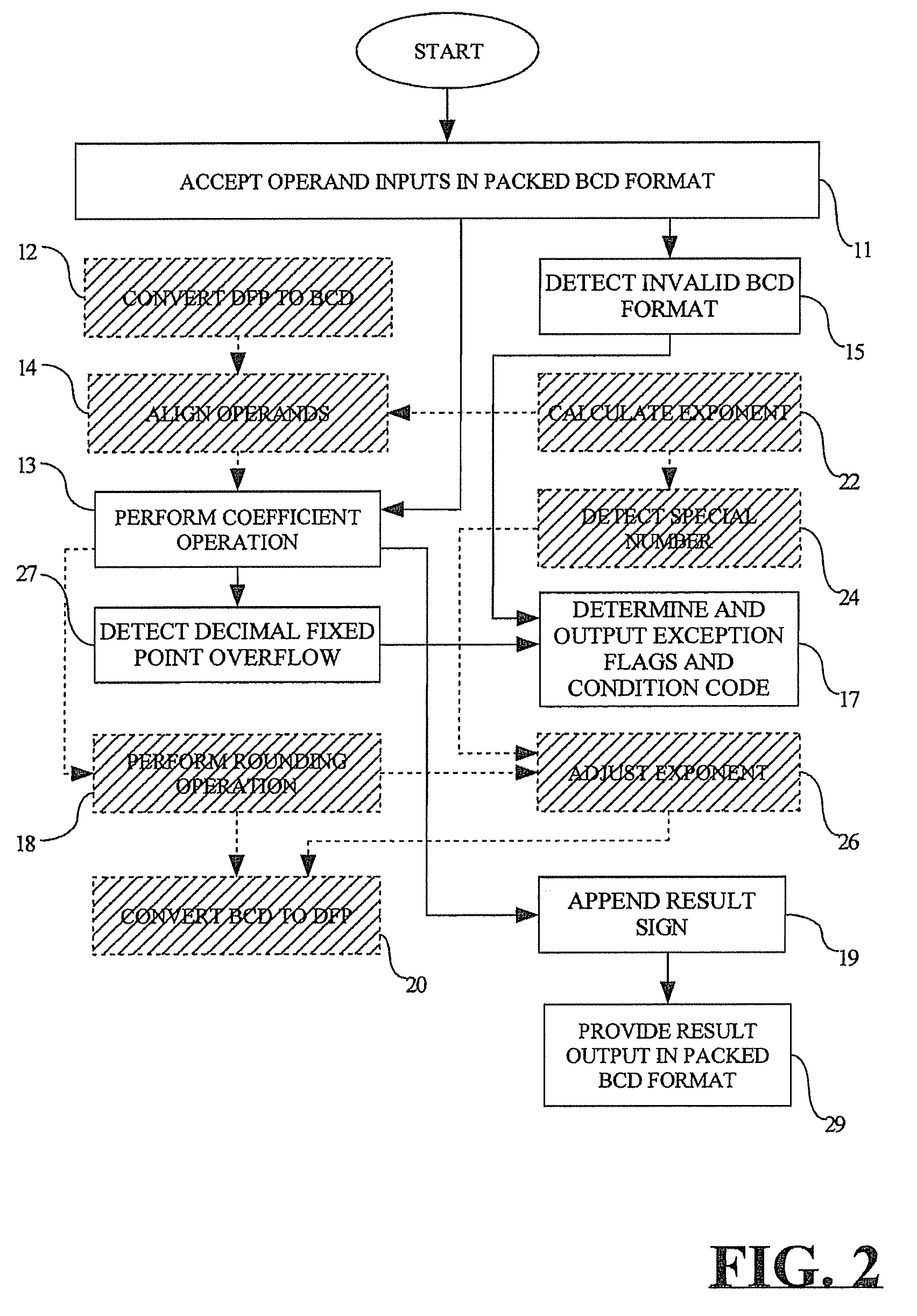
  • Figure 3
    Figure 3
Patent Text Reader

Abstract

A decimal floating point (DFP) unit is used to execute fixed point instructions. Two or more operands are accepted, wherein each operand is in a packed binary coded decimal (BCD) format. Any invalid BCD formats are detected by checking the operands for any invalid BCD codes. It is determined if an exception flag exists and, if so, outputting the flag; it is determined if a condition code exists and, if so, outputting the code. An operation is performed on the two or more operands to generate a result; wherein the operation takes place directly on BCD data, thus using the DFP unit to perform a BCD operation; appending a result sign to the result of the operation; and providing the result of the operation and the appended result sign as a result output in a packed BCD format.
Need to check novelty before this filing date? Find Prior Art

Description

BACKGROUND OF THE INVENTION

[0001] This invention relates to computer systems and, in particular, to processors that execute decimal arithmetic.

[0002] Decimal floating-point operations are becoming increasingly important in commercial transactions, resulting in manufacturers adding hardware specifically designed to execute these operations. Decimal fixed-point operations are equally important and are typically executed in a fixed-point unit of a processor. Additional hardware is usually required in the fixed-point unit to facilitate the execution of these decimal fixed-point instructions. This is important real estate (i.e., occupied space) in a processor with the effect that, as area is added to the stack, there is a potential impact on cycle time. Furthermore, the fixed-point unit contains a 64-bit (or 16-digit) dataflow but the operands for these decimal operations can be up to 31 digits long plus a sign digit, resulting in 128-bit operations. Operations with operands longer then 16...

Examples

Embodiment Construction

[0012]FIG. 1 sets forth a prior art operational sequence for performing a typical decimal floating point operation. The operational sequence commences at block 10 where one or more operand inputs are accepted in decimal floating point (DFP) format. Next, at block 12, the operand inputs are converted from DFP to binary-coded decimal (BCD) using a DFP to BCD decoder. At block 22, the exponent part of the operand is sent to an exponent calculator which calculates a resulting exponent depending on the nature of an operation to be performed. More specifically, the resulting exponent may consist of the exponent of the smaller of the two operands, the exponent of the larger of the two operands, the difference between the exponents, the sum of the exponents, or several other possibilities. Note that blocks 12 and 22 may be performed in parallel or in any order.

[0013]At block 14, the operands are aligned using an operand alignment mechanism. The operand alignment mechanism utilizes informati...