Supercharge Your Innovation With Domain-Expert AI Agents!

Self-correcting complex event processing system and corresponding method for error correction

a complex event processing and error correction technology, applied in the field of complex event processing and cep, can solve the problems of incomplete or inaccurate data streams, inability to accurately adjust the error correction method, etc., to achieve the effect of flexible adaptation of error correction

Active Publication Date: 2017-07-04
SOFTWARE AG
View PDF18 Cites 4 Cited by
  • Summary
  • Abstract
  • Description
  • Claims
  • Application Information

AI Technical Summary

Problems solved by technology

Further, it is known that event processing has to deal with huge amounts of data which has to be processed, referred to as “big data”.
In other words, the input event streams carry inherent uncertainties, such as incomplete or inaccurate data streams.
For example, a temperature sensor continuously determining temperature readings may be damaged by certain circumstances, where this might result in wrong temperature readings and therefore in erroneous values.
In this context, those skilled in the art will appreciate that such handling of inherent uncertainties and / or erroneous or faulty data is a difficult task given the huge amount of data to be processed in a correct and efficient manner.
If the configuration comprises incorrect events and parameters, this might lead to catastrophic consequences.
For example, the aircraft may touch the ground too early, with high speed beyond the landing strip, thereby resulting in a plane crash in the worst case.
However, the first prior art solution has the disadvantage that the uncertainty has to be handled in the expressions which are commonly defined in event processing, particularly in the queries of the EPAs.
This elimination approach has the disadvantage of losing crucial information.
It is well reported that processing of specific and reduced subsets of data leads to a reduced accuracy and completeness of results.
However, both prior art approaches achieve the uncertainty handling in the EPAs themselves, since error correction and in particular the complex adaptations to expression / queries are defined in the EPAs.
Other approaches do not adapt the expressions in the EPAs at all.
The inherent uncertainties of event streams are irrespectively incorporated in event processing or derivation, resulting in uncertain derived events.
Since the whole set of input events, comprising correct as well as incorrect input events, are subject to processing, the EPAs cannot perform reliably and efficiently.
In other words, the developer of each event based application has to be aware of uncertainties and possible errors and has to consider these in his event stream processing programs / queries, which is a considerable burden and prohibits fast and slim event processing application development.
In addition, erroneous events could lead to system problems (e.g. a CEP system might cease operation if it encounters out-of-time-sequence events).
It is therefore the technical problem to provide an event-based correcting system which removes incorrect event data without losing crucial information and without complex adaptations to a given CEP system, but at the same time performing in an efficient and scalable manner, thereby at least partly overcoming the above explained disadvantages of the prior art.
Hence, the EPAs have to deal with uncertainty handling as well as processing of a huge amount of erroneous data.
Further, the erroneous event can be completely discarded whenever no correction is required or reasonable and is accordingly not maintained in event processing.

Method used

the structure of the environmentally friendly knitted fabric provided by the present invention; figure 2 Flow chart of the yarn wrapping machine for environmentally friendly knitted fabrics and storage devices; image 3 Is the parameter map of the yarn covering machine
View more

Image

Smart Image Click on the blue labels to locate them in the text.
Viewing Examples
Smart Image
  • Self-correcting complex event processing system and corresponding method for error correction
  • Self-correcting complex event processing system and corresponding method for error correction
  • Self-correcting complex event processing system and corresponding method for error correction

Examples

Experimental program
Comparison scheme
Effect test

Embodiment Construction

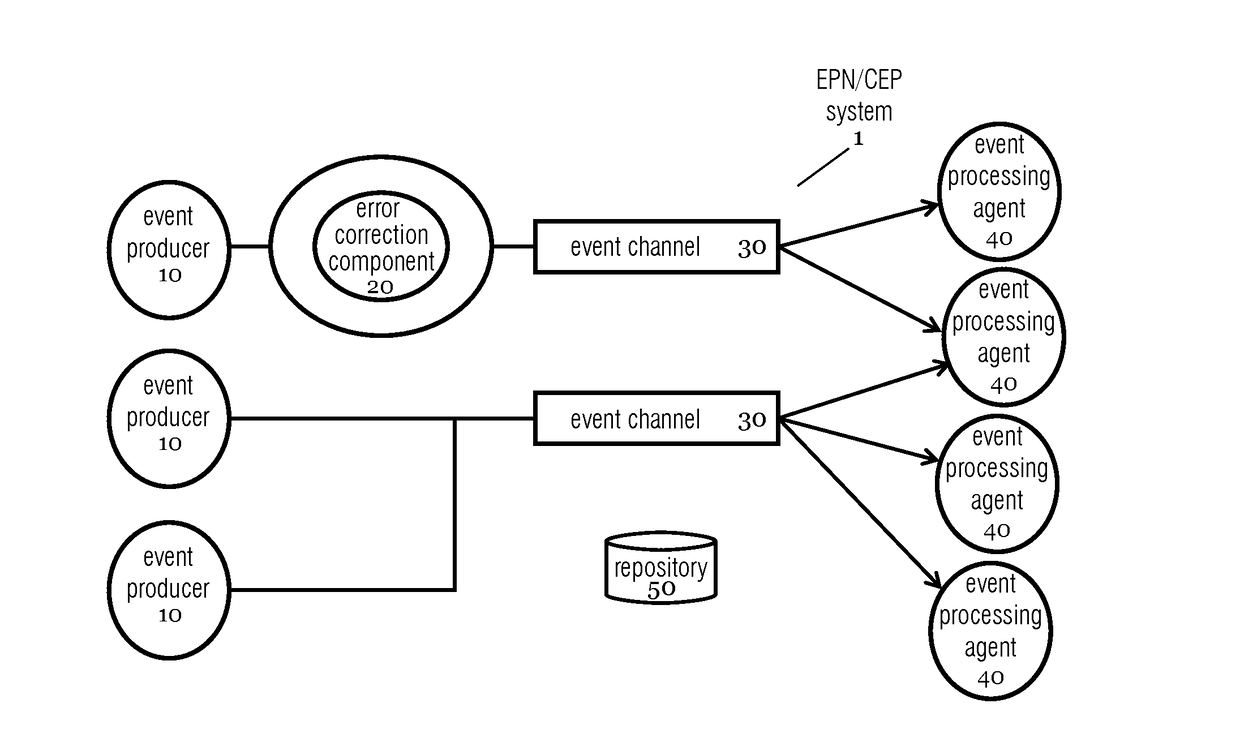
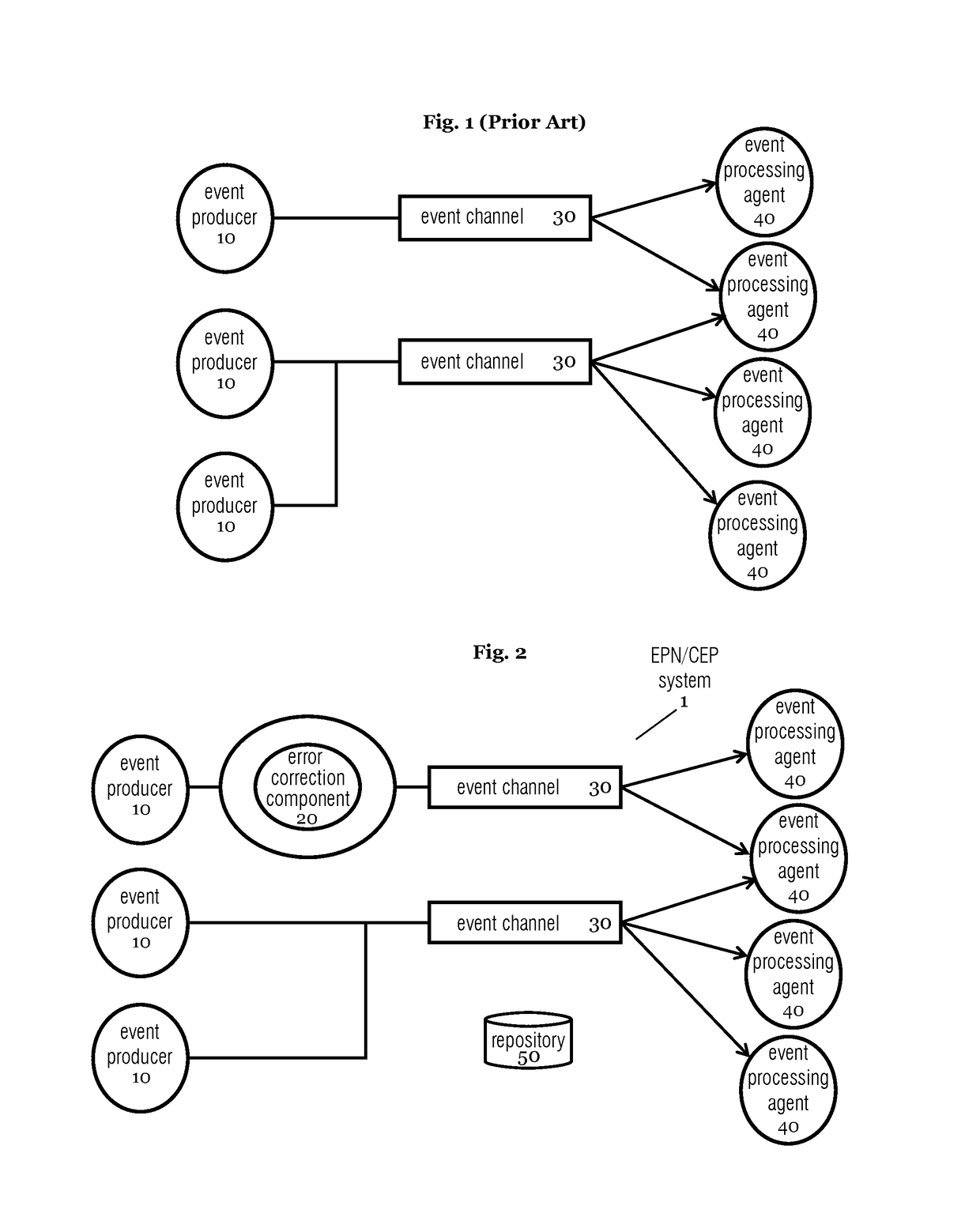
[0041]In the following, a presently preferred embodiment is described with respect to an error correction component as schematically shown in FIG. 2.

[0042]As can be seen in FIG. 2, the embodiment comprises an error correction component (ECC) 20 with an error correction mechanism (or self-correcting mechanism) in an EPN / CEP system 1. The error correction component 20 can be configured specifically for each event source 10 and / or input event stream, and is capable of correcting certain errors in the data streams such that event stream processing is error-free, scalable and efficient. Accordingly, CEP applications, in particular EPAs 40, do not have to bother with aspects of errors in “big data” and in the event-processing of the “big data”. The errors are equally referred to as uncertainties in the following.

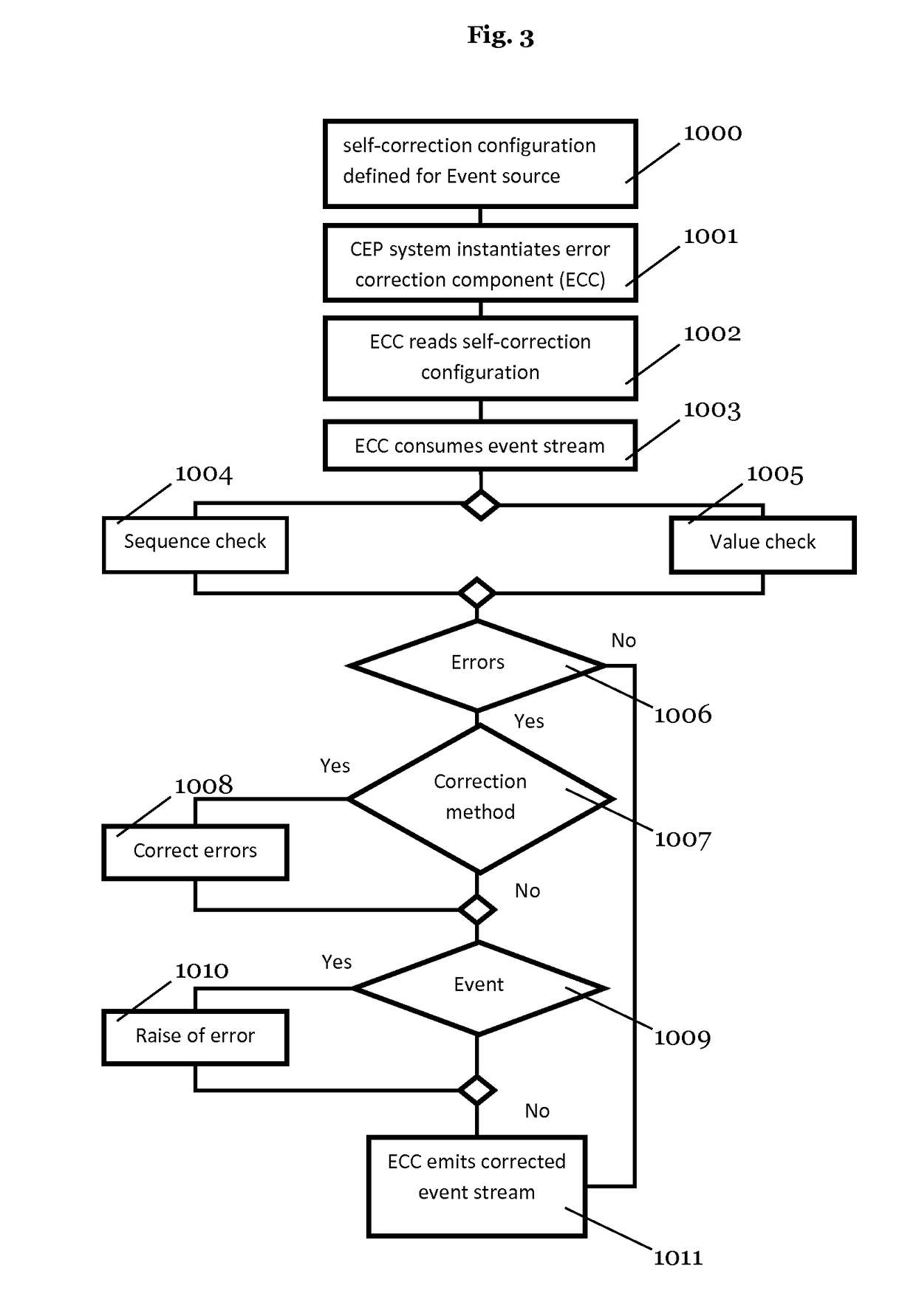
[0043]In one aspect, the configuration of error self-correction is achieved by specifying a configuration file for each event source 10. This configuration file comprises particul...

the structure of the environmentally friendly knitted fabric provided by the present invention; figure 2 Flow chart of the yarn wrapping machine for environmentally friendly knitted fabrics and storage devices; image 3 Is the parameter map of the yarn covering machine
Login to View More

PUM

No PUM Login to View More

Abstract

Certain example embodiments relate to a complex event processing, CEP, system, including an error correction component configured to receive a stream of events including at least one event from at least one event source. The error correction component is configured to detect at least one error in the at least one event. The error correction component is configured to emit a corrected stream of events including at least one event, which can then be processed by at least one event processing application.

Description

[0001]This application claims the benefit of European 13 190 497.1, filed Oct. 28, 2013, the entire content of which is hereby incorporated herein by reference.1. TECHNICAL FIELD[0002]Certain example embodiments relate generally to complex event processing, CEP, and more particularly to a self-correcting CEP system and to a corresponding method for error correction.2. BACKGROUND AND SUMMARY[0003]Complex computing systems are nowadays oftentimes implemented based on the so-called “event-driven architecture” (EDA), which is a software architecture pattern promoting the production, detection, consumption of and reaction to events. Such systems are also called “Event Processing Networks” (EPN) (cf. “Event Processing Network—A Conceptual Model” of Sharon et al., VLDB'07, Sep. 23-28, 2007, Vienna, Austria, and “Event Processing Under Uncertainty” of Artikis et al., DEBS'12, Jul. 16-20, 2012, Berlin, Germany). The EDA pattern may be applied in the implementation of applications and systems...

Claims

the structure of the environmentally friendly knitted fabric provided by the present invention; figure 2 Flow chart of the yarn wrapping machine for environmentally friendly knitted fabrics and storage devices; image 3 Is the parameter map of the yarn covering machine
Login to View More

Application Information

Patent Timeline
no application Login to View More
Patent Type & Authority Patents(United States)
IPC IPC(8): G06F11/10G06F11/07H04L12/24
CPCG06F11/10G06F11/0706G06F11/0793H04L41/0806
Inventor SCHONING, HARALD
Owner SOFTWARE AG
Features
  • R&D
  • Intellectual Property
  • Life Sciences
  • Materials
  • Tech Scout
Why Patsnap Eureka
  • Unparalleled Data Quality
  • Higher Quality Content
  • 60% Fewer Hallucinations
Social media
Patsnap Eureka Blog
Learn More