
Device and method for the non-invasive measurement of state of tension, biomechanical and viscoelastic properties of surfaces of soft biological tissues
a biomechanical and viscoelastic technology, applied in the field of medical diagnostic technologies, can solve the problems of excessive local stress generated by mechanical impulses, and achieve the effects of fast, reliable, and repeatable measurement results
- Summary
- Abstract
- Description
- Claims
- Application Information
AI Technical Summary
Benefits of technology
Problems solved by technology
Method used
Image

Examples
Embodiment Construction
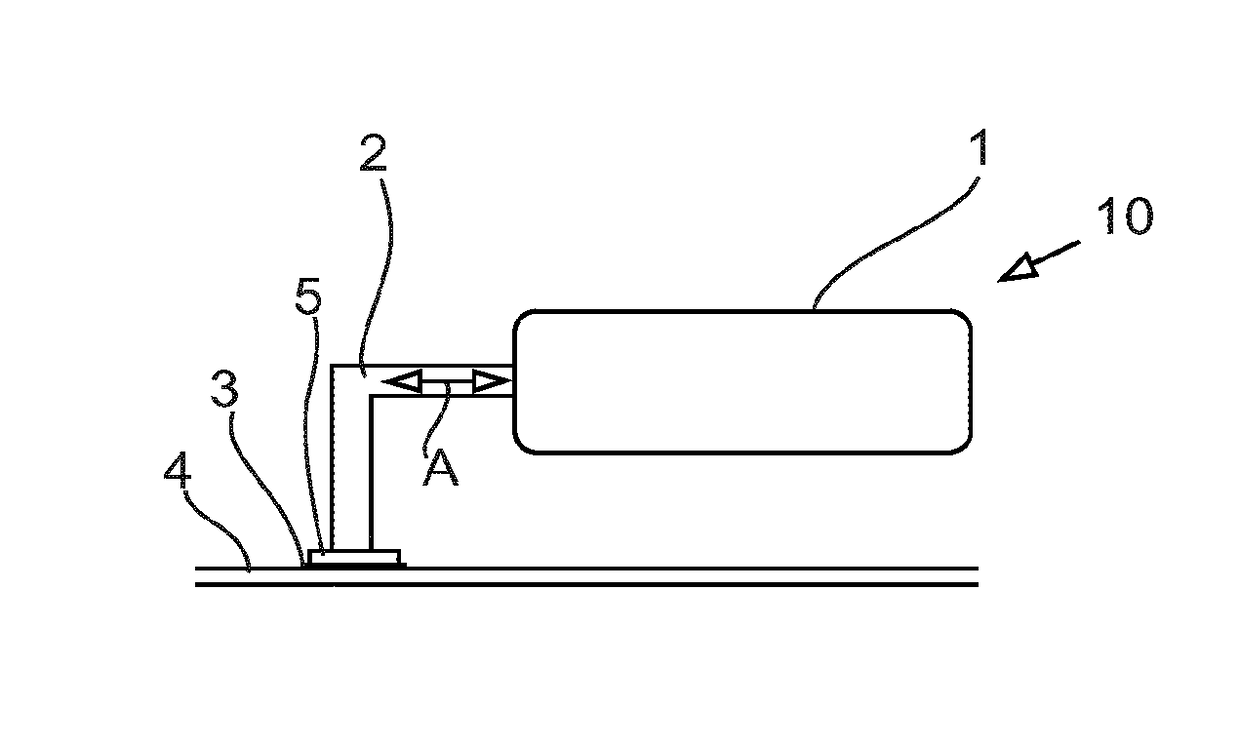
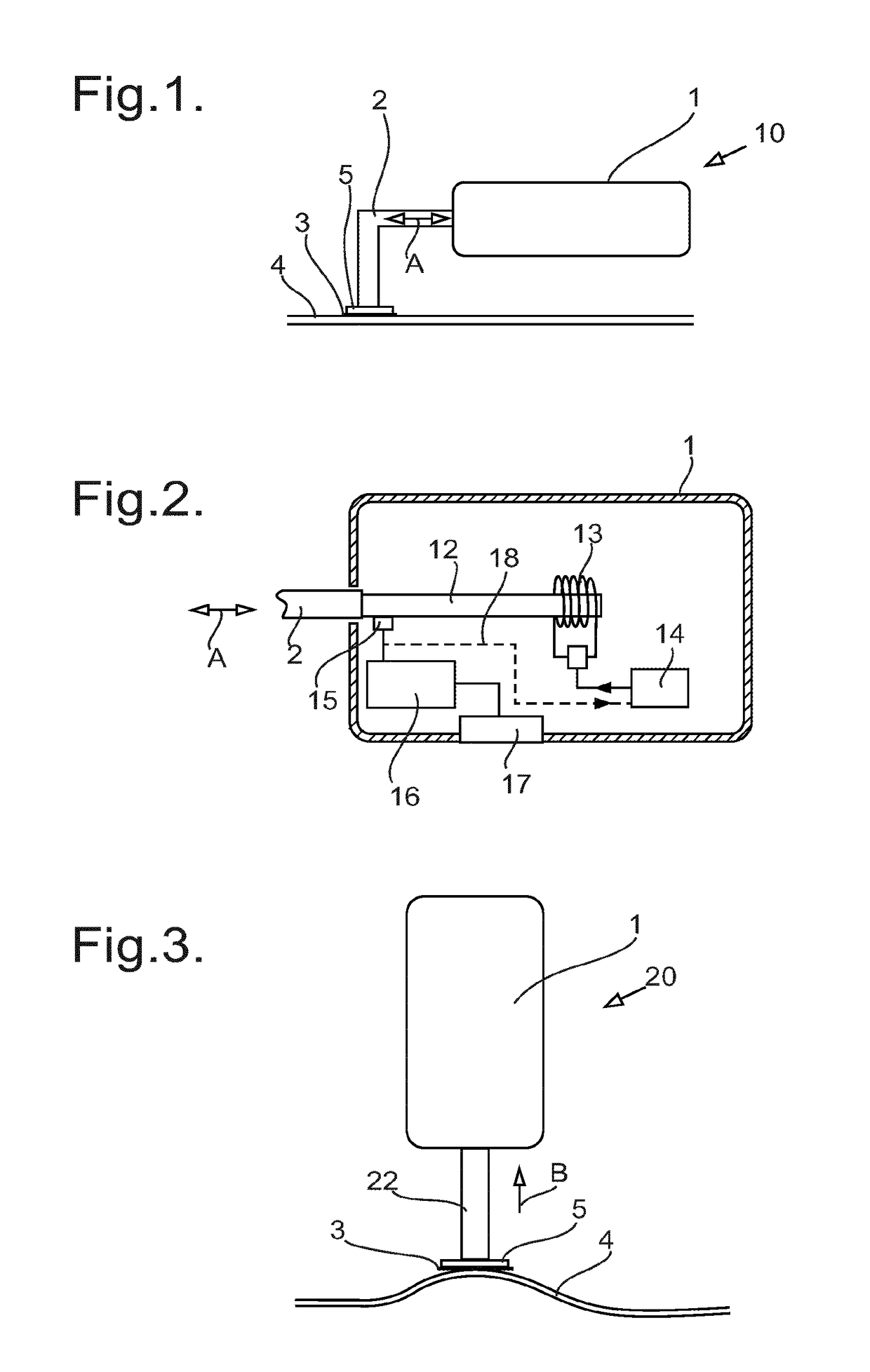
[0029]Referring to FIG. 1, a device 10 according to the present invention comprises an L-shaped testing end 2, a contact substance 3, and a body or housing 1 containing electronic, digital and mechanical elements and means, including sensors for governing the measuring process and for calculating parameters of a surface 4 of a soft biological tissue with elastic properties. The testing end 2 defines a contact surface 5 which is held parallel to the surface 4, and is also parallel to the direction of the mechanical impulse, indicated by the arrow A.
[0030]The contact substance 3 may be a double-sided adhesive tape, for example in the form of a circular patch, or alternatively may be a skin adhesive. If the contact substance 3 is a circular patch of double-sided adhesive tape, it may be of slightly larger diameter than the contact surface 5. For example the contact surface 5 may be a circle of diameter 10 mm, while the circular patch of double-sided adhesive tape may be of diameter 12 ...
PUM
| Property | Measurement | Unit |
|---|---|---|
| area | aaaaa | aaaaa |
| area | aaaaa | aaaaa |
| area | aaaaa | aaaaa |
Abstract
Description
Claims
Application Information
 Login to View More