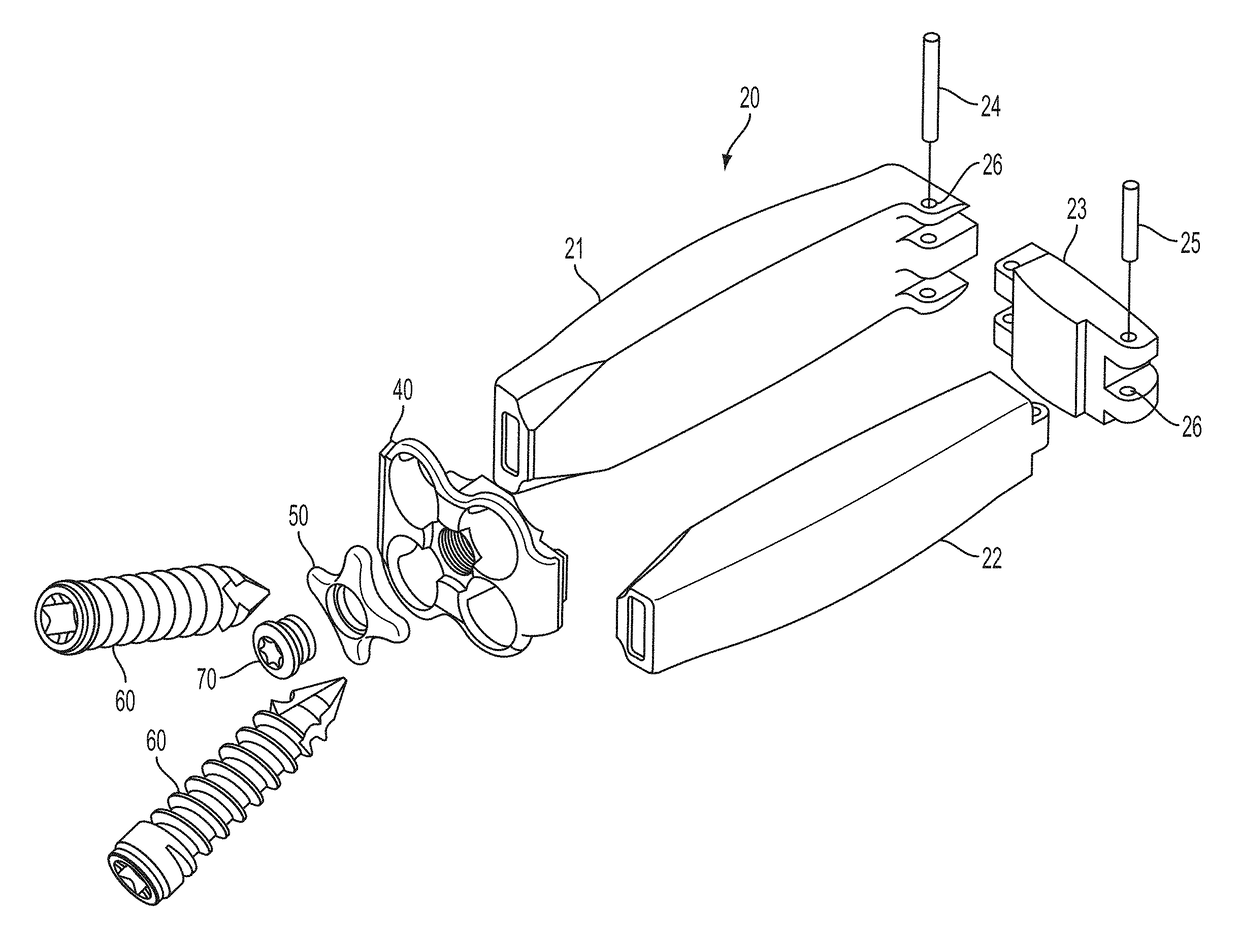
[0009]An apparatus of the invention includes an intervertebral spinal fusion bearing device provided in any number of suitable sizes and shapes and is configured to fit between two adjacent vertebrae, the load-bearing, interbody fusion component having one or more openings to allow access to surgically prepare the end plates of the two adjacent vertebrae, a separate, interchangeable, stress-shielded retention component configured to at least partially close the one or more openings of the load-bearing fusion bearing component, preventing undesirable loss of fusion materials, and to prevent migration of the fully assembled interbody fusion device, using one or more fasteners coupled to the retention component to compress the two adjacent vertebrae to the load-bearing component.
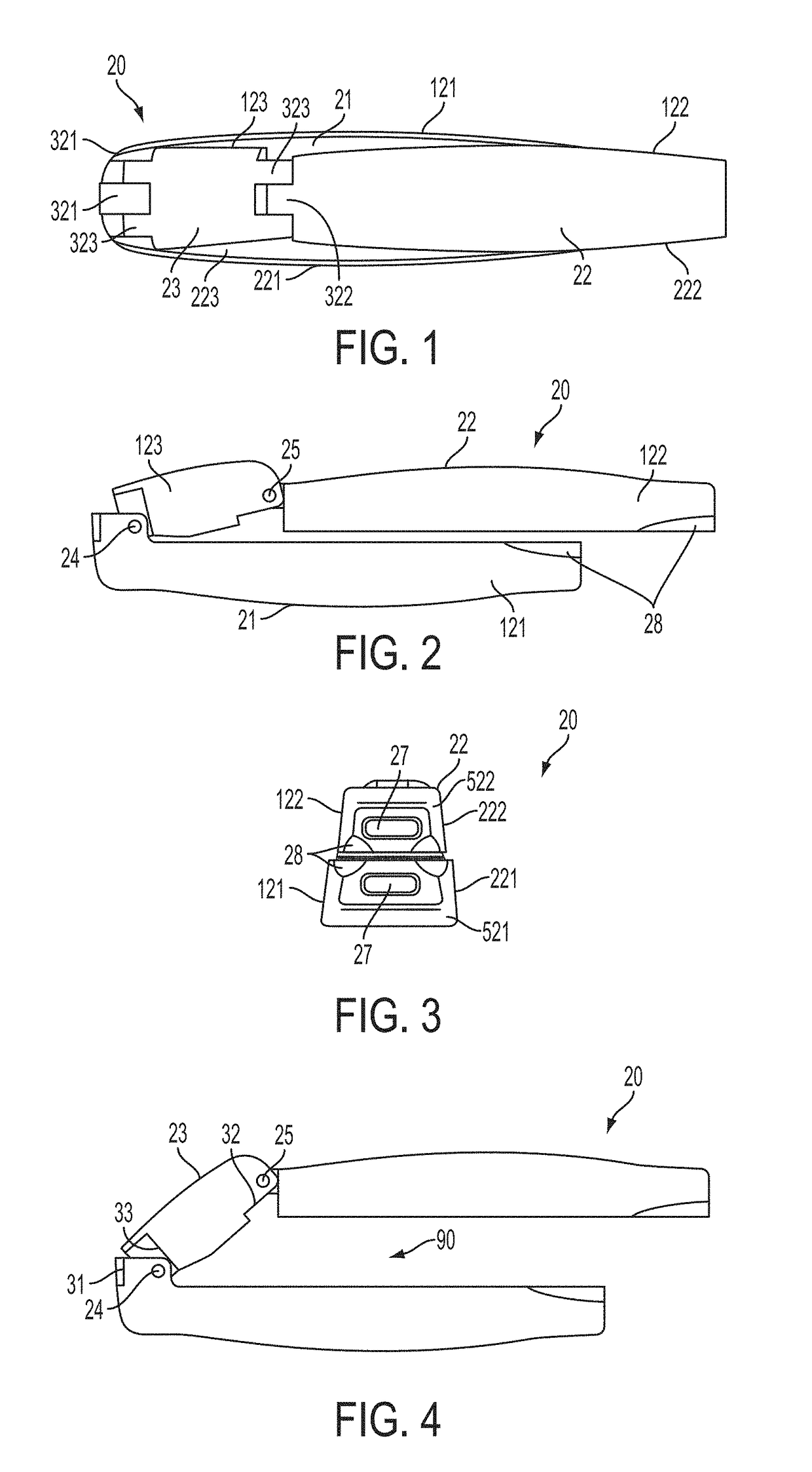
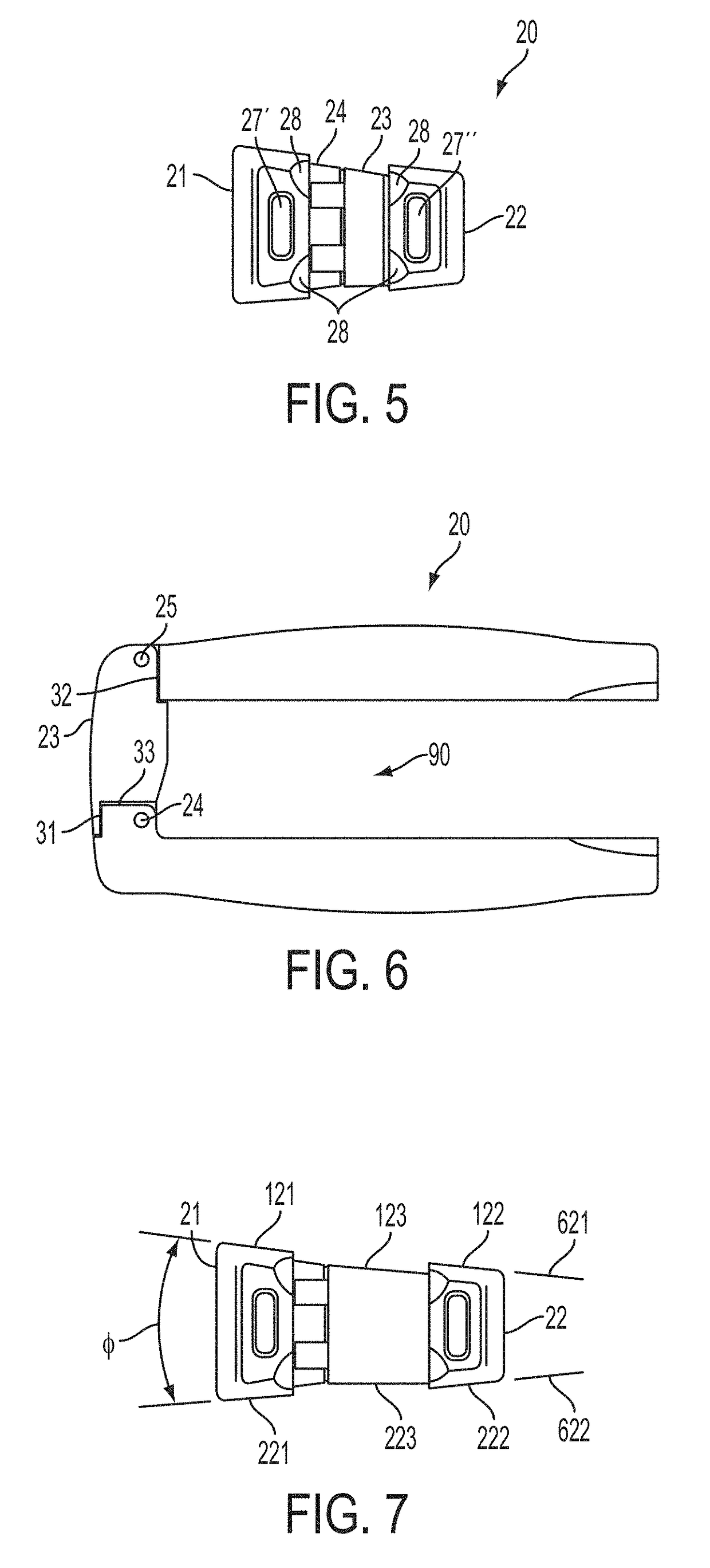
[0010]In one embodiment is provided a spinal fusion device, including an open-sided, load-bearing, interbody fusion component configured to be collapsible to facilitate minimally invasive surgical techniques and easier insertion between two adjacent vertebrae, whereupon the collapsed load-bearing, interbody fusion component can be properly positioned, rotated, and expanded to its full size, wherein the load-bearing, interbody fusion component has an open end, to allow for subsequent endplate preparation and the in-situ application of fusion-enhancing material that will help to facilitate fusion between the endplates, and a separate, interchangeable, stress-shielded retention component configured to couple to the load-bearing, interbody fusion component, at least partially closing the open end to prevent loss or migration of the fusion-enhancing material from the load-bearing, interbody fusion component, wherein one or more fasteners are coupled to the retention component, having bores configure therethrough to allow at least one of the one or more fasteners to be inserted through the bores and making initial contact with a vertebral endplate, and / or ring apophysis, and / or an external wall, and / or edge of the vertebrae, to compress the two adjacent vertebrae to the fusion bearing component
[0011]Another embodiment of the invention provides a method of fusing adjacent vertebrae including performing a lateral-approach discectomy, spreading the adjacent vertebrae, inserting a collapsed, open-sided, load-bearing interbody fusion component between the two adjacent vertebrae with an appropriate delivery instrument, rotating and positioning the device to engage the load-bearing edges of the fusion device with the endplates of the vertebrae, expanding the device to its fully opened size, preparing the end plates of the vertebrae for fusion by accessing the end plates through one or more openings formed in open-sided, load-bearing, interbody fusion component, placing a bone graft material between the endplates, completely filling the available space within the load-bearing interbody fusion component, then, securing a separate, interchangeable, stress-shielded retention component to the open-sided, load-bearing, interbody fusion component to prevent undesirable loss of fusion material, and one or more fasteners coupled to the retention component to compress the two adjacent vertebrae to the load-bearing, interbody fusion component to prevent migration of the assembled interbody fusion device, wherein the retention component includes bores configured to allow the one or more fasteners to be inserted through the bores and initiate contact with an endplate, and / or ring apophysis, and / or an external wall, and / or edge of the vertebrae, to compress the two adjacent vertebrae to the load-bearing component.



 Login to View More
  Login to View More