
Alkylation of olefins with isoparaffins in ionic liquid to make lubricant or fuel blendstock
a technology of isoparaffins and olefins, which is applied in the direction of hydrocarbon preparation catalysts, hydrocarbon oil treatment products, organic chemistry, etc., can solve the problems of air quality problems, undesirable olefinic double bonds, and problems in both fuels and lubricants, so as to increase the degree of branching and the molecular weight of the produ
Patent Information
- Authority / Receiving Office
- US · United States
- Current Assignee / Owner
- Publication Date
- 2007-06-21
Smart Images
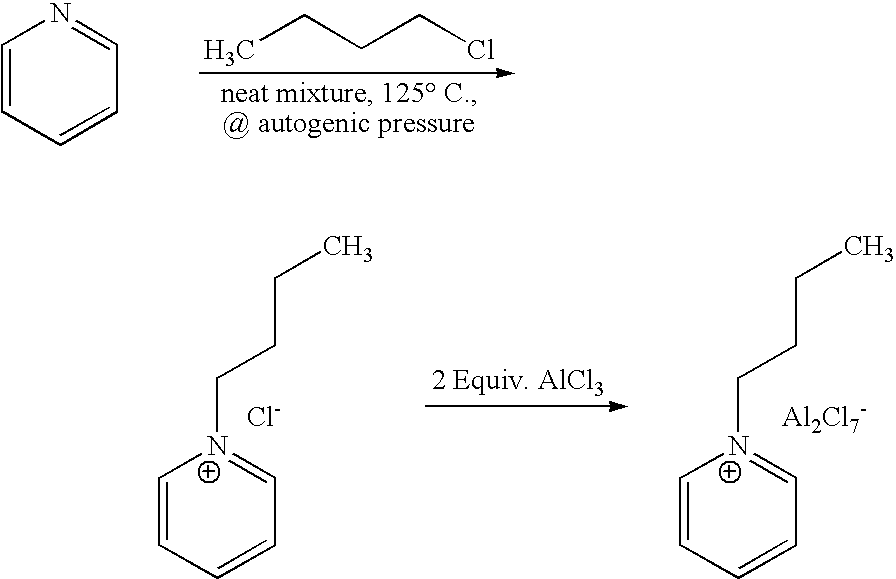
Figure 1
Abstract
Description
BACKGROUND OF THE INVENTION
[0001] Olefin oligomers and relatively long chain olefins can be used in the production of fuel and lubricant components or blendstocks. One problem with the use of olefins in either of the above uses is that the olefinic double bond can be undesirable. Olefinic double bonds cause problems in both fuels and in lubricants. Olefins can oligomerize forming ‘gum’ deposits in the fuel. Olefins in fuel are also associated with air quality problems. Olefins can also oxidize which can be a particular problem in lubricants. One way of minimizing the problem is to hydrogenate some or all of the double bonds to form saturated hydrocarbons. A method of doing this is described in US published Application US 2001 / 0001804 which is incorporated by reference herein in its entirety.
[0002] Hydrogenation can be an effective way to minimize the concentration of olefins in the lubricant or fuel. However, hydrogenation requires the presence of hydrogen and a hydrogenation cata...
Examples
example 1
Preparation of Fresh 1-Butyl-Pyridinium Chloroaluminate Ionic Liquid
[0041] 1-butyl-pyridinium chloroaluminate is a room temperature ionic liquid prepared by mixing neat 1-butyl-pyridinium chloride (a solid) with neat solid aluminum trichloride in an inert atmosphere. The syntheses of 1-butyl-pyridinium chloride and the corresponding 1-butyl-pyridinium chloroaluminate are described below. In a 2-L Teflon-lined autoclave, 400 gm (5.05 mol.) anhydrous pyridine (99.9% pure purchased from Aldrich) were mixed with 650 gm (7 mol.) 1-chlorobutane (99.5% pure purchased from Aldrich). The neat mixture was sealed and let to stir at 125° C. under autogenic pressure over night. After cooling off the autoclave and venting it, the reaction mix was diluted and dissolved in chloroform and transferred to a three liter round bottom flask. Concentration of the reaction mixture at reduced pressure on a rotary evaporator (in a hot water bath) to remove excess chloride, un-reacted pyridine and the chlor...
example 2
Alkylation of 1-decene with iso-butane
[0043] In a 300 cc Hastelloy autoclave, 100 gm (1.66 mol.) of liquefied isobutane and 10 gm (0.171 mol.) of 1-decene were added to 40 gm of 1-butyl-pyridinium chloroaluminate. Hydrochloric acid was used in the reaction as a promoter. The autoclave was sealed and the reaction was heated to 50° C. while stirring at ˜1000 rpm. The reaction was allowed to stir at 50° C. and at the autogenic pressure for 1 hour. Then, the stirring was stopped and the reaction was cooled to room temperature. The reaction was allowed to settle and the organic layer containing the feed and the products (sitting on the top of the ionic liquid layer) was separated from the ionic liquid by decantation. Excess isobutane was removed on a rotovap and the remaining oily liquid was analyzed by GC and GC-mass spectrometry. Table 1 below shows the GC analysis of the products. GC mass spectrometry of the largest peaks in the GC indicated the products to be saturated C14s (C14H30...
example 3
Alkylation of 1-decene with iso-pentane
[0045] Using the same procedure described above in Example 2, 13 gm of 1-decene was mixed with 101 gm of isopentane in 43 gm 1-butyl-pyridinium chloroaluminate. The reaction mixture (in autoclave) was heated to 50 degrees C. and stirred at 1000 rpm at autogenic pressure of 16 psi for 1 hr. The feed and the products were separated from the ionic liquid by decanting and the products (after removal of excess isopentane) were analyzed by GC and Mass Spectrometry. Table 2 below shows the GC analysis of the products. The major product appeared to be that of saturated C15s MW by GC-MS is 212. It also contained 14% of saturated C25 (MW=352).
TABLE 2ProductsWt %Below C10s13C109.5C15s38.6C20s3C25s14C30s5.6others7.5
[0046] As in the alkylation with isobutane, alkylation of 1-decene with isopentane led to the formation of saturated C15s. The major peak by GC-MS analysis has a molecular weight of 212 (C15 MW=212.4). In addition to the formation of C15s, C...