
Fused heterocyclic compounds
A compound and heterocyclic group technology, applied in the field of nitrogen-containing fused heterocyclic compounds, can solve problems such as low utilization value
- Summary
- Abstract
- Description
- Claims
- Application Information
AI Technical Summary
Problems solved by technology
Method used
Image

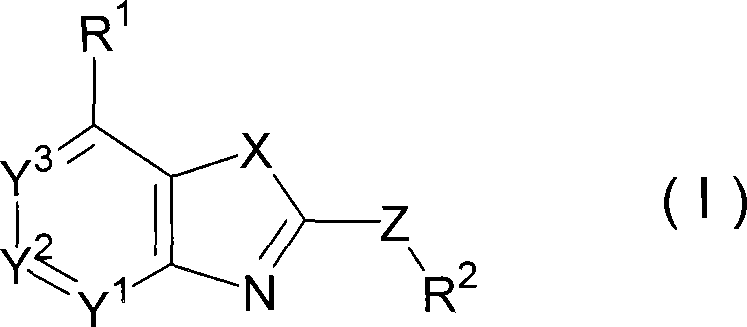
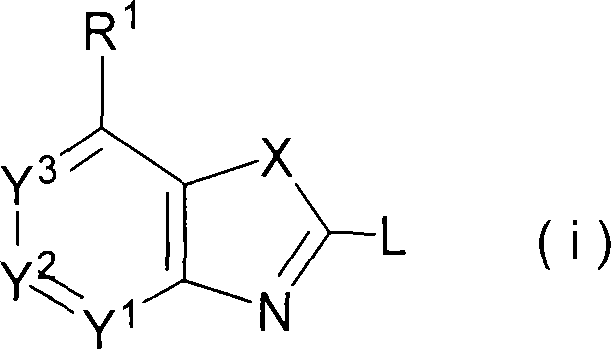
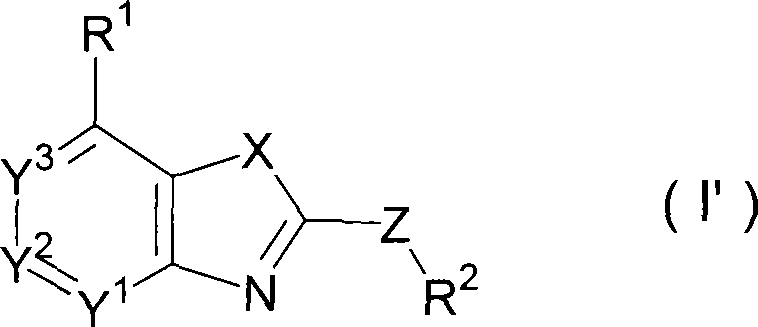
Examples
Embodiment 1
[0308] N-(4-bromo-2-methoxy-6-methylphenyl)-1-methyl-7-(1-propylbutyl)-1H-benzimidazol-2-amine hydrochloride
[0309]
[0310] Methyl 2-chloro-3-nitrobenzoate
[0311] A suspension of 20 g (99 mmol) of 2-chloro-3-nitrobenzoic acid in 800 mL of dichloromethane was cooled in an ice bath. Dimethylformamide (0.40 mL) was added to the reaction, followed by dropwise addition of 13.85 g (109 mmol) of oxalic acid. The reaction was allowed to warm to room temperature and stirred for 6h. Methanol (200 mL) was added dropwise and the reaction was stirred overnight. The reaction was concentrated to give a residue which was dissolved in dichloromethane and passed through a plug of silica gel eluting with a 50% ethyl acetate / hexane mixture. The filtrate was concentrated in vacuo to afford 21.5 g (100%) of the title compound.
[0312] 1 H NMR (CDCl 3 )δ3.98(s, 3H), 7.48(t, J=7.8Hz, 1H), 7.84(d, J=8.2Hz, 1H), 7.95(d, J=7.8Hz, 1H).
[0313] Methyl 2-methylamino-3-nitrobenzoate
[031...
Embodiment 8
[0341] {2-[(4-bromo-2-methoxy-6-methylphenyl)amino]-1-methyl-1H-benzimidazol-7-yl}(4-methoxyphenyl)methyl ketone.
[0342]
[0343] 7-(4-Methoxybenzoyl)-1-methyl-1,3-dihydro-2H-benzimidazol-2-one
[0344] 12 mL (6.00 mmol) of 4-methoxymagnesium bromide solution (0.5 M in THF) was diluted with 15 mL THF and cooled in an ice bath. To this solution was slowly added 309 mg (1.50 mmol) of 1-methyl-2-oxo-2,3-dihydro-1H-benzimidazole-7-carboxylic acid methyl ester and the reaction was stirred at 60°C 24h. The reaction was quenched with water. The aqueous mixture was extracted with ethyl acetate. The extract was washed with 1N aqueous hydrochloric acid and brine, dried over magnesium sulfate and concentrated in vacuo. The residue was purified by column chromatography, eluting with 20-70% ethyl acetate / n-hexane, to give the title compound (148 mg, 35%).
[0345] 1 H NMR (DMSO-d 6 )δ3.00(s, 3H), 3.87(s, 3H), 6.98(d, J=8.1Hz, 1H), 7.00-7.15(m, 3H), 7.19(d, J=8.1Hz, 1H), 7.81 ...
Embodiment 9
[0354] N-(4-bromo-2-methoxy-6-methylphenyl)-4-(1-ethylbutyl)-3-methyl-3H-imidazo[4,5-c]pyridine- 2-amine
[0355]
[0356] 4-Bromo-3-methyl-1H-imidazo[4,5-c]pyridin-2(3H)-one
[0357] Heat 20.0 g (103 mmol) of 3-methyl-4-nitro-1H-imidazo[4,5-c]pyridin-2(3H)-one in 168 mL of 48% hydrobromic acid at 135 °C Solution 6h. An additional 33 mL of 48% hydrobromic acid was added and the reaction was stirred overnight at 135°C. The reaction was cooled to room temperature and quenched into 1675 mL of ice water. The resulting suspension was adjusted to pH 9 by adding 125 mL of saturated aqueous ammonia solution. The precipitate was filtered and washed with 200 mL of water and dried in a 50° C. oven under vacuum overnight to give 17.58 g (75%) of the title product as a pale yellow solid.
[0358] 1 H NMR (DMSO-d 6 ) δ 3.54 (3H, s), 7.08 (1H, d, J=4.9Hz), 7.94 (1H, d, J=4.9Hz), 11.71 (1H, s).
[0359] MS calcd: 227; found: 228 (M+H).
[0360] (E)-4-(Hex-3-en-3-yl)-3-methyl-1H-im...
PUM
 Login to View More
 Abstract
Description
Claims
Application Information
 Login to View More