Amplification internal standard preparation based on DNA stochastic shuffling technology

A technology for amplifying internal standards and DNA sequences, which is applied in the field of amplification internal standard preparation based on DNA random shuffling technology, can solve the problems that have not yet been reported on the preparation methods of amplification internal standards, and overcome the influence of PCR amplification efficiency , improve accuracy and ensure consistency

CN101503735BActive Publication Date: 2012-07-18SHANGHAI JIAO TONG UNIV
0 Cites 0 Cited by

Patent Information

Authority / Receiving Office
CN · China
Patent Type
Patents(China)
Current Assignee / Owner
Publication Date
2012-07-18

Smart Images

  • Figure 1
    Figure 1
  • Figure 2
    Figure 2
  • Figure 3
    Figure 3
Patent Text Reader

Abstract

The invention provides a method for preparing a proliferation internal label based on a DNA random reorganization technique, and belongs to the field of the biological technology. The method comprises the following steps that: according to a target gene design, a specific detection primer and a TaqMan probe are obtained; according to DNA sequences on the probe combination part of a target fragment, DNA random reorganization software randomly generates reorganization sequences, and the generated reorganization sequences replace the DNA sequences on the probe combination part of the target fragment respectively to generate corresponding proliferation internal label sequences to be screened; by comparing the fluorescent probe design software with the BLAST-N software, the proliferation internal label sequences are screened to obtain the sequence which has the highest software evaluation value and is not homologous to the sequences of other pathogenic microorganism genomes, and the sequence is used as the proliferation internal label sequence; the proliferation internal label sequence obtained from the third step is cloned to a vector to construct the vector containing the proliferation internal label sequence; and the obtained proliferation internal label sequence is detected. The method can help to display the existence of the inhibition phenomenon in detection, thereby improving the accuracy rate of the detection result.
Need to check novelty before this filing date? Find Prior Art

Description

technical field

[0001] The invention relates to a method for preparing an internal standard for amplification in the field of biotechnology, in particular to a method for preparing an internal standard for amplification based on DNA random shuffling technology. Background technique

[0002] Fluorescent quantitative PCR technology is a nucleic acid quantitative technology developed on the basis of PCR qualitative technology. This technology adds fluorescent labeled probes to the PCR reaction system, uses the accumulation of fluorescent signals to monitor the entire PCR process in real time, and infers the identity of the target gene based on the fluorescent signals. initial amount. Fluorescent quantitative PCR technology has great advantages compared with the previous quantitative PCR technology with endpoint method. First of all, it is not only easy to operate, fast and efficient, high-throughput, capable of multiple reactions, but also has high sensitivity, repeatability a...

Examples

Embodiment

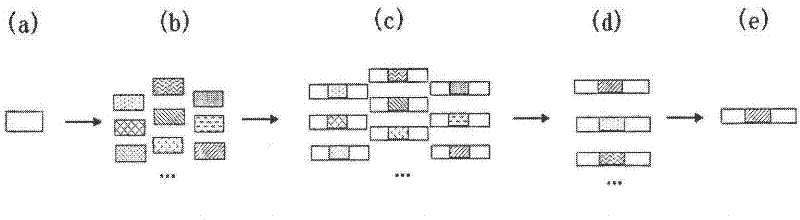
[0024] figure 1 Schematic diagram of the design steps for the amplification internal standard sequence, in the figure: (a) is the design of the target fragment probe; (b) is the random shuffling of the target fragment probe binding site sequence; (c) is the internal standard fragment to be screened and amplified (d) is the screening of the amplified internal standard fragment; (e) is the determination of the amplified internal standard sequence.

[0025] Step 1: Analyze the target gene and design specific detection primers and TaqMan probes

[0026] The known specific genes of Listeria monocytogenes were analyzed, and the target gene hlyA was selected for detection. Using the public BLAST software in Genbank, the sequence of the hlyA gene was compared with other microorganisms, and a sequence segment with high specificity was selected. Based on this sequence, a pair of primers and probes were designed using the software Bacon Designer 5.0.

[0027] The primer and probe seque...