

Method for the production of scaffolds for tissue engineering, comprising the use of an anchoring unit, and scaffold produced therewith
A unit, anchoring technology, applied in the field of stent material and stent marking, can solve the problem of not fitting
- Summary
- Abstract
- Description
- Claims
- Application Information
AI Technical Summary
Problems solved by technology
Method used
Image

Examples
Embodiment 1
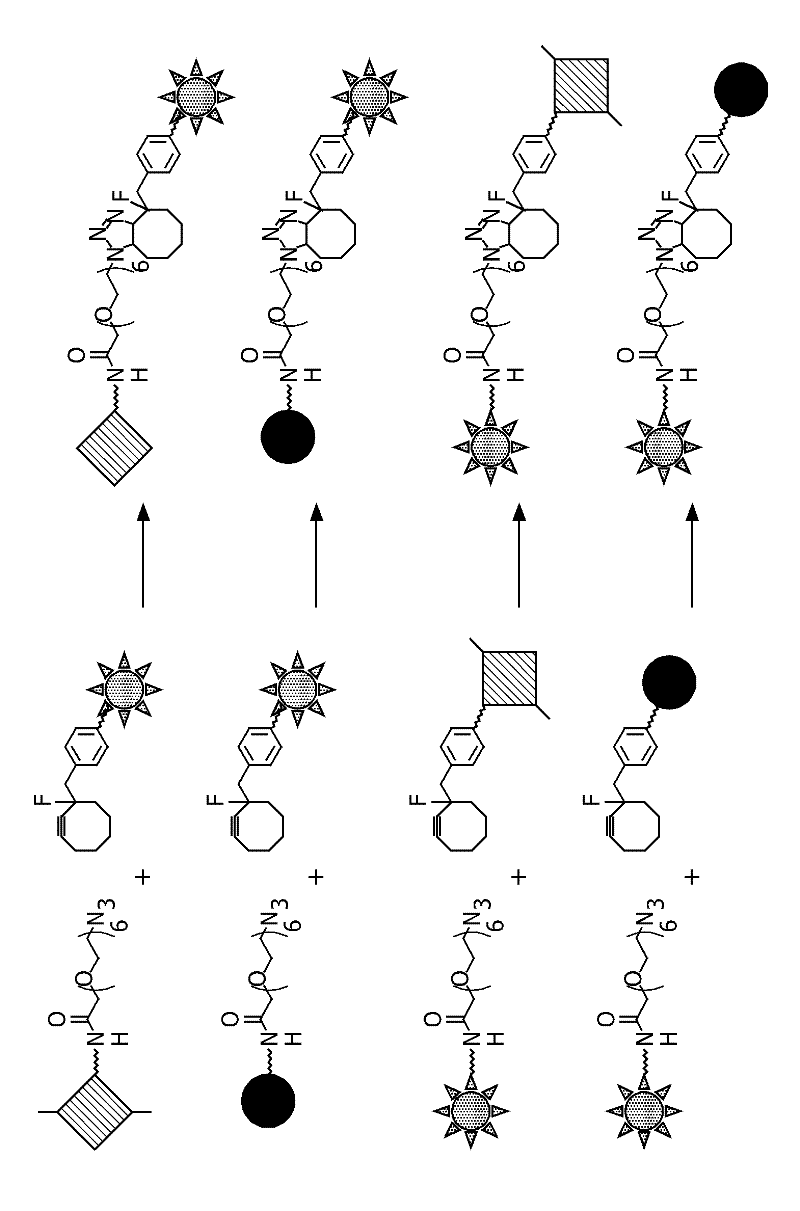
[0208] Example 1: Labeling of scaffolds with click chemistry comprising covalently bound anchor units.
[0209] Copolymers of ε-caprolactone and α-bromo-ε-caprolactone (or pure α-bromo-ε-caprolactone) were produced as scaffold-forming polymers. This procedure is described in Examples 1.1. - 1.3. The bromine groups of the copolymer are then replaced by azide (N 3 ) group substitution, the latter is the anchor unit of the present invention. This procedure is described in Example 1.4. The copolymers can be subjected to a scaffold forming process, for example by electrospinning before or after the substitution process. Labeling reagents are bound to the anchor units by means of the Staudinger reaction.
[0210] 1.1. Synthesis of α-bromocyclohexanone
[0211] α-Bromocyclohexanone was synthesized according to the following procedure: 49 g (0.306 mol) bromine was added dropwise to a stirred mixture of 30 g (0.306 mol) cyclohexanone and 200 mL distilled water over a period of 5 h...
Embodiment 2
[0224] Embodiment 2: use 18 F-labeled oligonucleotide binding reagent
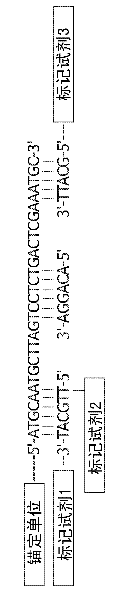
[0225] The oligonucleotide shown in Figure 5 is used at its 5' end 18 F Labeled according to the method of Kuhnast 2003. 18 F is preferred for positron emission tomography (PET) and scintigraphy (see Table 1). Complementary oligonucleotides are anchored to the scaffold material by methods according to the state of the art and thus serve as anchoring units according to the invention. Methods for binding oligonucleotides to silicate or polymer surfaces are known, for example, from the literature concerning the production of biochips.
Embodiment 3
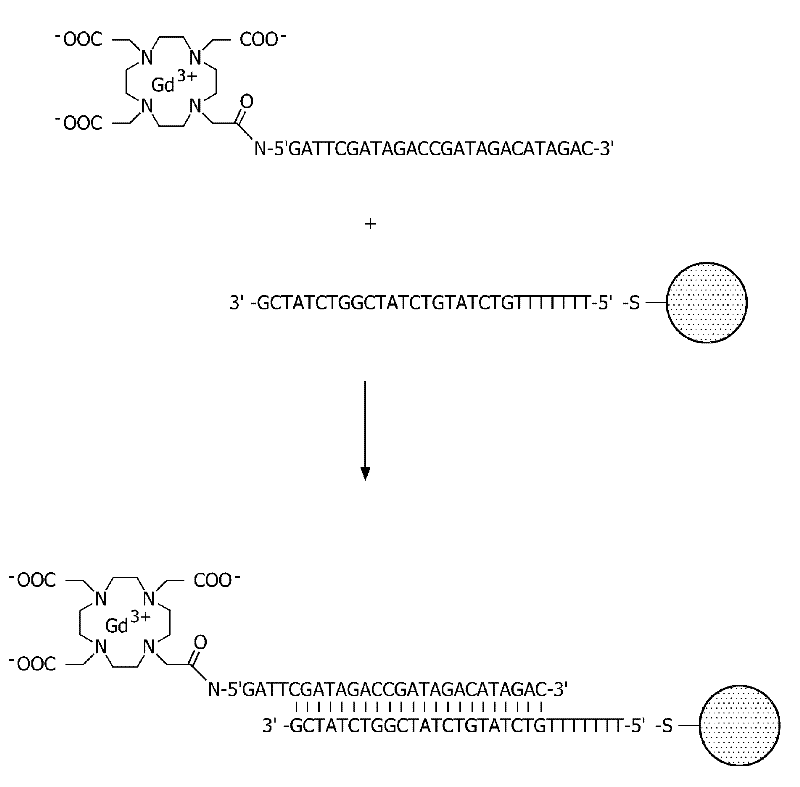
[0226] Example 3: Labeling of scaffolds by means of Gd-labeled oligonucleotides
[0227] 3.1. DNA-particle-component synthesis
[0228] Au (gold) particles can be prepared as described in the literature (Grabar et al. (1995)). These microparticles are readily modified with oligonucleotides that are functionalized at one end, eg, the 5' end, with an alkanethiol. Here, 1.5 ml (17 nM) of colloidal gold (13nm ?) solution was treated with 460 μl (3.75 μM) of the following species of SH-5'-oligonucleotide-3' for 24 hours (here the sequence was chosen randomly, i.e. any Other sequences are also possible):
[0229] 3'-GCTATCTGGCTATCTGTATCTGTTTTTTTT-5'-SH
[0230] To provide the DNA-gold-component. In this way, anchor units comprising oligonucleotides as binding reagents are obtained. see Figure 10 A description of the process.
[0231] 3.2. Synthesis of DNA-Gd-labeled components
[0232] 1 μmol of amine-modified oligonucleotides (sequence partially complementary to the ...
PUM
 Login to View More
 Abstract
Description
Claims
Application Information
 Login to View More