Check patentability & draft patents in minutes with Patsnap Eureka AI!

Automated device for production of bioengineered tissues and organs based on decellularization and recellularization

a bioengineered tissue and automatic technology, applied in the direction of apparatus sterilization, prosthesis, disinfection, etc., can solve the problems of inability to manufacture in vitro, lack of ideal transplantable scaffold, failure of organs such as heart, liver, kidney, etc., and achieve the effect of effectively perfusing tissue, effectively perfusing tissue, and effective perfusing tissu

Active Publication Date: 2021-09-16
AMOABEDINY GHASSEM +3
View PDF0 Cites 1 Cited by
  • Summary
  • Abstract
  • Description
  • Claims
  • Application Information

AI Technical Summary

Benefits of technology

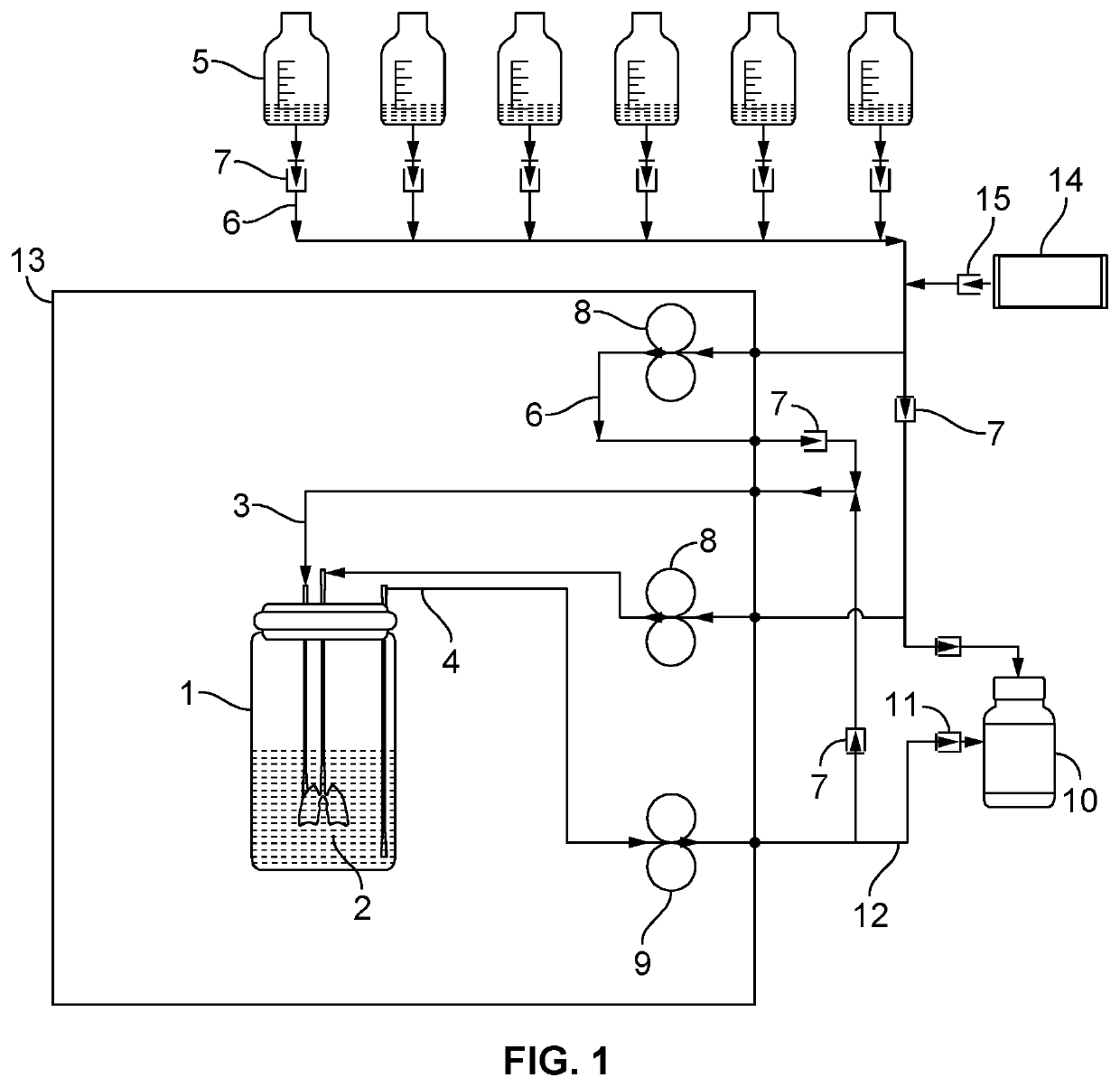
The device is designed to contain and perfuse various sizes of tissues for decellularization, tissue sterilization, or recellularization processes. It includes a main chamber with several inlets and outlets for liquids and gases, and a solution chamber for decellularization and sterilization, and a medium chamber for recellularization. The device also has a waste chamber for collecting the waste liquid. The solution inlet and outlets form a closed loop to circulate the liquid solution within the main chamber and effectively perfuse the tissue. This design allows for efficient and effective tissue treatment.

Problems solved by technology

However, despite the preservation of the whole structure, the current constructs derived from decellularization-based strategies still perform partial functions of organs, due to several challenges, including preservation of functional extracellular matrix structure, implementation of functional recellularization, the formation of functional vascular network, organ sterilization, and realization of long-term functional integration.
One of the key factors that prevents advancement of the field is the lack of an ideal transplantable scaffold that has all the necessary microstructure and extracellular cues for cell attachment, differentiation, functioning, as well as vascularization, which has so far proven to be difficult to manufacture in vitro.
Further, failure of organs such as heart, liver, kidney, cartilages and etc., is a major cause of the world's mortality due to a critical shortage of donor organs.

Method used

the structure of the environmentally friendly knitted fabric provided by the present invention; figure 2 Flow chart of the yarn wrapping machine for environmentally friendly knitted fabrics and storage devices; image 3 Is the parameter map of the yarn covering machine
View more

Image

Smart Image Click on the blue labels to locate them in the text.
Viewing Examples
Smart Image
  • Automated device for production of bioengineered tissues and organs based on decellularization and recellularization
  • Automated device for production of bioengineered tissues and organs based on decellularization and recellularization
  • Automated device for production of bioengineered tissues and organs based on decellularization and recellularization

Examples

Experimental program
Comparison scheme
Effect test

Embodiment Construction

[0020]The present invention generally relates to a tissue and organ engineering device, and more particularly relates to a device for production of bioengineered tissues and organs based on decellularization and recellularization technologies.

[0021]A description of embodiments of the present invention will now be given with reference to the figures. It is expected that the present invention may be embodied in other specific forms without departing from its spirit or essential characteristics. The described embodiments are to be considered in all respects only as illustrative and not restrictive. The scope of the invention is, therefore, indicated by the appended claims rather than by the foregoing description. All changes that come within the meaning and range of equivalency of the claims are to be embraced within their scope.

[0022]Referring to FIG. 1, a block diagram of an automated device configured to perform a decellularization process according to one embodiment of the present ...

the structure of the environmentally friendly knitted fabric provided by the present invention; figure 2 Flow chart of the yarn wrapping machine for environmentally friendly knitted fabrics and storage devices; image 3 Is the parameter map of the yarn covering machine
Login to View More

PUM

PropertyMeasurementUnit
pHaaaaaaaaaa
temperatureaaaaaaaaaa
sizesaaaaaaaaaa
Login to View More

Abstract

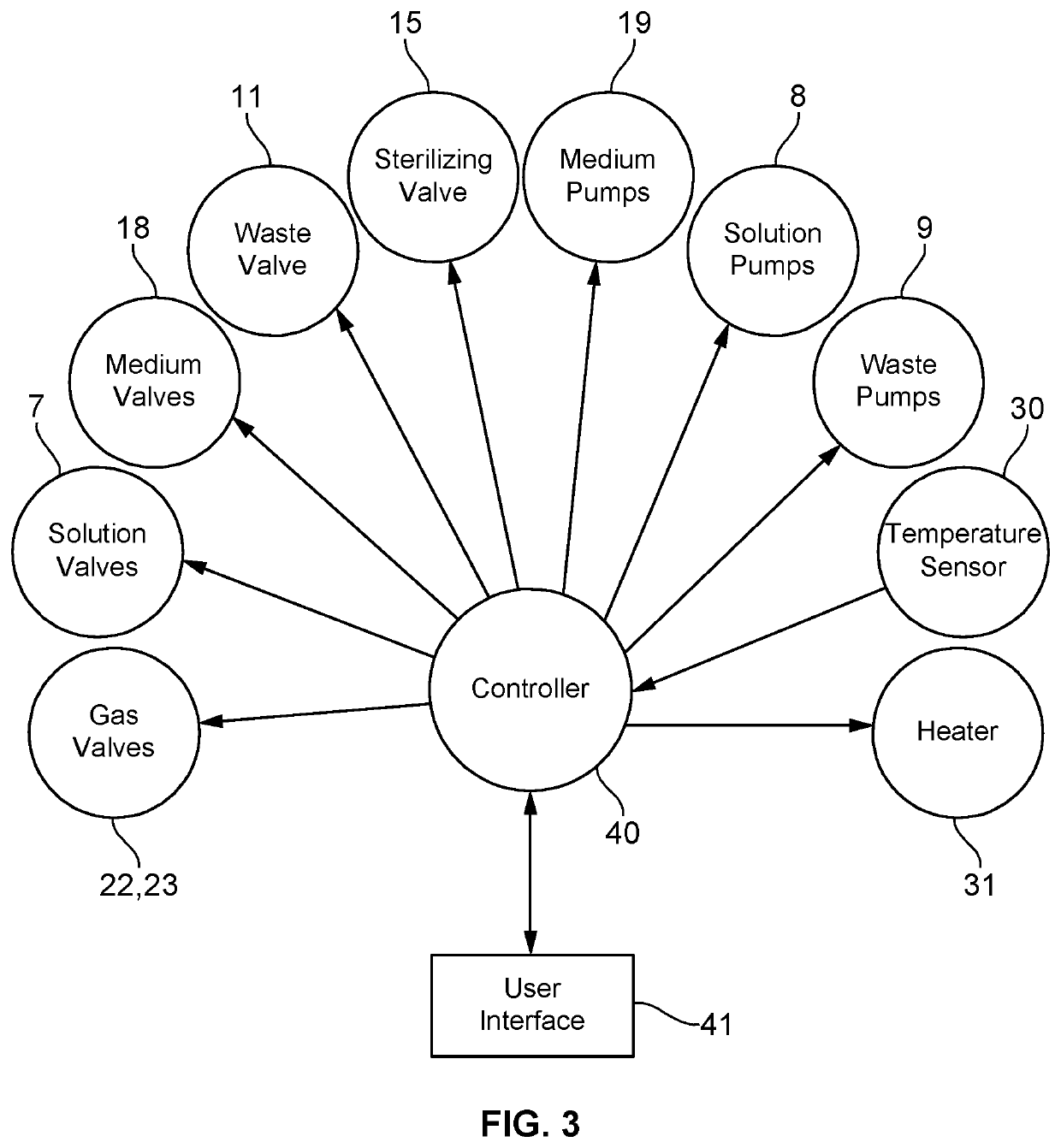
The present invention discloses an automated device for tissue and organ engineering. The device comprises a main chamber for performing decellularization, tissue sterilization, and recellularization and a set of solution and medium chambers, which provide solutions and medium for the decellularization and recellularization processes, respectively, in a continuous closed circuit. The device further comprises a sterilizing system for self-sterilization of the automated device. The device further comprises a user interface to input steps of protocols for tissue or organ engineering. The device further comprises a controller configured to control valves and pumps, which control and direct the flow of solutions and medium based on the steps of protocols, thereby automating the processes of decellularization, tissue sterilization, recellularization and self-sterilization. All parts of the device are installed in one single body in a fully integrated manner, in one example, which makes the device ready to use. The device minimizes the user intervention and enhances sterility, reproducibility, and efficiency.

Description

BACKGROUND OF THE INVENTION[0001]Tissue engineering involves the use of a tissue scaffold for the formation of new viable tissues for transplantation or in vitro monitoring of drug toxicity in model disease tissues. Tissue engineering, which uses elements including cells, scaffolds, and growth factors to fabricate functional organs in vitro, is a promising strategy to mitigate the scarcity of transplantable organs. In recent years, different construction strategies that guide the combination of tissue engineering elements have been applied in solid organ tissue engineering and have achieved much progress. Recently, a construction strategy based on whole-organ decellularization has become a popular and promising approach.[0002]However, despite the preservation of the whole structure, the current constructs derived from decellularization-based strategies still perform partial functions of organs, due to several challenges, including preservation of functional extracellular matrix stru...

Claims

the structure of the environmentally friendly knitted fabric provided by the present invention; figure 2 Flow chart of the yarn wrapping machine for environmentally friendly knitted fabrics and storage devices; image 3 Is the parameter map of the yarn covering machine
Login to View More

Application Information

Patent Timeline
no application Login to View More
Patent Type & Authority Applications(United States)
IPC IPC(8): A61L2/24A61L27/36A61L2/26A61L2/20
CPCA61L2/24A61L27/3683A61L2/26A61L2/202A61L2/206A61L2202/14A61L2430/40A61L2202/121A61L2202/15A61L2430/28A61L2430/26A61L2430/20A61L2202/122C12M21/08C12M29/10C12M37/00C12M41/48A61L2/0088A61L2/0094
Inventor AMOABEDINY, GHASSEMMOUSAVI, SEYED HOSSEIN MAHFOUZITALI, SEYED HAMID SAFIABADIGHANEI, MOSTAFA
Owner AMOABEDINY GHASSEM
Features
  • R&D
  • Intellectual Property
  • Life Sciences
  • Materials
  • Tech Scout
Why Patsnap Eureka
  • Unparalleled Data Quality
  • Higher Quality Content
  • 60% Fewer Hallucinations
Social media
Patsnap Eureka Blog
Learn More