
Ten-step self-equalization Ku frequency-band dielectric filter
A dielectric filter and self-equalization technology, applied in waveguide-type devices, electrical components, circuits, etc., can solve the problems of reducing product reliability and increasing the difficulty of debugging, improving reliability, reducing the amount of debugging, and overcoming parasitic coupling. Effect
- Summary
- Abstract
- Description
- Claims
- Application Information
AI Technical Summary
Problems solved by technology
Method used
Image

Examples
Embodiment Construction
[0026] Specific embodiments of the present invention will be described in detail below in conjunction with the accompanying drawings.
[0027] The transfer function of the TE01 module tenth-order self-equalizing Ku-band dielectric filter of the present invention adopts the form of 10-4-4, that is, the filter has 8 transmission zeros, 4 of which are used for delay equalization and 4 for out-of-band suppression pole, the synthesis of its coupling matrix is the same as that of a typical generalized Chebyshev filter, and the existing self-programmed or commercial software can obtain the filter coupling matrix that meets the index requirements. After synthesis, the main couplings in the coupling matrix are all positive, two negative cross-couplings are respectively located between dielectric resonators R2 and R9, R3 and R8, and one positive cross-coupling is located between dielectric resonators R1 and R10.
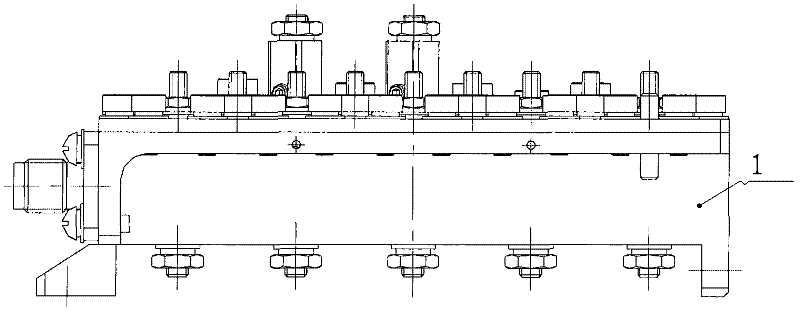
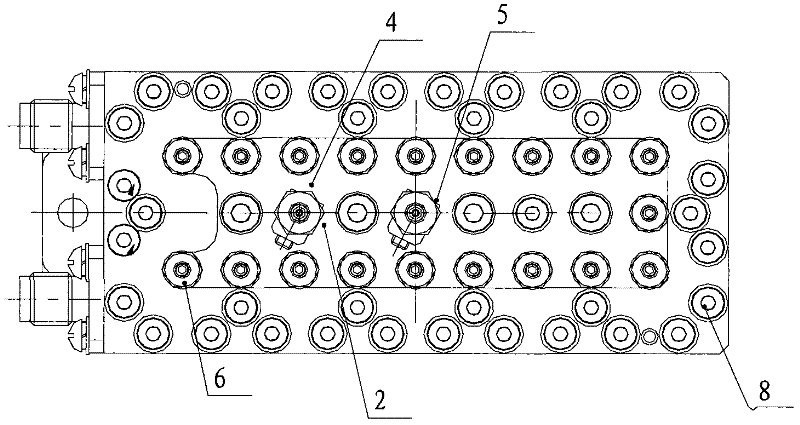
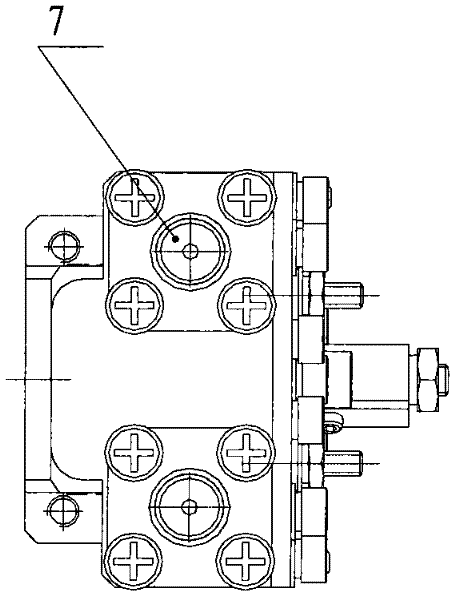
[0028] Such as figure 1 , 2 , 3, 4, and 5, the tenth-order self-bala...
PUM
 Login to View More
 Abstract
Description
Claims
Application Information
 Login to View More