

PWS (Public Warning System) secret key updating method, network side equipment and terminal in wireless communication system
A technology of wireless communication system and network side equipment, which is applied in wireless communication and key distribution, and can solve the problem that the PWS key update process has not yet been defined
- Summary
- Abstract
- Description
- Claims
- Application Information
AI Technical Summary
Problems solved by technology
Method used
Image



Examples
application example 1
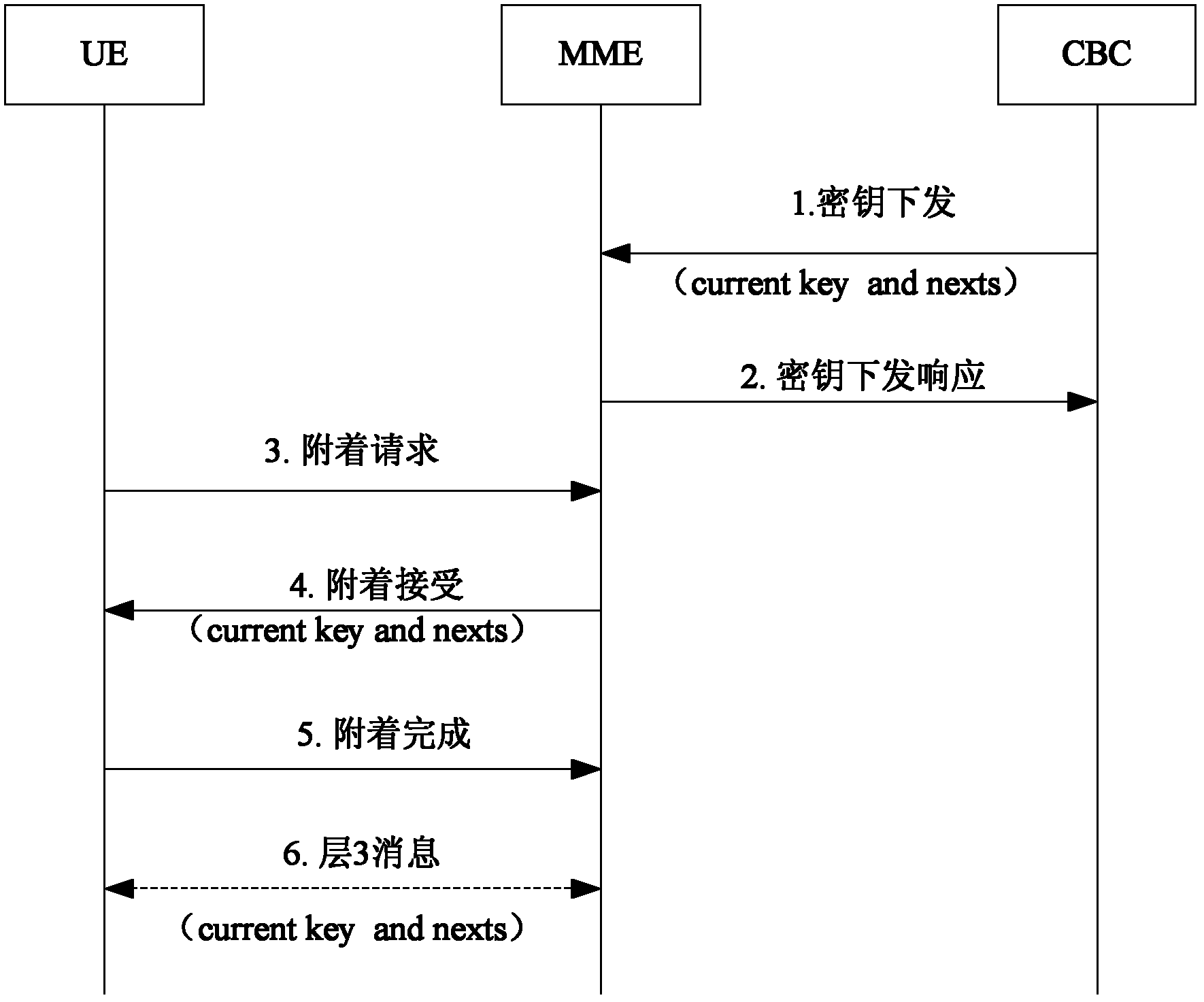
[0147] Such as figure 2 As shown, this application example shows the process of the network issuing the PWS key to the terminal for the first time. This process shows the flow chart of the LTE network. It is similar to the GSM / UMTS network. In the initial access process, two PWS keys are directly issued, a currently used key currentkey and the corresponding identifier. Information (ie key id), a next key to be used next key and the corresponding key id. The specific steps are as follows:
[0148] 1) The CBC sends two PWS keys to the MME, one currently used key current key and the corresponding key id, one next used key next key and the corresponding key id; of course, the PWS key also It can be issued by the CBE.
[0149] 2) After receiving the two PWS keys issued by the CBC, the MME saves them and sends a response message to the CBC;
[0150] 3) The UE sends a normal attach (attach) request message to the MME;
[0151] 4) The MME sends an attach accept (attach accept) m...
application example 2
[0153] Such as image 3 As shown, this application example shows a process in which the network periodically delivers the identification information of the PWS key to the terminal. This flow describes the process in which the network-side device periodically sends the identification information of the PWS key through a TAU response message or a broadcast message in an LTE network. For the GSM / UMTS network, it can be delivered through RAU or broadcast message. The steps are as follows:
[0154] 1) The UE sends a TAU request message to the MME;
[0155] 2) The MME sends a TAU response message to the UE, which carries the identification information (current key id) of the PWS key currently used by the current network, and may also carry the identification information of the next PWS key to be used by the current network ( next key id);
[0156] Of course, the current key id and next key id may not be carried in the TAU response message, but carried in other broadcast messages...
application example 3
[0160] Such as Figure 4 As shown, this application example shows the process that the terminal needs to update the currently used PWS key. This application example is the normal key update process, that is: the currently used PWS key becomes invalid, the next used PWS key is used to replace the currently used PWS key, and the next used PWS key will be regenerated The key is delivered to the UE. The steps are as follows:
[0161] 1) CBC sends a key update message to MME, which carries the next PWS key that the current network will use;
[0162] 2) After receiving the key update message, the MME saves the next used key stored locally as the currently used PWS key, and uses the PWS key carried in the message as the next used PWS key Save and send a key update response message to CBC;
[0163] 3) The UE sends a TAU request message to the MME;
[0164] 4) The MME sends a TAU response message to the UE, which carries the identification information of the currently used PWS key...
PUM
 Login to View More
 Abstract
Description
Claims
Application Information
 Login to View More