
Superconducting motor with ultra-low loss
A superconducting motor, ultra-low technology, applied in electrical components, electromechanical devices, etc., can solve problems such as large copper consumption and large AC loss, and achieve the effects of low cooling capacity, improved power density, and compact structure
- Summary
- Abstract
- Description
- Claims
- Application Information
AI Technical Summary
Problems solved by technology
Method used
Image

Examples
Embodiment Construction
[0024] The present invention will be further explained below in conjunction with the drawings.
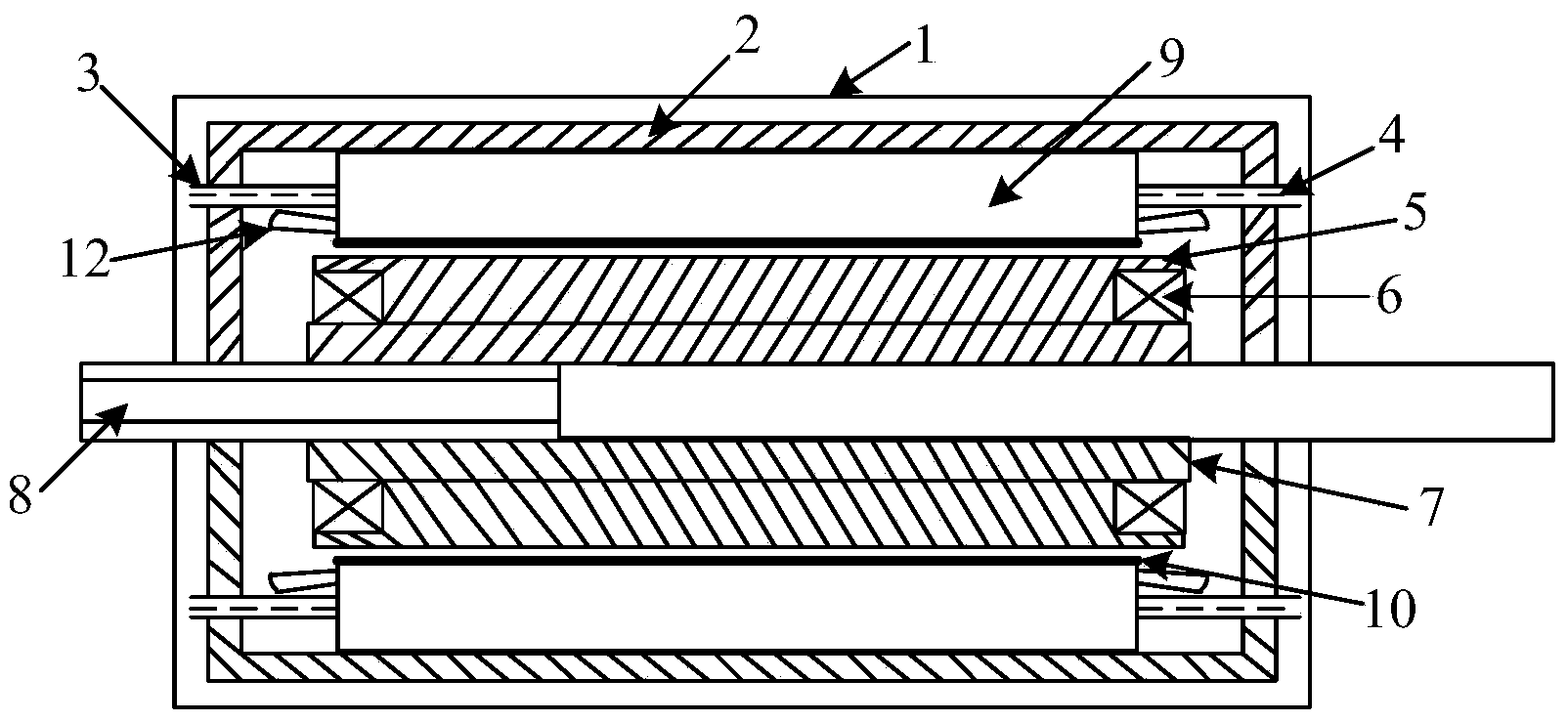
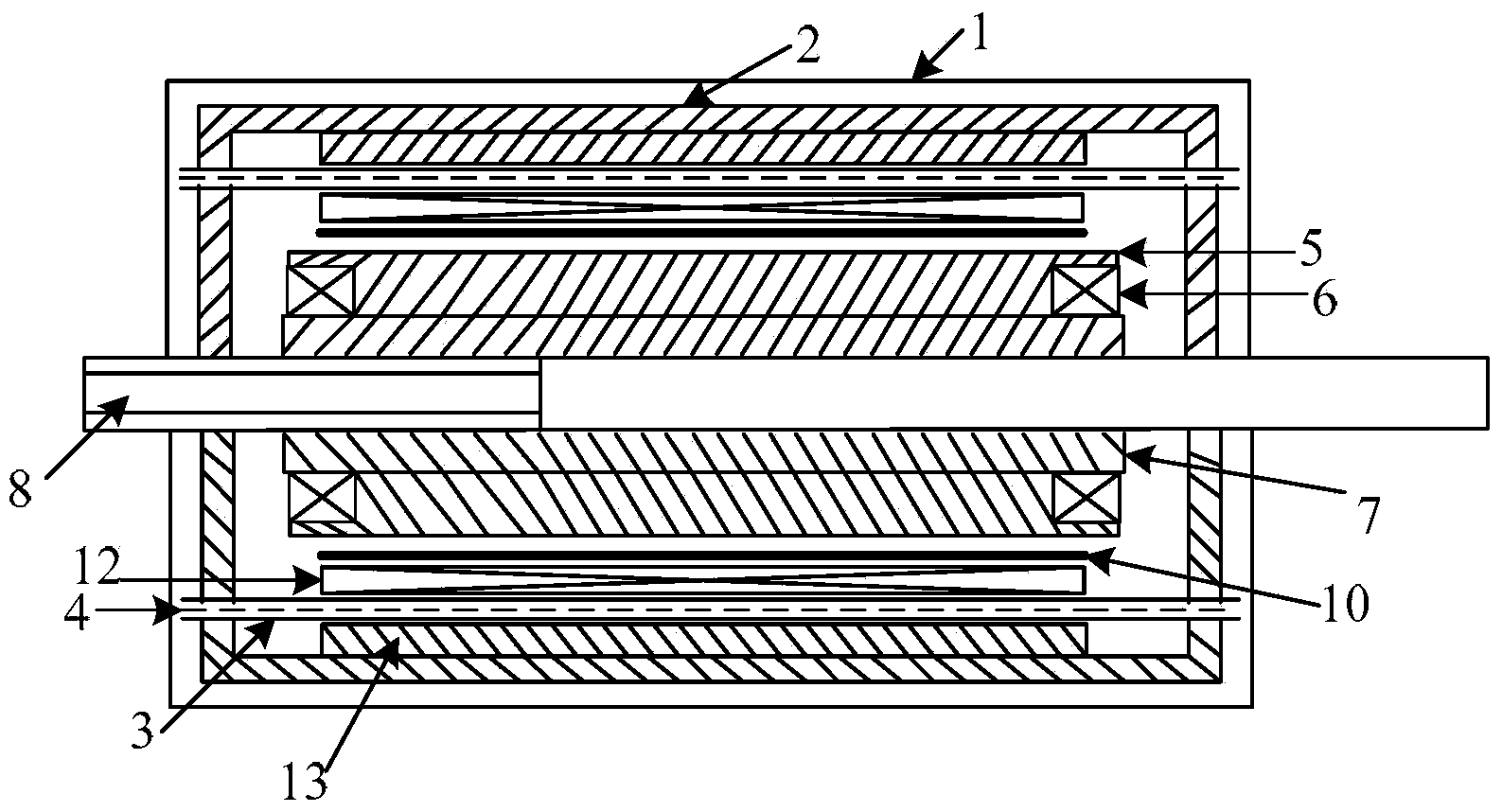
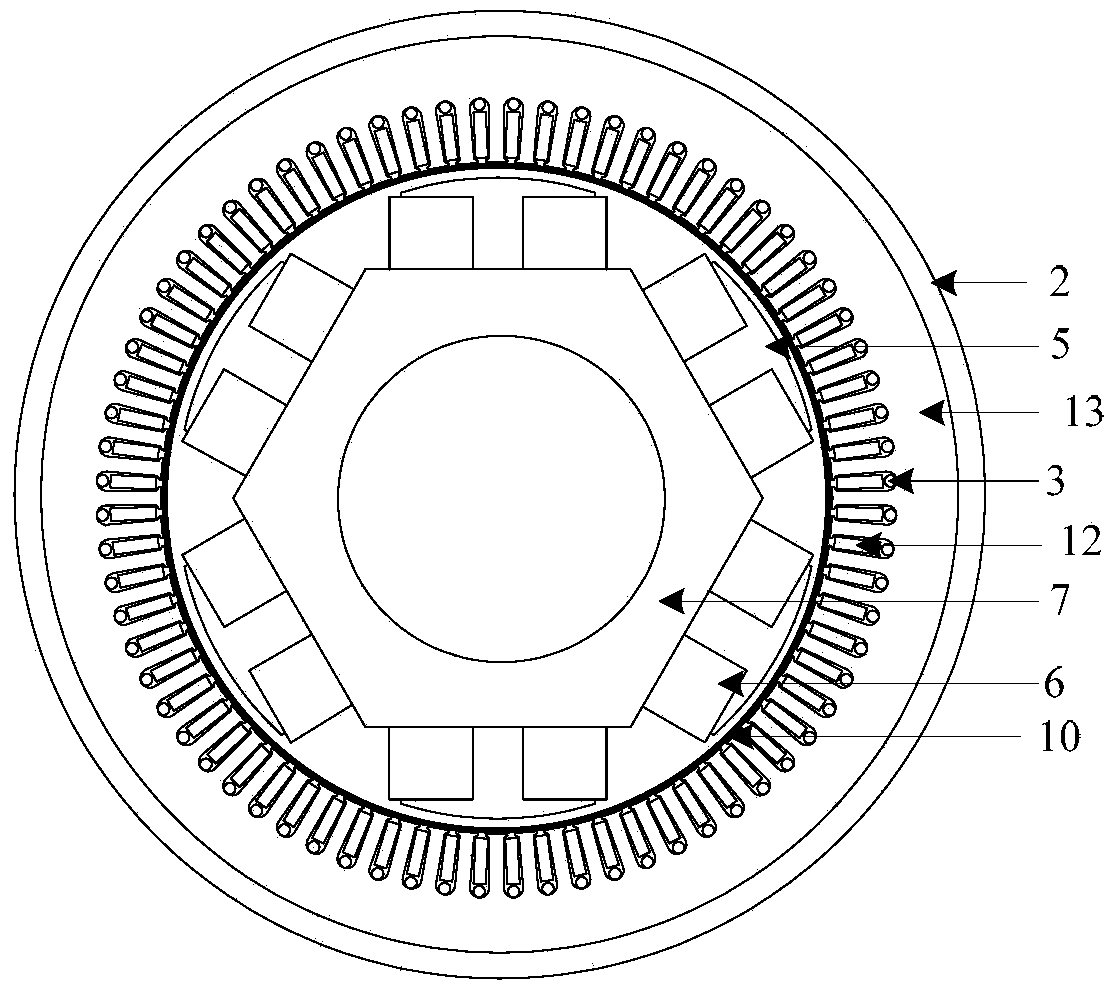
[0025] Such as figure 1 , 2 , 3, 4, 5, 6, and 7 show a superconducting motor with ultra-low loss, including a casing 2, a stator 9 and a rotor 11. The rotor 11 has a coreless structure and is mainly composed of pole shoes 5. , The rotor support 7 and the hollow shaft 8 are composed of a field winding 6 wound on the pole piece 5, the field winding 6 is a superconducting coil; the stator 9 is mainly composed of an armature winding 12 and a stator core 13, in the stator 9 A cooling pipe 3.1 is provided at the bottom of each stator slot. The two ends of the cooling pipe 3.1 are provided with an isolation sleeve 3.2. The same end of all cooling pipes 3.1 is connected to a manifold 3.3. All cooling pipes 3.1 are the same The other end is connected to another bus pipe 3.3; the casing 2 includes a casing 2.1, a spiral tube 2.2 is wound on the outside of the casing 2.1, and the casing 2 is cov...
PUM
 Login to View More
 Abstract
Description
Claims
Application Information
 Login to View More