Check patentability & draft patents in minutes with Patsnap Eureka AI!

A special slice material for biodegradable non-woven fabrics and preparation method thereof

A biodegradable, non-woven fabric technology, applied in the manufacture of rayon, textiles and paper, single-component polyester rayon, etc., can solve problems such as melt fracture, low melt index, and high brittleness of finished products, and achieve accelerated Large elongation at break, increased melt index, and good mechanical strength

Inactive Publication Date: 2015-09-02
HAINAN UNIV
View PDF1 Cites 0 Cited by
  • Summary
  • Abstract
  • Description
  • Claims
  • Application Information

AI Technical Summary

Problems solved by technology

[0007] At present, most polylactic acid chips sold in the domestic market have low melt index and poor fluidity, which are not suitable for the production of non-woven fabrics by spunbonding. Studies have shown that pure polylactic acid samples are prone to thermal decomposition when spunbonded at high temperatures. , resulting in deterioration of the mechanical properties of the product, and when spunbonded at a lower temperature, the melt flow is unstable and melt fracture is prone to occur, and the finished product is also very brittle

Method used

the structure of the environmentally friendly knitted fabric provided by the present invention; figure 2 Flow chart of the yarn wrapping machine for environmentally friendly knitted fabrics and storage devices; image 3 Is the parameter map of the yarn covering machine
View more

Image

Smart Image Click on the blue labels to locate them in the text.
Viewing Examples
Smart Image
  • A special slice material for biodegradable non-woven fabrics and preparation method thereof
  • A special slice material for biodegradable non-woven fabrics and preparation method thereof

Examples

Experimental program
Comparison scheme
Effect test

preparation example Construction

[0023] The present invention provides a kind of preparation method of biodegradable non-woven special chips, comprising:

[0024] Using polylactic acid and poly(2-ethyl-2-oxazoline) as raw materials, after drying at 50°C to 70°C for 6-12 hours, melt blending in a mixing equipment to obtain the biodegradable Chips for non-woven fabrics.

[0025] Poly(2-ethyl-2-oxazoline), also known as poly(N-propionylethyleneimine), the English name is (poly(2-ethyl-2-oxazoline), abbreviated as PEOX, which belongs to the polymerization of ethyleneimine The substance is prepared by cationic ring-opening polymerization of 2-ethyl-2-oxazoline (abbreviated as EOX), and is an amorphous polymer with good thermal stability. So far, on the use of poly(2-ethyl There have been no reports at home and abroad on the related research on improving the fluidity and toughness of polylactic acid (yl-2-oxazoline).

[0026] In the embodiment of the present invention, based on 100 parts by weight of polylactic a...

Embodiment 1

[0032] Weigh each component according to the following parts by mass:

[0033] 100 parts by weight of polylactic acid; 0.5 parts by weight of poly(2-ethyl-2-oxazoline) 50000 molecular weight.

[0034] The preparation process is as follows:

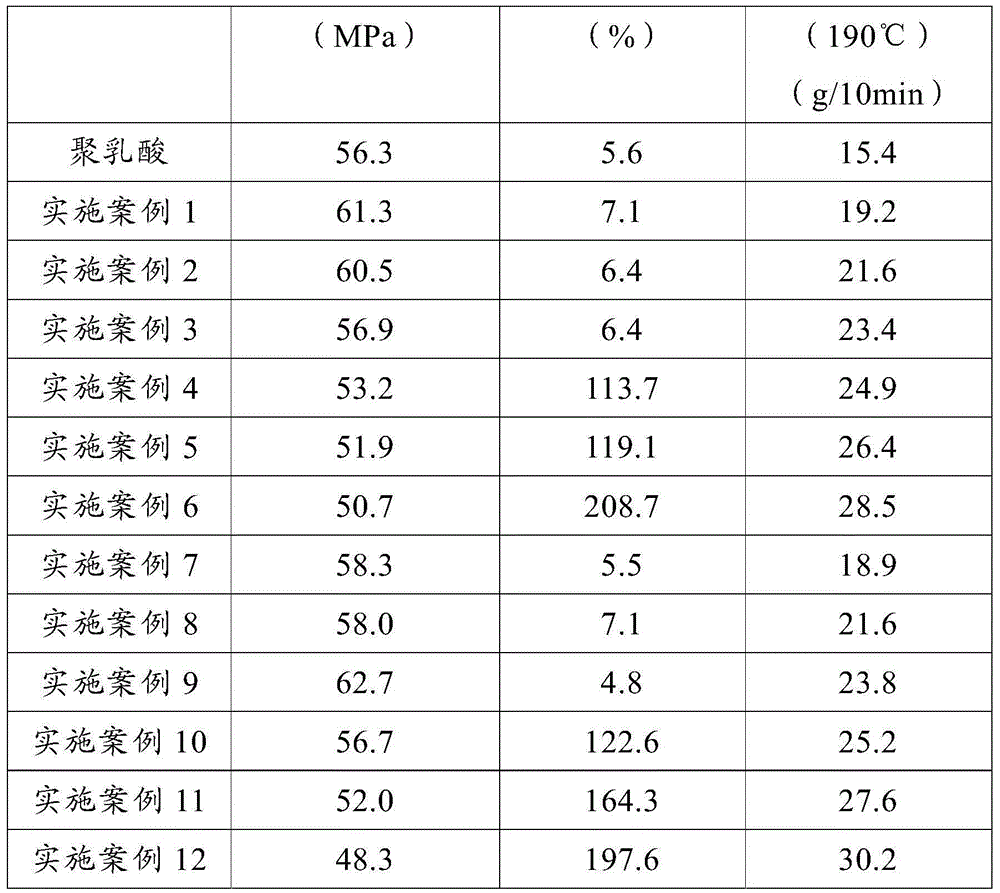
[0035] The above components were dried in a vacuum oven at 50° C. for 12 hours. The dried components were melt-blended in an internal mixer in proportion, the blending temperature was 180°C, the blending time was 3 min, and the rotation speed was 60 rad / min to obtain a blend.

[0036] The melt index of the blend was measured using an XNR-400B melt flow rate tester (diameter of the outlet is Φ2.095±0.005mm, length of the outlet is 8.000±0.025mm), the temperature was 190°C, and the pressure was 2160g.

[0037] Press the blend into a plate on a flat vulcanizer, cut it into a dumbbell-shaped sample, and test the mechanical properties with a tensile testing machine: the length of the sample is 75mm, the width is 4±0.1mm, and the thickness is ...

Embodiment 2

[0039] Weigh each component according to the following parts by mass:

[0040] 100 parts by weight of polylactic acid; 1 part by weight of poly(2-ethyl-2-oxazoline) 50000 molecular weight.

[0041] The preparation process is as follows:

[0042]The above components were dried in a vacuum oven at 50° C. for 12 hours. The dried components were melt-blended in an internal mixer in proportion, the blending temperature was 180°C, the blending time was 3 min, and the rotation speed was 60 rad / min to obtain a blend.

[0043] The melt index of the blend was measured using an XNR-400B melt flow rate tester at a temperature of 190° C. and a pressure of 2160 g.

[0044] Press the blend into a plate on a flat vulcanizer, cut it into a dumbbell-shaped sample, and test the mechanical properties with a tensile testing machine: the length of the sample is 75mm, the width is 4±0.1mm, and the thickness is 1±0.1mm. The speed was 25mm / min, the experiment was repeated 6 times, and the average v...

the structure of the environmentally friendly knitted fabric provided by the present invention; figure 2 Flow chart of the yarn wrapping machine for environmentally friendly knitted fabrics and storage devices; image 3 Is the parameter map of the yarn covering machine
Login to View More

PUM

PropertyMeasurementUnit
glass transition temperatureaaaaaaaaaa
thermal decomposition temperatureaaaaaaaaaa
melt flow indexaaaaaaaaaa
Login to View More

Abstract

The invention provides a slice material special for a biodegradable non-woven fabric and a preparation method thereof. The preparation method comprises the following steps: drying under the condition of 50-70 DEG C for 6-12 hours by taking polylactic acid and poly(2-ethyl-2-oxazoline) as raw materials; then carrying out melt blending in mixing equipment to obtain the slice material special for the biodegradable non-woven fabric, wherein the poly(2-ethyl-2-oxazoline) is 0.5-10 parts by weight in terms of 100 parts by weight of the polylactic acid, the glass-transition temperature Tg of the poly(2-ethyl-2-oxazoline) is 58.6 DEG C, the thermal decomposition temperature of the poly(2-ethyl-2-oxazoline) is 365-380 DEG C, the number-average molecular weight of the poly(2-ethyl-2-oxazoline) is 50000 or 200000, the blending temperature is 180 DEG C, the blending time is 3-8 minutes, and the rotation speed of the mixing equipment is 30-100 rad / minute during blending.

Description

technical field [0001] The invention relates to the field of non-woven fabric manufacturing, in particular to a special slice material for biodegradable non-woven fabrics and a preparation method thereof. Background technique [0002] Non-woven fabrics, also known as non-woven fabrics, are composed of directional or random fibers, and have the characteristics of moisture resistance, breathability, flexibility, light weight, non-toxic, non-irritating, rich colors, and low prices. The production technologies of non-woven fabrics mainly include spunbond method, meltblown method, pulp air-laid method, needle (water) puncture method, chemical bonding method and thermal bonding method, etc. Among them, the spunbond method is a nonwoven technology that has been applied on a large scale. The spunbonding method, also known as the spinning method, is one of the main methods for the production of non-woven fabrics. Its principle is to use the method of chemical fiber spinning to spin,...

Claims

the structure of the environmentally friendly knitted fabric provided by the present invention; figure 2 Flow chart of the yarn wrapping machine for environmentally friendly knitted fabrics and storage devices; image 3 Is the parameter map of the yarn covering machine
Login to View More

Application Information

Patent Timeline
no application Login to View More
Patent Type & Authority Patents(China)
IPC IPC(8): C08L67/04C08L79/02D01F6/92D01F1/10
Inventor 徐鼐徐瑞璋庞素娟潘莉莎林强张政卿魏太演马楠松
Owner HAINAN UNIV
Features
  • R&D
  • Intellectual Property
  • Life Sciences
  • Materials
  • Tech Scout
Why Patsnap Eureka
  • Unparalleled Data Quality
  • Higher Quality Content
  • 60% Fewer Hallucinations
Social media
Patsnap Eureka Blog
Learn More