
Method and device for extracting music characteristics
A music feature and audio signal technology, applied in the field of signal processing, can solve problems such as reducing the recognition rate of the CMI system, and achieve the effect of reducing the impact, accurate extraction, and improving the recognition rate
- Summary
- Abstract
- Description
- Claims
- Application Information
AI Technical Summary
Problems solved by technology
Method used
Image

Examples
Embodiment 1
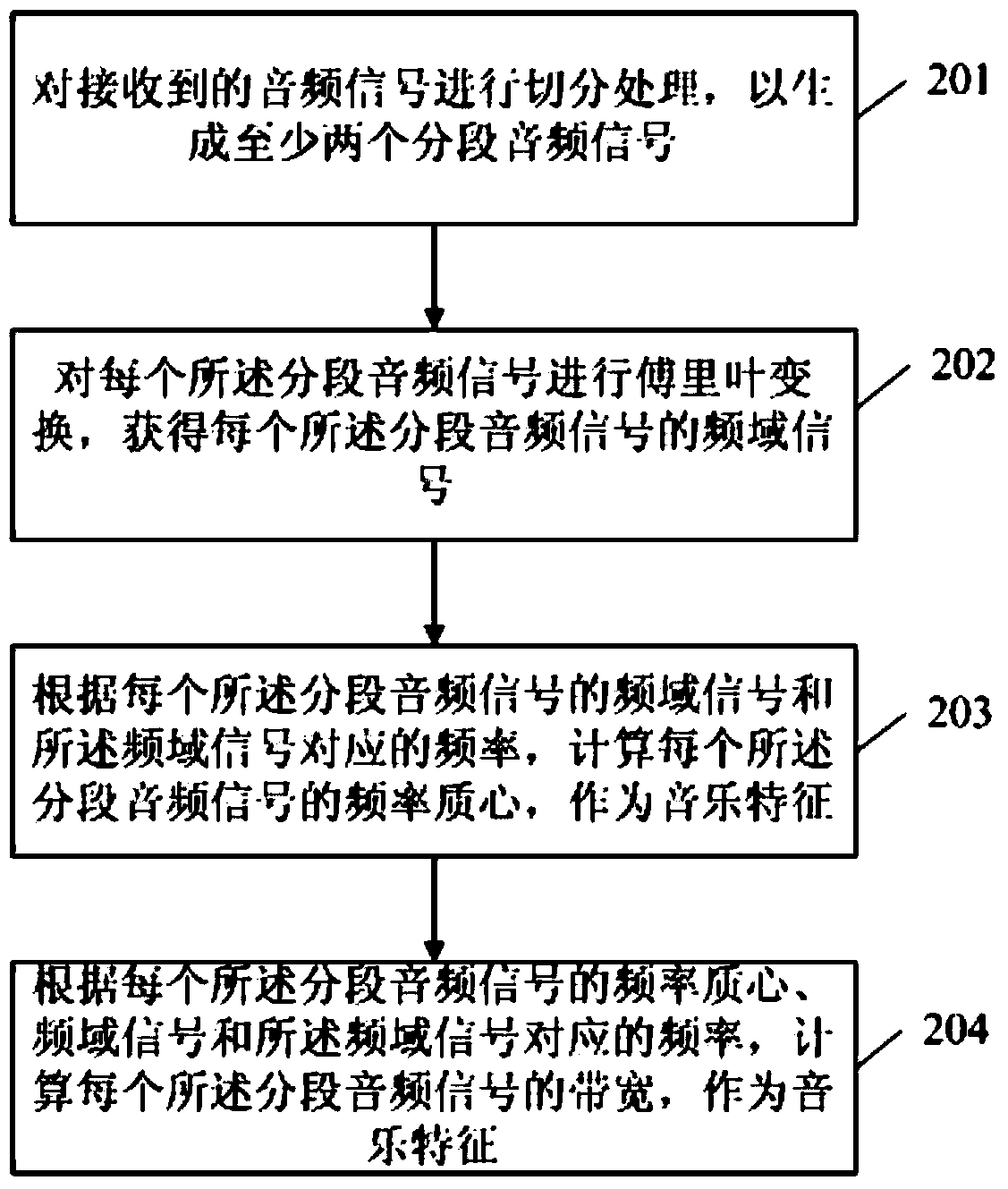
[0022] figure 2 It is a flow chart of the method for extracting music features provided by the first embodiment of the present invention. The execution subject of this embodiment can be a feature extraction unit, and the feature extraction unit can also be called a device for extracting music features. It is composed of hardware and / or Software implementation, can be configured in the local client, can also be configured in the server in the network, not specifically limited here, the method provided in this embodiment specifically includes the following steps:
[0023] Step 201: Segment the received audio signal to generate at least two segmented audio signals.
[0024] In this solution, the audio signal can be from any source, for example, the user records the audio signal himself, or receives the audio signal acquired. Preferably, the received audio signal may be segmented into at least two segments of audio signals of equal length, or the received audio signal may be seg...
no. 2 example
[0043] On the basis of the above-mentioned embodiments, this embodiment further adds a step of calculating each segment according to the music feature of each segmented audio signal after acquiring the music feature of each segmented audio signal. Differential features of audio signals, as musical features. The steps may be performed after step 203 and before step 204, or after step 204, or both after step 203 and after step 204, which are not specifically limited here.
[0044] For example, after the frequency centroid of each segment audio signal is obtained, the frequency centroid of the current segment audio signal can be subtracted from the frequency centroid of the previous segment audio signal, as the frequency centroid difference feature of the current segment audio signal, used to describe the frequency The change law of the centroid; when the bandwidth of each segment audio signal is obtained, the bandwidth of the current segment audio signal can be subtracted from t...
no. 3 example
[0047] In this embodiment, on the basis of the above-mentioned embodiments, a further step is added: after the music features are obtained, the extracted music features are concatenated into a multi-dimensional vector, and the multi-dimensional vector is subjected to dimensionality reduction processing.
[0048] After obtaining a certain music feature of a certain segment of audio signal, usually the feature will not be used alone, but several music features will be combined to form a high-dimensional feature vector, so as to describe a segment of audio signal more accurately. The dimensionality of the newly constructed feature vectors may be relatively high. On the one hand, the dimensionality reduction technology can reduce the dimensionality of the feature vectors, reduce the amount of calculations for subsequent establishment of feature indexes and feature matching, and on the other hand, it can also reduce the relationship between the dimensions of the feature vectors. The...
PUM
 Login to View More
 Abstract
Description
Claims
Application Information
 Login to View More