Fluorescence detection method for isocarbophos and profenofos based on aptamer

A nucleic acid aptamer and isocarbophos technology, which is applied in fluorescence/phosphorescence, material excitation analysis, etc., can solve problems in the field of food safety in its infancy, and achieve high sensitivity and selectivity

CN104597022AActive Publication Date: 2015-05-06ANHUI SCI & TECH UNIV
2 Cites 10 Cited by

Patent Information

Authority / Receiving Office
CN · China
Current Assignee / Owner
Publication Date
2015-05-06

Smart Images

  • Figure 1
    Figure 1
  • Figure 2
    Figure 2
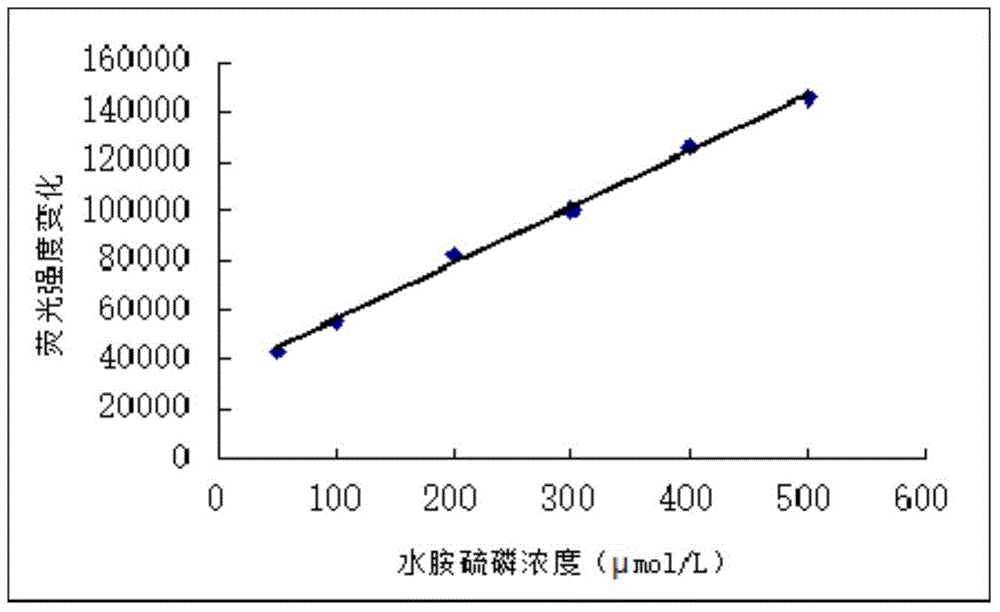
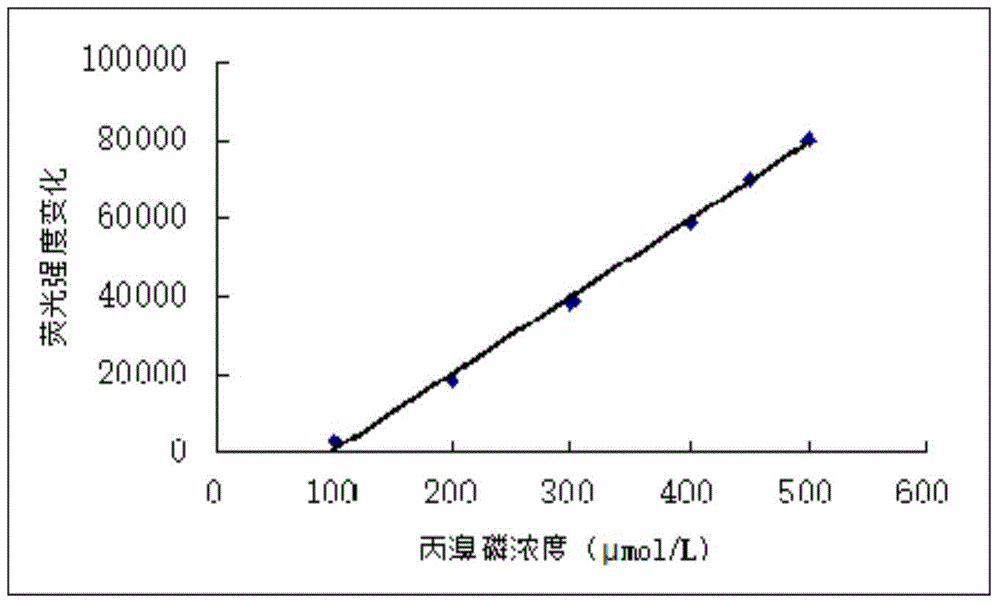
  • Figure 3
    Figure 3
Patent Text Reader

Abstract

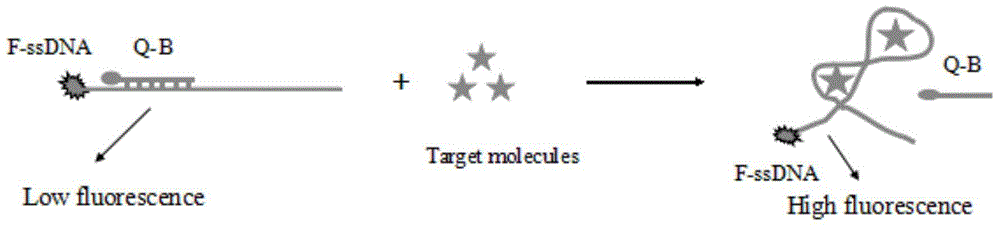
The invention relates to the technical field of biology and particularly relates to a fluorescence detection method for isocarbophos and profenofos based on an aptamer. According to a detection principle, a fluorophore is marked on a 5' end of the aptamer, and a segment of sequence, which is complemented and hybridized with the aptamer, is designed, and a quenching group is marked on a 3' end of the aptamer; when the aptamer is hybridized with a complementary sequence, a fluorescence signal is very weak; when isocarbophos and profenofos are used for identifying and combining the aptamer, the complementary sequence is dissociated and the fluorescence signal is enhanced; a standard curve is established by using the change of the fluorescence signal and a lowest detection limit and a linear range are determined; and the content of a target molecule in a sample is judged according to the sample curve. The method is rapid and simple, and has relatively high sensitivity and selectivity; and the method is suitable for rapidly detecting isocarbophos and profenofos in the sample.
Need to check novelty before this filing date? Find Prior Art

Description

technical field

[0001] The invention relates to the field of biotechnology, in particular to a nucleic acid aptamer-based fluorescence detection method for amiphos and profenofos. Background technique

[0002] Organophosphorus pesticides are the main body of pesticides in my country. The national standard stipulates that the maximum allowable residue of organophosphorus pesticides in agricultural products is 0.2mg / kg (GB / T5009.199-2003). Amphos is a highly toxic and banned pesticide, and profenofos is a limited-use organophosphorus pesticide. However, in recent years, due to the unreasonable use of pesticides, pesticide residues in agricultural products are seriously exceeding the standard, and food poisoning incidents have gradually increased, which has seriously endangered food safety in my country. The poisonous cowpea incident in 2010 was caused by the overuse of the highly toxic pesticide amphos. The monitoring of pesticide residues is inseparable from the rapid and s...

Examples

Embodiment Construction

[0030] The present invention will be further described below in conjunction with the accompanying drawings and embodiments, but the present invention is not limited to the embodiments, and any improvements made all fall within the protection scope of the present invention without departing from the spirit of the present invention.

[0031] Aptamer-based fluorescence detection method of amophos and profenofos, please also refer to figure 1 ,Specific steps are as follows:

[0032] 1), hybridize the nucleic acid aptamer F-ssDNA with the complementary sequence Q-B.

[0033] The nucleic acid aptamer F-ssDNA is a 35-base single-stranded DNA that is labeled with a fluorophore FAM at the 5' end and recognizes azathiophos and profenofos. The sequence is:

[0034] 5'-FAM-AGCTTGCTGCAGCGATTCTTGATCGCCACAGAGCT-3'.

[0035] The complementary sequence Q-B is a 15-base single-stranded DNA labeled DABCYL at the 3' end, and the sequence is:

[0036] 5'-GAATCGCTGCAGCAA-DABCYL-3'.

[0037] The...