AI technical title is built by Patsnap AI team. It summarizes the technical point description of the patent document.
A knowledge map and vector technology, applied in the field of knowledge map representation learning, can solve the problem of not being able to accurately represent entities, relationships, and characteristics
Inactive Publication Date: 2016-06-01
TSINGHUA UNIV
View PDF0 Cites 72 Cited by
Summary
Abstract
Description
Claims
Application Information
AI Technical Summary
This helps you quickly interpret patents by identifying the three key elements:
Problems solved by technology
Method used
Benefits of technology
Problems solved by technology
[0005] In view of this, the purpose of the present invention is to solve the problems in the prior art that cannot accurately represent the connections between entities, relationships and characteristics, so as to improve the quality of knowledge graph representation
Method used
the structure of the environmentally friendly knitted fabric provided by the present invention; figure 2 Flow chart of the yarn wrapping machine for environmentally friendly knitted fabrics and storage devices; image 3 Is the parameter map of the yarn covering machine
View more
Image
Smart Image Click on the blue labels to locate them in the text.
Viewing Examples
Smart Image
Click on the blue label to locate the original text in one second.
Reading with bidirectional positioning of images and text.
Smart Image
Examples
Experimental program
Comparison scheme
Effect test
Embodiment 1
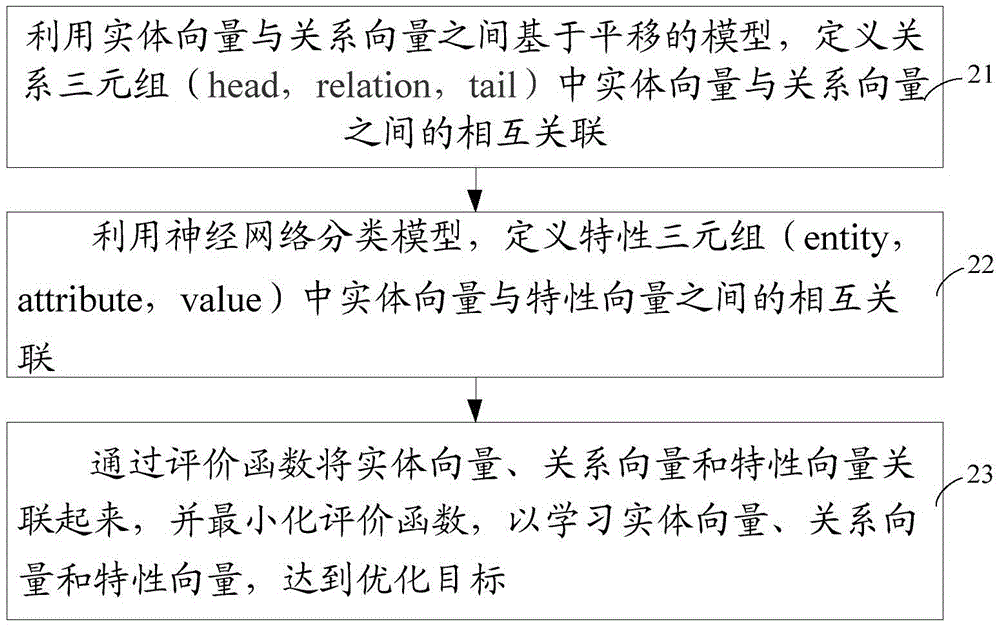
[0017] The invention discloses a knowledge graph representation learning method, and its flow diagram is as figure 2 As shown, the method includes:
[0018] Step 21: Use the translation-based model between the entity vector and the relationship vector to define the correlation between the entity vector and the relationship vector in the relationship triples (head, relationship, tail).
[0019] Among them, using the translation-based model between the entity vector and the relationship vector to define the correlation between the entity vector and the relationship vector in the relationship triplet includes:
[0020] S211. Define the probability of the relational triplet as p ( h | r , t , X ) = exp ( g ( h , r , t ) ) X h ‾ exp ( g ( h ‾ , r , t ) ) ;
[0021] Represent any entity in the knowledge graph; It is the normalization factor of the probability function of the relationship ...
Embodiment 2
[0045] Since the knowledge graph representation learning method of the present invention treats relationships and characteristics differently, further, the mutual connection between characteristics can be considered.
[0046] The knowledge graph representation learning method of the second embodiment of the present invention includes the following steps:
[0047] Step 31: Use the translation-based model between the entity vector and the relationship vector to define the correlation between the entity vector and the relationship vector in the relationship triples (head, relationship, tail).
[0048] Among them, using the translation-based model between the entity vector and the relationship vector to define the correlation between the entity vector and the relationship vector in the relationship triplet includes:
[0049] S311. Define the probability of the relational triplet as p ( h | r , t , X ) = exp ( g ( h , r , t ) ) X ...
the structure of the environmentally friendly knitted fabric provided by the present invention; figure 2 Flow chart of the yarn wrapping machine for environmentally friendly knitted fabrics and storage devices; image 3 Is the parameter map of the yarn covering machine
Login to View More
PUM
Login to View More
Abstract
The invention discloses a knowledge graph representation learning method. The method comprises the following steps: defining the correlation between entity vectors and relation vectors in a relation triple (head, relation, tail) by utilizing a translation-based model between the entity vector and the relation vector; defining the correlation between entity vectors and feature vectors in a feature triple (entity, attribute, value) by utilizing a neural network classification model; and correlating the entity vectors, the relation vectors and the feature vectors with one another through an evaluation function, and minimizing the evaluation function to learn the entity vectors, the relation vectors and the feature vectors so as to achieve the optimization aim. By adopting the method disclosed in the invention, the relation among the entity, the relation and the feature can be accurately represented.
Description
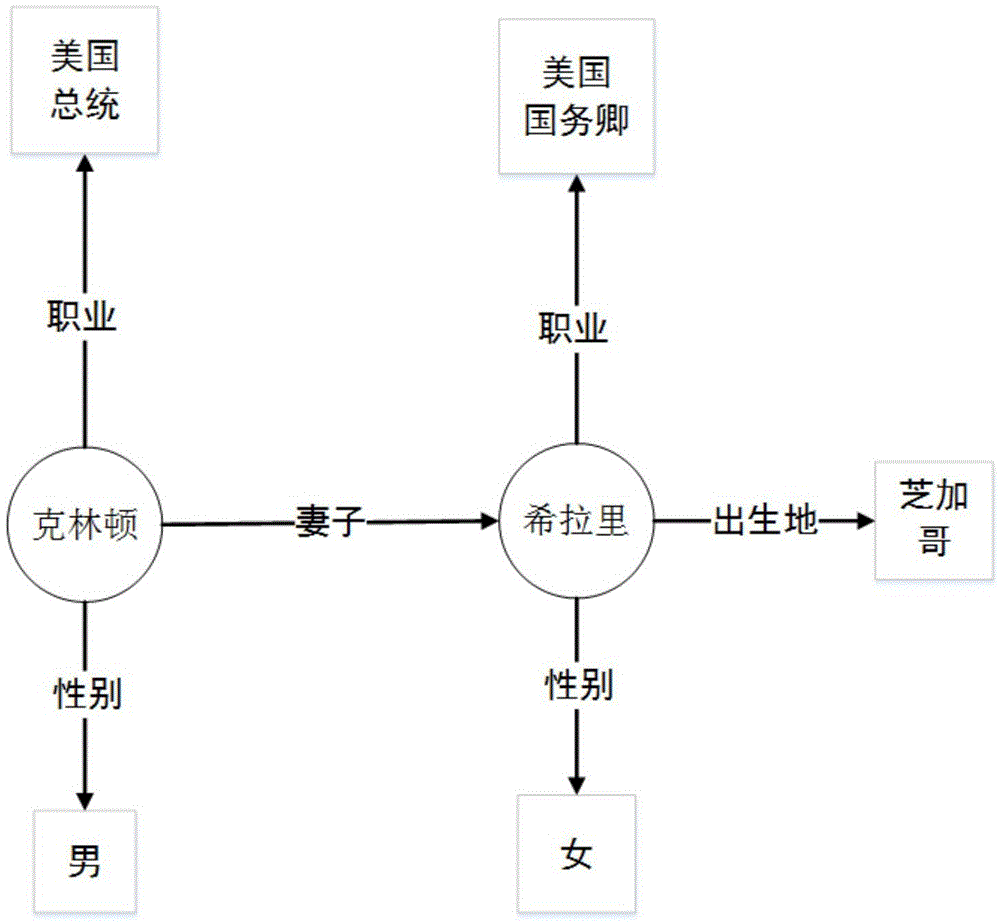
Technical field [0001] The present invention relates to the fields of natural languageprocessing and knowledge graphs, in particular to a knowledge graph representation learning method. Background technique [0002] With the rapid development of society, we have entered the era of information explosion, and massive new entities and information are generated every day. The Internet is the most convenient information acquisition platform today, and users have an increasingly urgent need for effective information screening and summarization. How to obtain valuable information from massive data has become a problem. The knowledge graph came into being. [0003] The knowledge graph represents all the proper nouns and things in the world such as people, place names, book names, and team names as entities, and represents the internal connections between entities as relationships, and aims to represent the massive knowledge in the database as between entities Use relationships as a tern...
Claims
the structure of the environmentally friendly knitted fabric provided by the present invention; figure 2 Flow chart of the yarn wrapping machine for environmentally friendly knitted fabrics and storage devices; image 3 Is the parameter map of the yarn covering machine
Login to View More
Application Information
Patent Timeline
Application Date:The date an application was filed.
Publication Date:The date a patent or application was officially published.
First Publication Date:The earliest publication date of a patent with the same application number.
Issue Date:Publication date of the patent grant document.
PCT Entry Date:The Entry date of PCT National Phase.
Estimated Expiry Date:The statutory expiry date of a patent right according to the Patent Law, and it is the longest term of protection that the patent right can achieve without the termination of the patent right due to other reasons(Term extension factor has been taken into account ).
Invalid Date:Actual expiry date is based on effective date or publication date of legal transaction data of invalid patent.



 Login to View More
  Login to View More