
AHU377 crystal form and preparation method and uses thereof
A technology of AHU377, 1.AHU377, applied in organic chemical methods, medical preparations containing active ingredients, pharmaceutical formulations, etc., can solve problems such as unfavorable process quality control, cumbersome operation, etc.
- Summary
- Abstract
- Description
- Claims
- Application Information
AI Technical Summary
Problems solved by technology
Method used
Image

Examples
Embodiment 1
[0081] Example 1: Preparation of AHU377 Form III:
[0082] Weigh 3.39kg of the product solution of synthetic AHU377 (the product solution contains about 726g of AHU377, and the solvent is dichloromethane) in a 20L jacketed reactor. Add 7.5L of toluene, raise to 50°C, distill under reduced pressure to the remaining 5L volume, cool down to room temperature, add 2.5L of toluene, add 1.2L of n-heptane, after solid precipitation, add 4.8L of n-heptane dropwise into the kettle. Stir and mature overnight, filter and rinse with 1 L of n-heptane and dry under vacuum at 40°C. Add the dried solid into a 20L jacketed reactor, add 8.5L of toluene, rise to 50°C to dissolve, and then cool down to 20°C. Add 1.36L of n-heptane and it becomes turbid, add 200mL of toluene and return to 50°C to dissolve the clear, cool down to 20°C for spontaneous crystallization. Add 5 L of n-heptane dropwise into the kettle at a rate of 8 mL / min, stir and mature overnight. Filter and rinse with 1.5 L of n-h...
Embodiment 2
[0088] Example 2: Preparation of Crystal Form IV Seed Crystals
[0089] 100 mg of the crystal form III solid obtained in Example 1 was added to 1 mL of a mixed solution of n-heptane and toluene at a volume ratio of 1:1, stirred overnight at room temperature, and centrifuged to obtain a solid product.
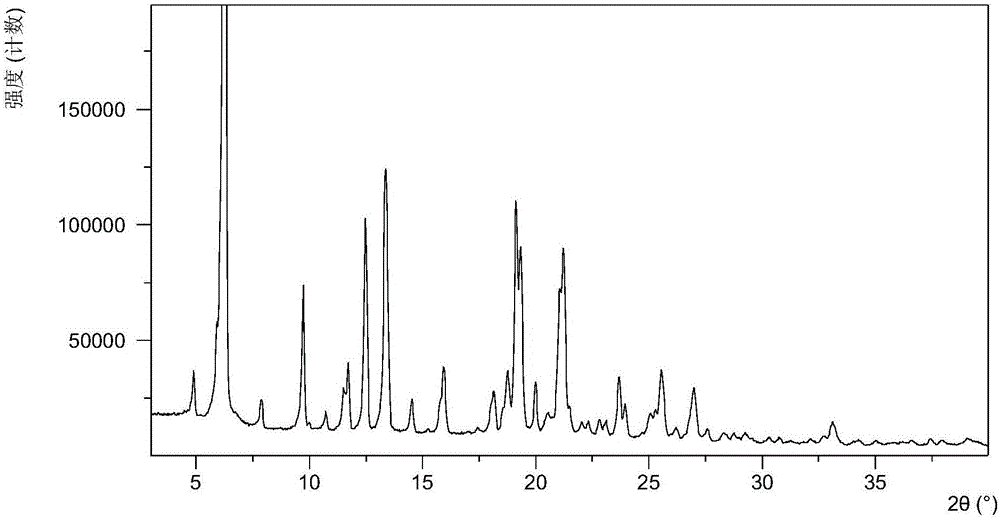
[0090] After testing, the solid product obtained in this example is crystal form IV, and its X-ray powder diffraction data are shown in Table 2, and its XRPD pattern is as follows Figure 9 .
[0091] Table 2
[0092] theta
Embodiment 3
[0093] Example 3: Preparation of AHU377 Form IV
[0094] Weigh 3.39 kg of the product solution of synthetic AHU377 (the product solution contains about 726 g of AHU377, and the solvent is dichloromethane). Add 7.5L of toluene, rise to 50°C and distill under reduced pressure to the remaining 5L volume, cool down to room temperature, and add 2.5L of toluene. Add 1.2L of n-heptane, and after the solid precipitates, add 4.8L of n-heptane dropwise into the kettle. Stir and mature overnight, filter and rinse with 1 L of n-heptane and dry under vacuum at 40°C. Add the dried solid to a 20L jacketed reactor, add 8.5L of toluene, raise the temperature to 50°C to dissolve, then cool down to 20°C. After adding 1.36L of n-heptane, turbidity appeared, add 200mL of toluene and return to 50°C to dissolve the clear, cool down to 20°C to spontaneously crystallize. Add 5 L of n-heptane dropwise into the kettle at a rate of 8 mL / min, and stir and mature overnight. Filter and rinse with 1.5L n...
PUM
 Login to View More
 Abstract
Description
Claims
Application Information
 Login to View More