Efficient co-mixed ternary organic solar battery based on all optical waveband absorption

A solar cell and blending technology, applied in the field of solar cells, can solve the problems of poor stability of photovoltaic cells, complex production process, and difficulty in greatly improving photoelectric conversion efficiency, and achieve enhanced energy conversion efficiency, short-circuit current density enhancement, and absorption effect. better results

CN108269919AInactive Publication Date: 2018-07-10TAISHAN UNIV
0 Cites 5 Cited by

Patent Information

Authority / Receiving Office
CN · China
Patent Type
Applications(China)
Current Assignee / Owner
Publication Date
2018-07-10
Estimated Expiration
Not applicable · inactive patent

Smart Images

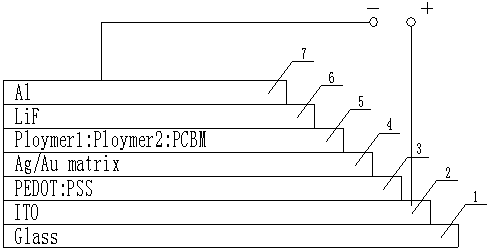
  • Figure 1
    Figure 1
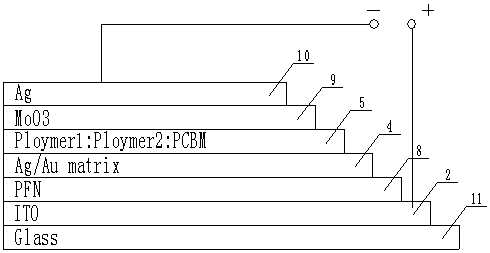
  • Figure 2
    Figure 2
Patent Text Reader

Abstract

The invention belongs to the technical field of polymer solar batteries, and relates to structural design of an efficient co-mixed ternary organic solar battery based on optical waveband absorption. According to the battery, a silver (gold) nanometer matrix is introduced to a ternary system battery, and an electric field is constrained around a micro structure; by exciting a near field effect, theoptical field is almost permeated into an active layer; the active layer is spin coated on a Ag / Au matrix to naturally form a similar micro-nano grating structure; by exciting surface plasma polaritons, the incident light is limited in the active layer; and by adjusting the micro-nano square matrix period, the metal thin film thickness and the like, an enhanced optical absorption effect can be generated within the ultra-wide range of the ultraviolet light, visible light and near infrared region. Meanwhile, a donor polymer and an acceptor with similar chemical structures and complementary spectral absorption are co-mixed into a solution so as to prepare into a film, so that the absorption spectrum is expanded, the open-circuit voltage, the short-circuit current and a filling factor of a device are substantially improved, the energy conversion efficiency is high, the preparation success rate of the device is high, and the preparation complexity of the device is low.
Need to check novelty before this filing date? Find Prior Art

Description

technical field

[0001] The invention belongs to the technical field of solar cells, and relates to a high-efficiency blended ternary organic solar cell based on all-optical band absorption. Background technique

[0002] With the rapid development of society and economy, non-renewable resources such as oil and natural gas are becoming increasingly exhausted, and energy has become one of the strategic issues that are generally concerned by countries all over the world. Studies have shown that solar energy is an internationally recognized ideal alternative energy source and the most direct clean energy available to human beings. At present, there are two main bottlenecks in organic polymer solar cells that need to be solved urgently. One is that the limitations of traditional structural cells make the active layer’s absorption efficiency for sunlight low, which makes it difficult to greatly improve the photoelectric conversion efficiency. The other is the limitations of photovo...

Examples

Embodiment Construction

[0012] Such as figure 1 , figure 2 As shown, a high-efficiency blended ternary organic solar cell based on all-optical band absorption adopts a ternary system blended heterojunction structure, which is divided into two types: forward device and reverse device. The structural hierarchy of the forward device is as follows from top to bottom: metal Al cathode layer (7), cathode LiF modification layer (6), blended active layer (5), silver (gold) nano-matrix layer (4), hole PEDOT:PSS transport layer (3), ITO (2), glass anode layer (1). The structural hierarchy of the reverse device is as follows from top to bottom: metal Ag anode layer (10), anode MoO3 modification layer (9), blended active layer (5), silver (gold) nano-matrix (4), hole PFN Transport layer (8), ITO (2), glass cathode layer (11).

[0013] The donor material is composed of a wide bandgap polymer with an optical bandgap greater than 1.8eV and a narrow bandgap polymer with an optical bandgap less than 1.4eV. The a...