
Visible light communication using colour shift keying
A technology of visible light communication and color shift keying, applied in short-range systems, electromagnetic wave transmission systems, transmission systems, etc., can solve the problem of reducing the number of different symbols, improve the signal-to-noise ratio, increase the number of symbols, and high transmit power. The effect of efficiency
Patent Information
- Authority / Receiving Office
- CN · China
- Patent Type
- Applications(China)
- Current Assignee / Owner
- Publication Date
- 2019-12-27
Smart Images
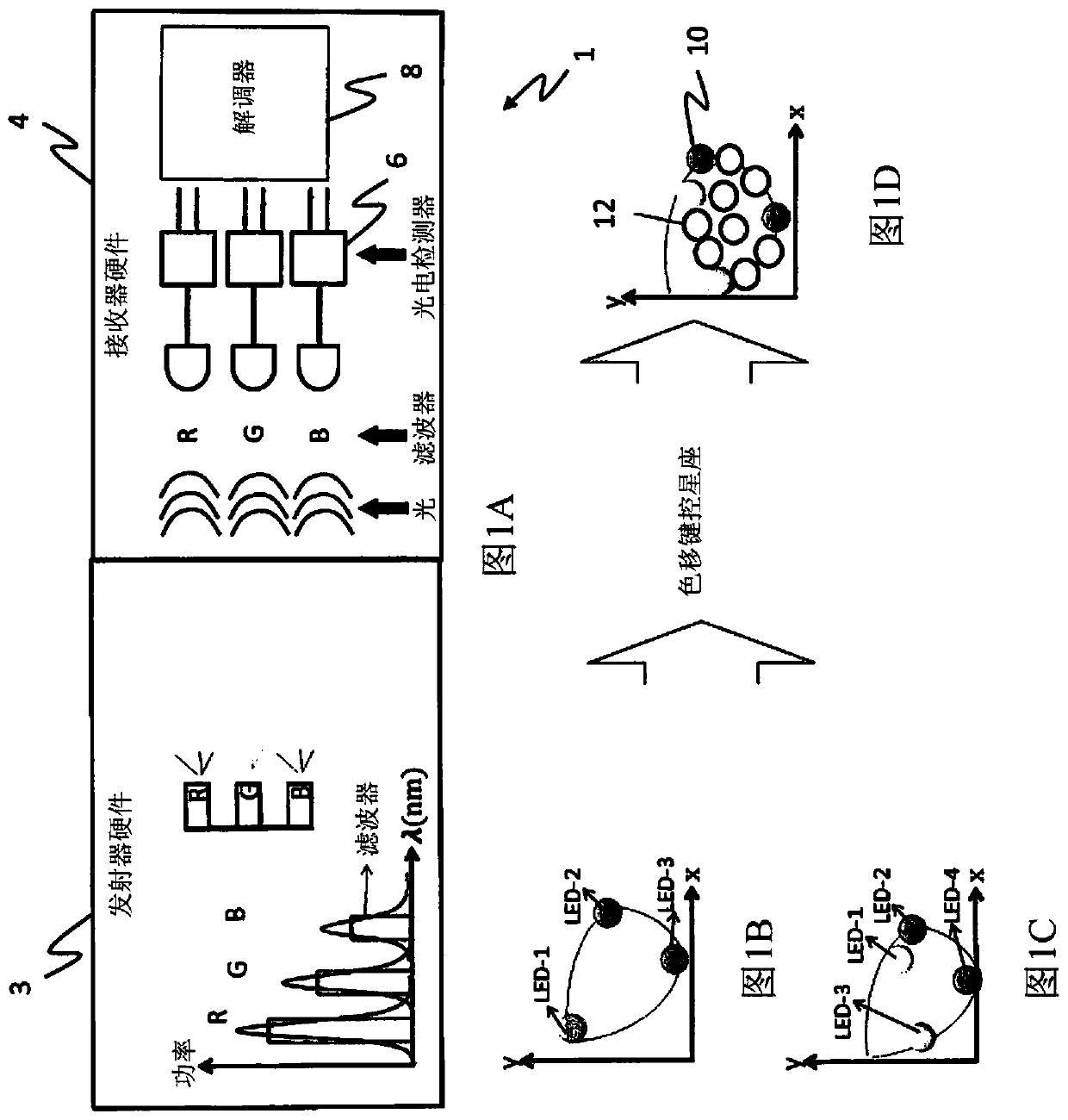
Figure 1 
Figure 2 
Figure 3
Abstract
Description
[0001] The present invention relates to the visible light communication transmitter according to claim 1, the visible light communication receiver according to claim 6, the visible light communication system according to claim 11, the visible light communication method according to claim 12 and The color shift keying method according to claim 15. Background technique
[0002] It is known to transmit information using visible light by encoding the information using constellations of different colors. This is called color shift keying (CSK). Prior art systems may use color constellations of three or four primary colors. Such a system can be implemented using LEDs of different colors, the number of said LEDs can be three, in which case the system is called a three-LED or T-LED system, or the number of said LEDs can be four, In this case the system is called a quad-LED or Q-LED system. For example, WO 2012 / 097885 describes coding schemes and methods for color shift keying const...
Examples
Embodiment Construction
[0041] Figure 1A Elements of a prior art visible light communication system 1 for color shift keying are schematically shown. The visible light communication system 1 includes a transmitter 3 and a receiver 4 . The emitter 3 comprises a plurality of light emitting diodes (LEDs), the number of said LEDs may be three, in which case the system is called a three-LED or T-LED system, or the number of said LEDs may be four, In this case the system is called a quad-LED or Q-LED system. Light is emitted by each of the LEDs at their respective peak emission wavelengths, such as Figure 1A The smooth curve in the graph of , which plots the output power of the LED against the wavelength λ. These peak emission wavelengths represent the primary colors of a color constellation, which may be, for example, the red-green-blue (RGB) color space. However, since LEDs emit visible light at only three or four peak wavelengths, any other color of light than that defined by the peak wavelengths ca...