Lower limb recovery exercise equipment for neurology department
What is AI technical title?
AI technical title is built by Patsnap AI team. It summarizes the technical point description of the patent document.
A kind of exercise equipment and neurology technology, applied in the field of medical neurology, can solve the problems of uncoordinated movement, adjustment, and the inability to use it for patients of different heights
Active Publication Date: 2021-05-11
河南昆仑精准医疗科技有限公司 +2
View PDF10 Cites 1 Cited by
Summary
Abstract
Description
Claims
Application Information
AI Technical Summary
This helps you quickly interpret patents by identifying the three key elements:
the structure of the environmentally friendly knitted fabric provided by the present invention; figure 2 Flow chart of the yarn wrapping machine for environmentally friendly knitted fabrics and storage devices; image 3 Is the parameter map of the yarn covering machine
View more
Image
Smart Image Click on the blue labels to locate them in the text.
Viewing Examples
Smart Image
Click on the blue label to locate the original text in one second.
Reading with bidirectional positioning of images and text.
Smart Image
Examples
Experimental program
Comparison scheme
Effect test
Embodiment 1
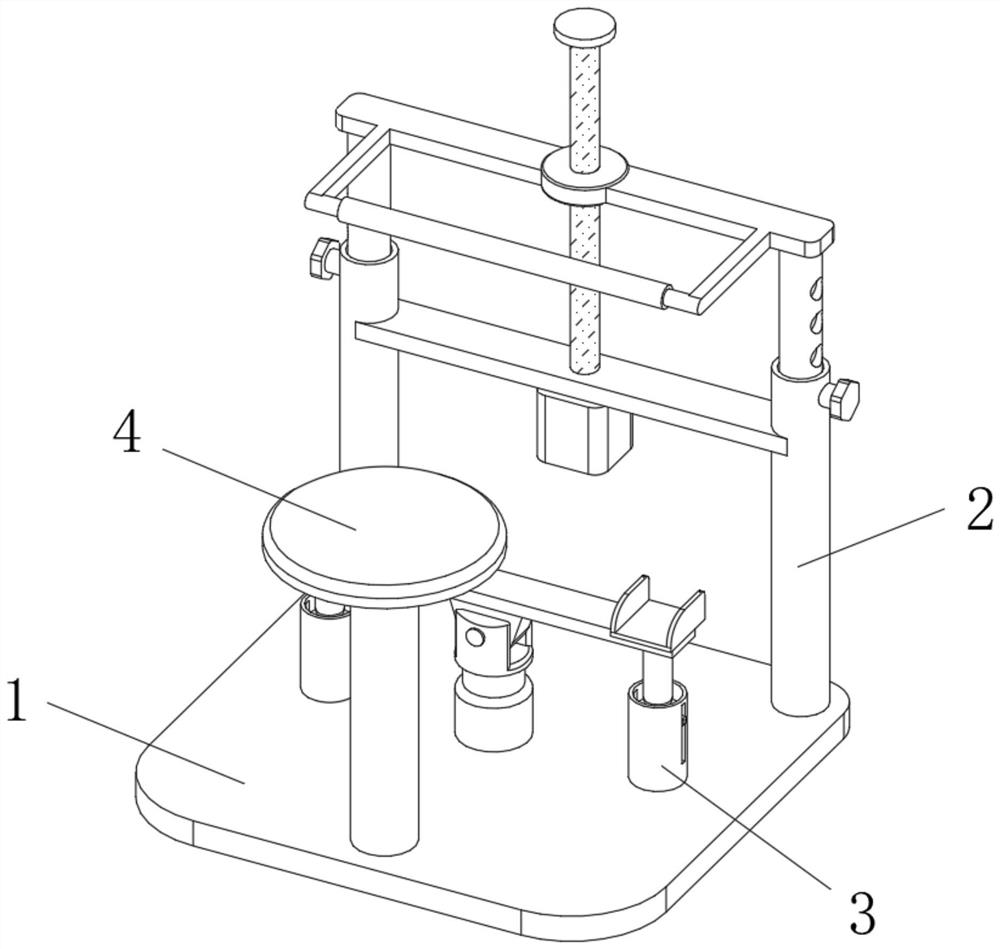
[0028] Such as Figure 1-2 As shown, a lower limb recovery exercise device for neurology of the present invention includes a base 1, a support mechanism 2, an exercise mechanism 3 and a stool 4;
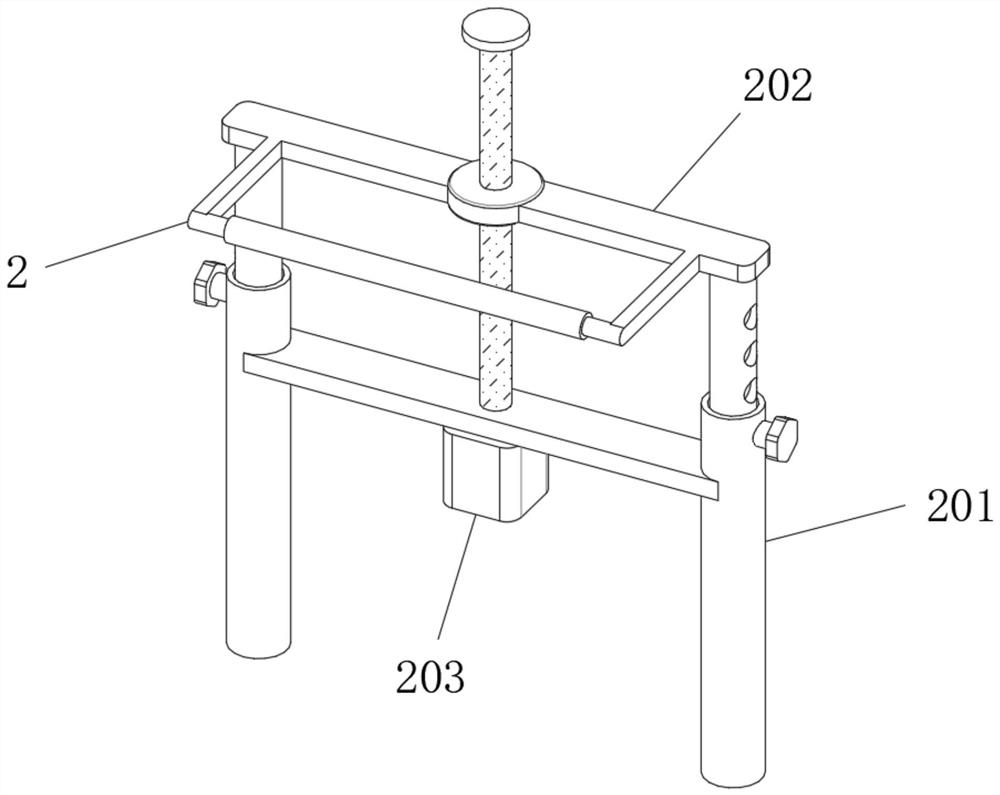
[0029] Among them, such as Figure 1-3 As shown, the supporting mechanism 2 includes two limiting components 201, supporting components 202 and adjusting components 203, the supporting component 202 is fixedly installed at the position above the two limiting components 201, and the adjusting component 203 is fixed Installed between the two limiting components 201 and corresponding to the position of the supporting component 202;
[0030] Among them, such as Figure 1-4 As shown, the limit assembly 201 includes a limit support 2011, a limit support 2012, several fixing holes 2013 and a fixing pin 2014, the limit support 2011 is fixedly connected to the top of the placement base 1 , the limit post 2012 is slidably arranged on the inner wall of the limit support tube 2011, a pluralit...
Embodiment 2
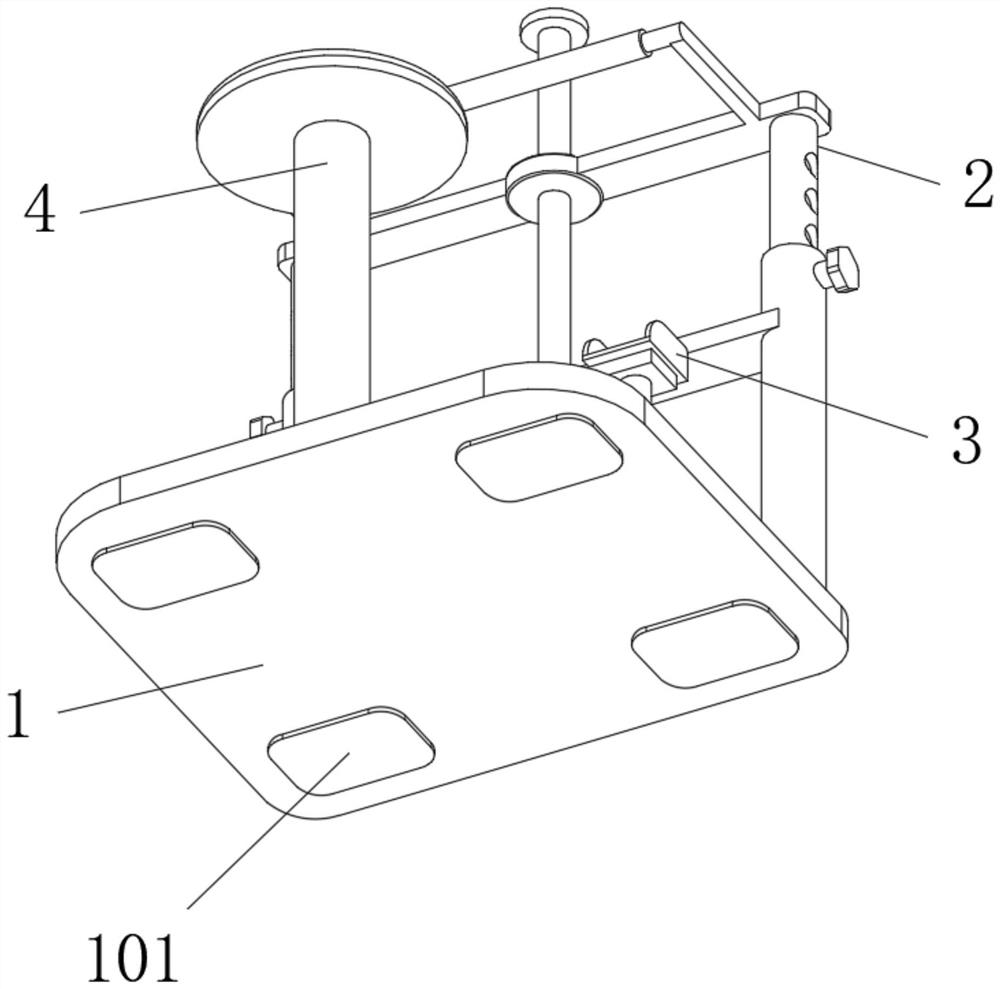
[0041] Such as Figure 1-2 As shown, the difference between this embodiment and Embodiment 1 lies in that the four corners of the bottom of the base 1 are fixedly connected with placing pads 101 , and the placing pads 101 are rubber anti-skid pads.
[0042] By adopting the above technical solution, a rubber anti-slip pad is provided on the bottom of the base 1, which greatly increases the stability of the device, thereby ensuring the safety of the patient's exercise, and further improving the practicability of the device.
Embodiment 3
[0044] Such as Figure 1-2 As shown, the difference between this embodiment and embodiment 2 is that the edge of the board surface of the stool 4 is designed in an arc shape, and the board surface is covered with a sponge pad that matches it.
[0045] By adopting the above technical scheme, the patient can sit on the bench for exercise during preliminary exercise, and adding a sponge pad on the bench increases the comfort of the patient when sitting on it.
the structure of the environmentally friendly knitted fabric provided by the present invention; figure 2 Flow chart of the yarn wrapping machine for environmentally friendly knitted fabrics and storage devices; image 3 Is the parameter map of the yarn covering machine
Login to View More
PUM
Login to View More
Abstract
The invention discloses lower limbrecoveryexercise equipment for neurology department. The lower limbrecoveryexercise equipment for the neurology department comprises a placing base, a support mechanism, an exercise mechanism and a stool, the support mechanism is fixedly installed on the rear side of the upper portion of the placing base, and the exercise mechanism is fixedly installed in the middle of the upper portion of the placing base; the stool is fixedly connected to the position, corresponding to the exercise mechanism, above the placement base; and limiting sliding grooves (3034) are formed in the two sides of the shell (3031) correspondingly, and limiting sliding blocks (3035) are fixedly connected to the positions, corresponding to the two limiting sliding grooves (3034), of the two sides of the stress plate (3033) correspondingly. By means of the device, the exercise intensity can be adjusted according to the requirements of patients, so that targeted training can be conducted on the patients, the exercise effect is better, the support device of the device can be adjusted according to the heights of different patients, and therefore the device can be suitable for more patients to use and is better in practicability.
the structure of the environmentally friendly knitted fabric provided by the present invention; figure 2 Flow chart of the yarn wrapping machine for environmentally friendly knitted fabrics and storage devices; image 3 Is the parameter map of the yarn covering machine
Login to View More
Application Information
Patent Timeline
Application Date:The date an application was filed.
Publication Date:The date a patent or application was officially published.
First Publication Date:The earliest publication date of a patent with the same application number.
Issue Date:Publication date of the patent grant document.
PCT Entry Date:The Entry date of PCT National Phase.
Estimated Expiry Date:The statutory expiry date of a patent right according to the Patent Law, and it is the longest term of protection that the patent right can achieve without the termination of the patent right due to other reasons(Term extension factor has been taken into account ).
Invalid Date:Actual expiry date is based on effective date or publication date of legal transaction data of invalid patent.


 Login to View More
  Login to View More